DISC Personality Test - Tony Robbins: Uncover Your Style
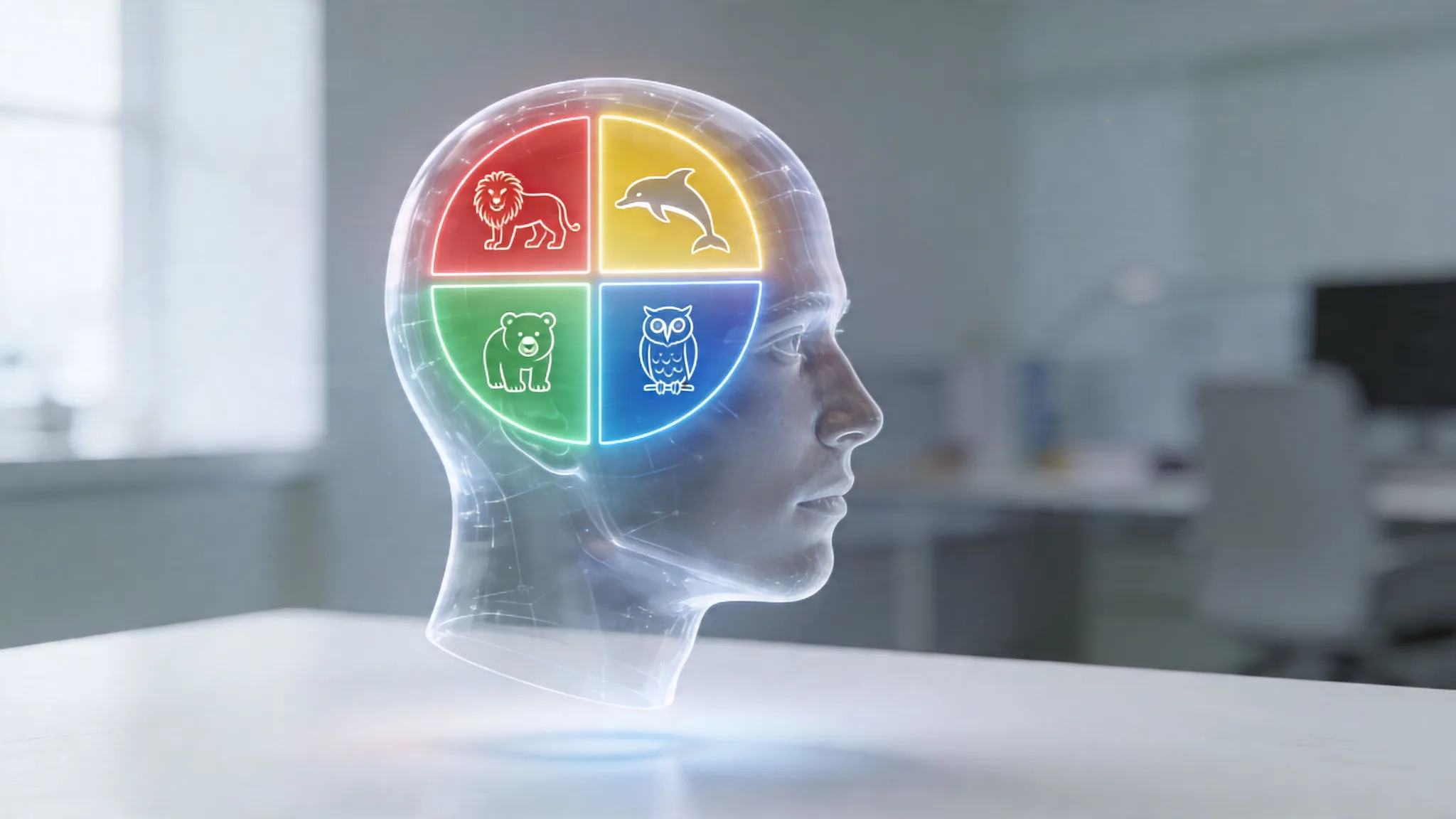
You’re in a meeting. One colleague wants a decision in five minutes. Another wants everyone’s feelings checked first. A third is asking for more data before they’ll commit. You leave thinking the same thing that often arises after a messy interaction: “Why is this so hard when everyone is smart?”
That question is exactly why personality frameworks stick around.
The DISC personality test Tony Robbins promotes is popular because it gives people a fast, usable language for behavior. Not your soul. Not your destiny. Your behavior. It tries to answer a practical question: when pressure hits, deadlines tighten, and communication gets messy, how do you tend to show up?
Tony Robbins presents DISC as a tool for understanding strengths, conflict patterns, and communication habits. For many people, that’s useful right away. It can help you stop taking differences personally and start reading them as style differences instead. If you like learning through self-reflection, coaching, or strong personality development books , DISC fits that same spirit. It gives you a framework you can test in real life by watching yourself and other people.
Still, it’s not magic. It won’t explain every contradiction in your personality, and it won’t replace deeper inner work. But as a decoder ring for everyday behavior, it earns its popularity.
The Secret Decoder Ring for Human Behavior
A startup founder once told me, “I feel like I hired great people, but they keep annoying each other.” That wasn’t a talent problem. It was a style problem.
One team lead kept firing off short messages like “Need this by 3.” She thought she was being efficient. Her operations manager read those notes as cold and abrupt. Meanwhile, their client-facing specialist kept adding warmth, stories, and extra context to every update, which the lead found exhausting. Nobody was wrong. They were just speaking different behavioral dialects.
That’s where DISC gets interesting. It offers a simple way to understand why one person pushes, another persuades, another stabilizes, and another scrutinizes. Instead of labeling someone “difficult,” you start noticing patterns. Some people want speed. Some want a connection. Some want predictability. Some want precision.
The DISC model traces back to psychologist William Moulton Marston , whose work in the 1920s introduced the four behavioral styles that modern DISC tools are built on. In the Tony Robbins version, the assessment focuses on dominance, influence, steadiness, and conscientiousness . According to the Tony Robbins DISC overview , more than 2 million people have taken the 15-minute DISC assessment .
That adoption matters less as a brag and more as a clue. Lots of people have found this model useful because it’s easy to understand quickly. You don’t need a psychology degree to use it. You just need enough honesty to notice your patterns.
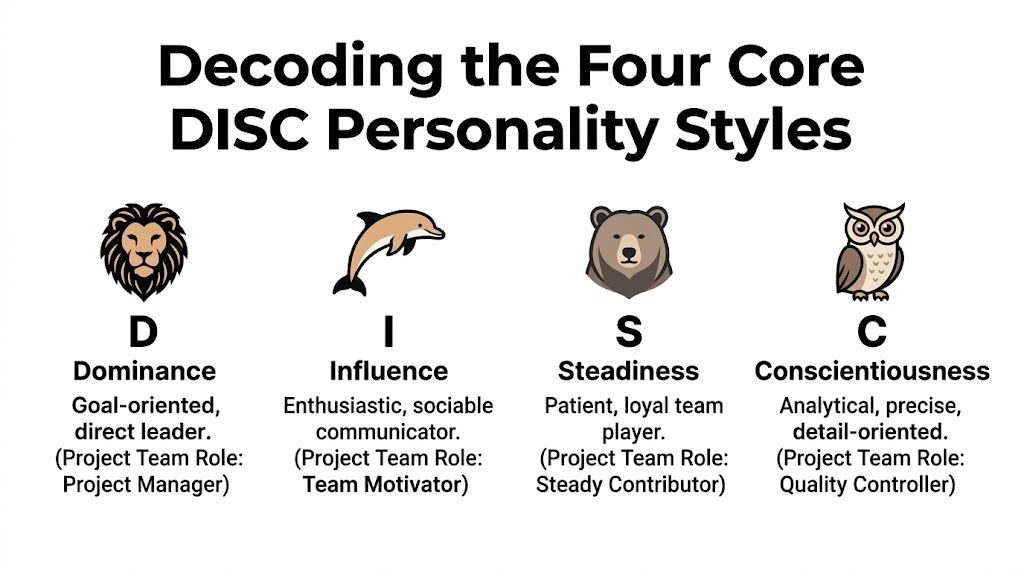
Decoding the Four Core DISC Personality Styles
Think of DISC like a project team. Every team needs someone to drive progress, someone to rally people, someone to keep things steady, and someone to catch what others miss. The four styles map neatly onto those roles.
Dominance
D stands for Dominance. This is the style most associated with directness, urgency, and results.
On a project team, D is often the person saying, “What’s the goal, what’s blocking us, and who owns the next step?” They usually prefer brief communication, fast decisions, and visible progress.
Their strengths often show up as:
• Decisiveness: • They’ll move a stuck conversation forward.
• Courage under pressure: • They’re often comfortable taking charge.
• Focus on outcomes: • They care about what gets done.
Their blind spot is easy to spot, too. A strong D can bulldoze people without meaning to. Efficiency can turn into impatience.
Influence
I stands for Influence. This style brings energy, optimism, and social momentum.
In the team analogy, I am your motivator and connector. They’re often the person who keeps morale up, gets buy-in, and makes an idea sound exciting enough to matter.
Common strengths include:
• Enthusiasm: • They can lift a room.
• Persuasion: • They help people get on board.
• Relational ease: • They tend to build rapport quickly.
The challenge is follow-through and focus. A strong I may chase the fun part of work and lose interest in repetitive details.
Steadiness
S stands for Steadiness. This is the calm, reliable, people-supportive style.
On a team, S is often the person others trust when things get tense. They’re patient, cooperative, and usually less interested in drama than in keeping things workable.
They often bring:
• Consistency: • They keep the machine running.
• Loyalty: • They support people over time.
• Patience: • They don’t panic easily.
Their blind spot is avoiding disruption. A strong S may stay quiet too long, even when change is necessary.
Conscientiousness
C stands for Conscientiousness. This style values accuracy, structure, and standards.
Your C person is the quality controller. If everyone else is excited, they’re the ones asking, “Did we verify that?” They often care greatly about correctness and process.
Typical strengths:
• Analytical thinking: • They catch errors others skip.
• Precision: • They like things done properly.
• Self-discipline: • They often hold high standards.
The downside is overanalysis. A strong C can get stuck polishing something that was already good enough to ship.
DISC works best when you treat these as tendencies, not boxes . Individuals often recognize one or two styles first, then notice the others in different situations.
What Makes the Tony Robbins DISC Test Unique
The broad DISC model is simple. The Tony Robbins version adds a layer of nuance that makes it more useful in coaching and workplace conversations.
Natural Style and Adapted Style
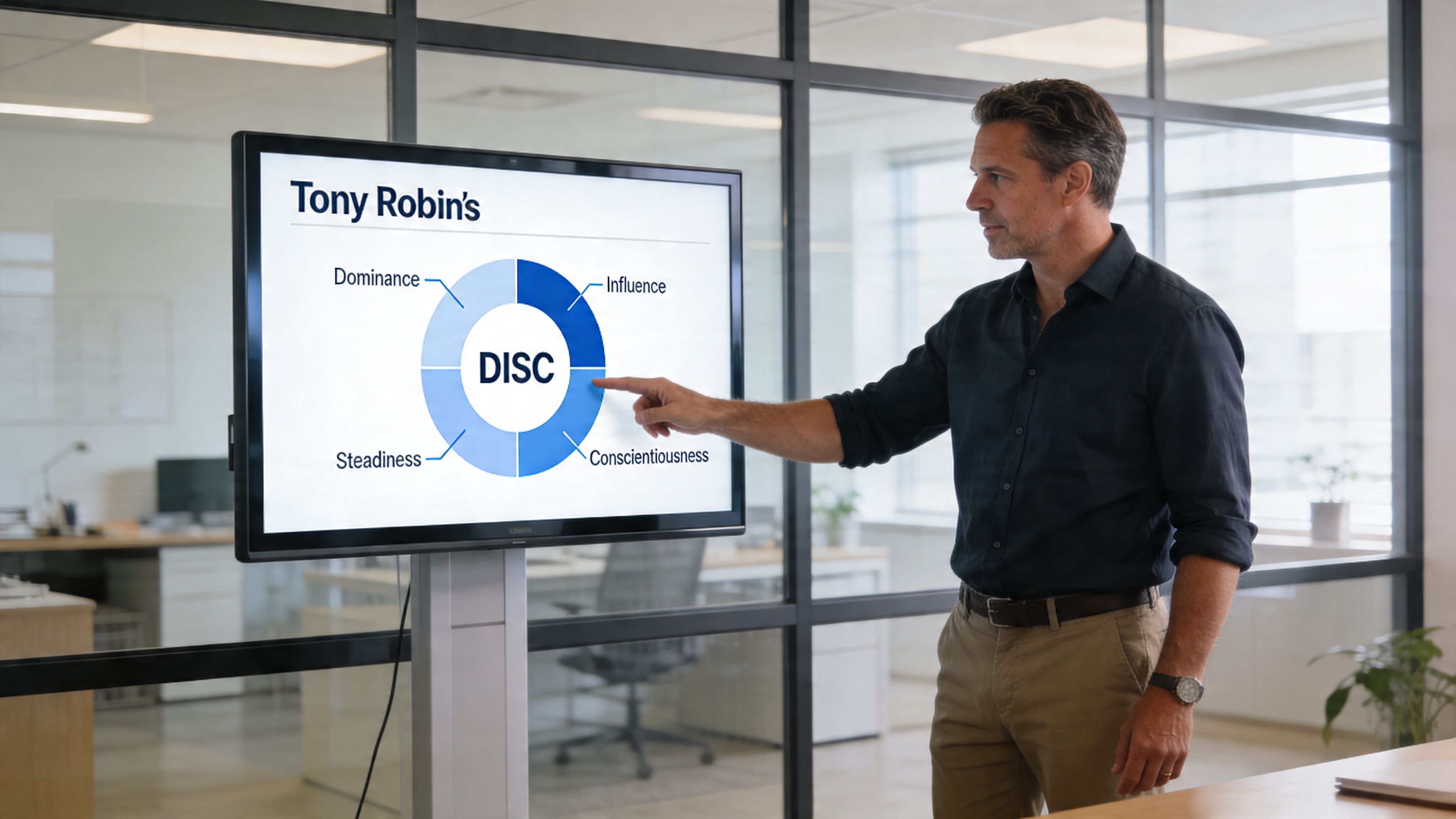
One of the most practical features is the dual-graph system . It shows both Natural Style and Adapted Style . The description from Internal Change explains that this framework distinguishes between your innate behavior patterns and the way you adjust in social or professional settings.
That matters more than it may seem.
Say your natural style is calm, collaborative, and methodical. Then you step into a sales leadership role that rewards fast decisions, public confidence, and constant urgency. Over time, you may adapt and look much more forceful at work than you feel within. From the outside, people think, “That’s just who she is.” But internally, the gap can feel draining.
Why that Difference Matters
This adapted-versus-natural split helps explain a common kind of burnout. Not all exhaustion comes from workload. Some of it comes from acting “on” for too long.
A practical example:
• Natural pattern: • quiet, deliberate, careful with risk
• Adapted pattern at work: • assertive, high-energy, always available
That person may perform well. They may even look impressive. But if the adaptation becomes constant, the assessment can reveal that their public behavior is costing them energy.
Blended Traits, Not Rigid Labels
Another useful aspect is that the Tony Robbins DISC assessment doesn’t treat people as cardboard cutouts. The assessment materials describe a blended personality vector model that recognizes trait blending rather than forcing people into one fixed bucket. The report also includes 7 Motivators and practical communication guidance in a three-part structure through the sample report from Assessments 24x7 .
That makes the tool more coachable.
If someone says, “I’m a D, so I’m blunt,” that’s not self-awareness. That’s branding bad behavior. A blended model is more honest. You may lead with one style and still carry strong elements of another. A forceful executive can also be highly conscientious. A warm, influential speaker can also crave steadiness and routine.
That complexity is where the assessment becomes useful instead of gimmicky.
Putting Your DISC Results into Action
Another report isn't what's needed. What is needed is a way to use one.

Personal Growth in Real Conversations
A client of mine once got a DISC result that reflected strong C and S tendencies. Her immediate reaction was, “So I’m the cautious overthinker.” That wasn’t wrong, but it was incomplete.
What helped her wasn’t the label. It was the translation. She realized she kept delaying hard conversations because she wanted the wording to be perfect and the mood to be stable. In other words, her style shaped her conflict pattern. Once she saw that, she made one simple change. She stopped waiting for the perfect moment and started using a prepared opening sentence.
That sentence was: “I want to solve this early, before it gets weird.”
For her, DISC became a mirror for behavior. Not identity. Behavior is easier to change.
Team Dynamics Without The Drama
Managers often get the most value from DISC when they stop asking, “Who’s the problem?” and start asking, “Where are the style collisions?”
A practical team example looks like this:
• The fast mover: • wants short updates, quick decisions, and visible progress
• The relationship builder: • wants discussion, enthusiasm, and buy-in
• The stabilizer: • wants clarity, harmony, and enough time to adjust
• The analyst: • wants evidence, process, and fewer sloppy assumptions
When a leader sees those patterns, meetings improve fast. The fast mover gets a time-boxed decision point. The analyst gets the background materials earlier. The stabilizer gets advance notice before major shifts. The relationship builder gets space to influence the room.
This kind of thinking also supports broader conversations about culture and collaboration. If you’re interested in how organizations rethink teamwork beyond standard office habits, this piece on redefining team innovation offers a useful lens.
A good team debrief might include questions like:
For readers who want to compare behavioral tools directly with broader personality frameworks, this personality assessment resource can be helpful as a next step.
Here’s a short explainer that shows how communication style can shift your outcomes:
Hiring and Leadership With Caution
DISC can help with role-fit conversations, but people often get careless.
A hiring manager might notice that a candidate’s style seems well-suited to a role that requires patient follow-through, or high social energy, or rigorous detail management. That can be useful. What DISC should not become is a shortcut for deciding who gets hired, promoted, trusted, or ignored. Use it as one input, not the verdict.
A better leadership use is coaching. If a supervisor knows an employee naturally prefers steadiness but is working in a highly adaptive role, they can talk about recovery, communication support, and realistic expectations. That’s a smarter use of the tool than trying to sort people into “good fits” and “bad fits.”
The Reliability and Limitations of DISC Assessments
DISC has real strengths. It’s easy to grasp, easy to remember, and easy to apply in teams. That alone gives it practical power.
The Tony Robbins version also has a credibility advantage. According to the Assessments 24x7 sample report , the assessment uses a third-party validation process , with the publisher contracting the Assessments Standards Institute to conduct validation and reliability research. That doesn’t make it perfect, but it does separate it from personality quizzes that are little more than entertainment.
What DISC Does Well?
DISC is especially good at helping people describe:
• Communication preferences: • direct, relational, steady, or detail-focused
• Workplace friction: • where style clashes may be causing avoidable tension
• Behavior under pressure: • how someone tends to respond when demands rise
That’s useful territory. Teams often improve just by gaining shared language.
Where DISC Stops Short?
Here’s the main limitation. DISC is stronger on what you do than why you do it . Two people can both look highly dominant. Both may speak firmly, move quickly, and dislike hesitation. But their motives can be completely different. One may push because they fear losing control. Another may push because they feel responsible for protecting everyone’s time. Same visible behavior. Different internal engine.
That difference matters in coaching, relationships, and personal growth. If you only understand behavior, you can improve tactics. If you understand motivation, you can change patterns.
DISC also depends heavily on self-reporting. If you answer based on who you want to be, who your boss rewards, or who you’ve trained yourself to appear as, your result may reflect performance more than essence. That doesn’t make the assessment useless. It just means it should be handled with humility. The best way to use DISC is as a conversation starter , not a final diagnosis.
DISC vs The Enneagram: Choosing Your Path to Self-Discovery
If DISC tells you how you tend to behave, the Enneagram asks a deeper question: what inner motive keeps generating that behavior? That’s the cleanest way to compare them.
DISC is often the better choice when your goal is immediate communication improvement. The Enneagram is often the better choice when your goal is deeper self-observation, emotional growth, or understanding long-running patterns in relationships.
A Simple Side-By-Side View
| Aspect | DISC Assessment | Enneagram System |
|---|---|---|
| Primary focus | Observable behavior and communication style | Core motivation, fear, desire, and inner pattern |
| Main question | How do I tend to act? | Why do I keep acting this way? |
| Best use case | Team communication, leadership style, workplace friction | Personal growth, relationship depth, emotional awareness |
| Language of the system | Four behavioral styles | Nine core types with deeper internal dynamics |
| Strength | Fast, practical, easy to apply | Deep, reflective, strong for long-term transformation |
| Limitation | Can stay at the surface of behavior | Can feel more complex and take longer to integrate |
When DISC is The Better Tool
Use DISC when:
• You need a shared work language fast: • Teams can adopt it quickly.
• You want cleaner communication: • It helps people tailor tone and pace.
• You’re coaching for behavioral flexibility: • It’s great for practical adjustments.
A sales manager, for example, may not need every team member’s deepest childhood script in order to improve a weekly meeting. They may just need to know who wants brevity, who wants connection, and who wants supporting detail.
When the Enneagram is the Better Tool
Use the Enneagram when:
• You keep repeating the same life pattern: • especially in conflict or intimacy
• You want to understand your inner driver: • not just your outward style
• You’re doing serious self-development work: • therapy, coaching, relationship repair, spiritual growth
DISC can sometimes feel too shallow. It might tell you that you avoid conflict, control conversations, or seek approval. The Enneagram Test asks what deeper need makes that strategy feel necessary.
If you’ve ever taken a personality test and thought, “Yes, that describes me, but it doesn’t explain me,” that’s usually the moment people start looking beyond behavioral models. This comparison of Enneagram and MBTI differences is also useful if you’re trying to sort through multiple systems at once.
A Practical Decision Framework
Choose DISC if your current problem sounds like this:
• “My team keeps misreading each other.”
• “I want to communicate better at work.”
• “I need a practical tool, not a deep identity journey.”
Choose the Enneagram if your current problem sounds like this:
• “I keep having the same conflict in different relationships.”
• “I understand my habits, but not my motives.”
• “I want to grow, not just perform better.”
Both tools can help. They just help in different layers of the human experience.
Your Blueprint for Better Understanding
The DISC personality test Tony Robbins promotes is useful because it gives people a fast, practical read on behavior. It can improve communication, coaching, and teamwork when you use it with humility. Its biggest value is clarity around patterns you can observe.
Its biggest limit is depth.
If you want to understand not just how you behave but what drives those patterns from the inside, go deeper. Tools matter. So does choosing the right one for the question you’re asking. If you’re ready for that next layer, this guide on how to know yourself better is a strong place to continue.
If you want a deeper look at your core motivations, fears, and growth patterns, Enneagram Universe offers a thoughtful next step. Its assessment experience is built for people who don’t just want a label. They want insight they can use in relationships, work, and everyday self-awareness.