Deep Thinker Meaning: Explore Your Inner World

You answer a text, and someone says, “Wow, you’ve really thought about this.” In a meeting, you’re still turning one idea over while everyone else has already moved to the next slide. At a party, small talk feels like eating crackers when you were hoping for a real meal.
A lot of people who search for deep thinker meaning are trying to answer a quiet question about themselves. Why do I process things this way? Why do I keep asking “why” after other people seem satisfied with the first answer? Why do I feel both gifted and exhausted by my own mind?
If that sounds familiar, you’re probably not “too much,” broken, or slow. You may have a mind that prefers depth over speed. That’s not a rigid identity. It’s a pattern. A processing style. And once you understand it, you can work with it instead of fighting it.
The World Through a Different Lens
A deep thinker often notices what other people skip. Not because they’re trying to be difficult, but because their mind naturally keeps digging. Someone says, “That’s just how it is,” and your brain replies, “But why is it that way?, Who decided that?, and What are we missing?”
That difference can feel lonely. In everyday American life, speed often gets rewarded. Quick answers. Fast meetings. Short texts. Hot takes. A deep thinker usually wants a little more time. They want context, nuance, and meaning.
A Deep Thinker Is Not Just a Stereotype
People often picture a deep thinker as a gloomy genius staring out a rainy window. That image misses the point. Deep thinking isn’t about looking serious or sounding intellectual. It’s about how a person processes experience.
A practical way to define it is this: a deep thinker tends to pause, examine, connect, and reflect before landing on a conclusion.
That can show up in ordinary moments:
• After a disagreement: • You replay the conversation and look for the hidden fear under each person’s words.
• While reading a book: • You stop every few pages because one sentence sparks a chain of ideas.
• At work: • You don’t just ask whether a plan will work. You ask whether it fits the larger goal.
Why This Matters In Real Life
When people don’t understand their own style, they often mislabel it. They call themselves indecisive, though they are thorough. They call themselves awkward when they prefer meaningful exchange over surface chatter.
Clarity changes that. Once you understand the deep thinker’s meaning, you can start sorting your strengths from your stress responses. You can also stop comparing your internal pace to other people’s external speed.
That’s where things get useful. Not flattering. Useful.
What Does It Actually Mean to Be a Deep Thinker
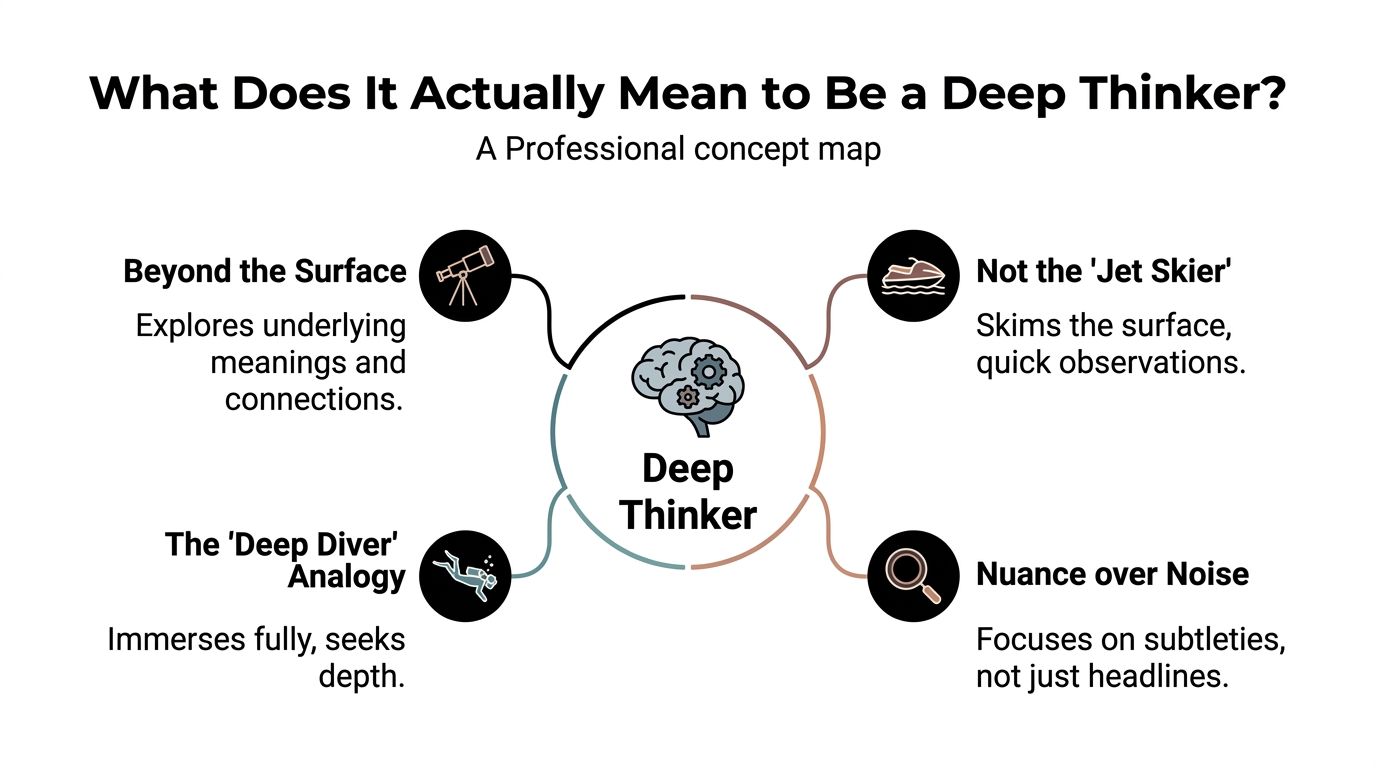
The easiest way to understand a deep thinker is through an analogy.
A jet skier moves fast across the surface. They cover a lot of ground quickly, notice the obvious features, and keep going. A scuba diver goes below the surface. They move more slowly, but they see structures, patterns, and hidden life that surface travelers never notice.
A deep thinker is the mental scuba diver.
Depth Is The Point, Not Speed
Deep thinking doesn’t mean someone is automatically smarter. It means they tend to go further into an idea before they feel done with it. They examine assumptions, compare possibilities, and look for the larger pattern.
A 2023 survey on deep thinking found that 80% of people wanted a new thinking approach, yet only 34% said they spent time on deep thinking practices. The same survey reported that 81% recognized deep thinking as helpful for self-awareness. That gap matters. Many people value depth, but fewer build a life that makes room for it.
If you enjoy reflective topics like this, you can explore their blog for more perspectives on inner growth and thoughtful living.
The Core Parts of Deep Thinking
Three mental habits show up again and again.
| Habit | What it looks like | Everyday example |
|---|---|---|
| Meta-cognition | Thinking about your own thinking | You notice, “I’m reacting defensively. Let me slow down and ask why.” |
| Critical analysis | Testing ideas instead of accepting them at face value | A headline goes viral, and you immediately wonder what context is missing. |
| Synthesis | Connecting separate ideas into one larger picture | A book, a memory, and a work problem suddenly click together in your journal. |
Why Deep Thinkers Can Seem Unusual
A deep thinker often frustrates people who want a fast yes or no. They may ask one extra question in a meeting that changes the whole conversation. They may hesitate before speaking, not because they have nothing to say, but because they’re sorting what’s accurate, fair, and useful.
That’s one reason many people resonate with Type 5 , the investigator profile in the Enneagram. If that style sounds familiar, this guide to Enneagram Type 5 The Investigator gives a good picture of analytical depth in action.
Unmistakable Signs You Are a Deep Thinker
Some signs are subtle. Others show up so often that your friends have probably commented on them for years.

You Don’t Take Things at Face Value
Someone tells you, “It’s no big deal.” You hear the words, but you also notice their tone, timing, and body language. You wonder whether they mean it, whether they want reassurance, or whether they’re avoiding something harder.
That habit lines up with a description of deep thinkers as people with high trait introspection who may pause to consider 10 different possibilities before responding, rather than accepting the first explanation that appears. That same source describes deep thinkers as rejecting face-value acceptance until evidence supports a stronger conclusion, and notes that early reading often helps build that reflective pattern through repeated exposure to ideas and interpretation in this discussion of deep thinking traits .
Small Talk Drains You Fast
You can do it. You just don’t enjoy staying there.
At a neighborhood barbecue, you’ll survive three minutes of weather talk, but your energy rises when someone asks a real question. What changed your mind this year? What are you afraid to admit? Why do families repeat the same patterns?
Deep thinkers often crave substance because their minds naturally move toward meaning.
You Rehearse Conversations in Your Head
Before sending a difficult text, you may run the whole exchange internally. If I say it this way, they may hear criticism. If I say it that way, it may sound vague. If I wait until tomorrow, I might be calmer.
That inner rehearsal can feel excessive, but it’s often your brain trying to be accurate and responsible.
Here’s a quick visual explanation that many readers find useful:
You Carry a Busy Inner World
A trip to Target can turn into a philosophical detour. One overheard comment reminds you of your childhood, then a family pattern, then a question about identity, then a note you want to write later in your phone.
That inner life isn’t random. It’s associative. Deep thinkers often connect experiences across time, emotion, and meaning.
• You ask follow-up questions naturally. • Not to challenge people, but because your mind wants the full picture.
• You notice contradictions. • A company says it values people, but every decision rewards speed over care.
• You need solitude to digest life. • Quiet helps you sort signal from noise.
The Superpowers and Kryptonite of Deep Thinking
Every strength casts a shadow. The same mind that sees more can also carry more.

Superpower and Kryptonite Side-By-Side
| Superpower | Why it helps | Kryptonite | What it can feel like |
|---|---|---|---|
| Pattern recognition | You catch what doesn’t fit | Overanalysis | You keep searching for the perfect answer |
| Self-awareness | You understand your motives better | Rumination | You replay the same issue without relief |
| Creativity | You combine ideas in fresh ways | Mental overload | Too many connections arrive at once |
| Thoughtful decisions | You consider consequences carefully | Slow decisions | Even small choices can feel heavy |
One of the hardest truths for deep thinkers is that their gift can become their trap. The same depth that helps you make wise decisions can make ordinary choices feel loaded with significance.
A 2025 meta-analysis summarized here reported that people high in Need for Cognition had 2.1x higher rates of anxiety disorders, 37% longer decision times due to overanalysis, and 52% reporting chronic rumination. That doesn’t mean deep thinking is a problem. It means unmanaged depth can become a burden.
When the Gift Becomes Too Heavy
Take a simple example. You’re choosing whether to switch jobs.
A fast processor might ask, “Do I like the offer?” A deep thinker may ask:
Those are smart questions. They become painful when you can’t stop generating more of them.
How to Keep the Strength Without Feeding the Stress
You don’t need to become shallow. You need boundaries for depth.
• Use time boxes: • Give yourself a set window for thinking, then make the best decision available.
• Separate useful reflection from looping: • Journaling can clarify. Replaying the same thought without movement usually doesn’t.
• Choose the level of depth the moment requires: • Not every email deserves existential analysis.
• Move your body: • Walking, lifting, stretching, or cleaning can help your mind stop spinning in place.
A healthy, deep thinker learns range. They can dive deep when the moment calls for it, then come back to the surface and live their actual life.
Decoding Communication for Deep Thinkers
Communication gets messy when two people use different filters.
A deep thinker often leads with logic. They want to know what happened, why it happened, whether the reasoning holds up, and what pattern explains it. Another person may lead with feeling. They want to know whether the exchange feels safe, respectful, and connecting.
Neither style is wrong. The trouble starts when each person thinks their filter is the obvious one.

Why Conversations Go Sideways
Research summarized in this article on deep thinkers and deep feelers notes that mixed thinker-feeler interactions show 35% higher misunderstanding rates because thinkers focus on evidence, while feelers focus on emotional resonance.
You can see this in a common workplace exchange. A manager says, “Can you explain why this project changed direction?”. A thinker hears: “Let’s examine the logic.” A feeler may hear: “I’m being questioned, and my judgment may not be trusted.”
Same sentence. Different nervous systems.
The Thinker-Feeler Bridge
The fix isn’t to stop being thoughtful. It’s to translate.
Try this bridge protocol in meetings, friendships, and marriage.
• Start with intent: • Say what you’re trying to do. “I’m not attacking your idea. I’m trying to understand the reasoning.”
• Name one feeling before one analysis: • “I can see this was frustrating. I also want to look at what led to it.”
• Ask permission for depth: • “Do you want comfort first, or do you want me to help think it through?”
• Reflect back their language: • If they talk about feeling dismissed, don’t answer only with facts.
A Practical Comparison
| If you’re a deep thinker | Try saying | Why it helps |
|---|---|---|
| You want clarity | “Help me understand how you got there” | Sounds less combative than “That doesn’t make sense” |
| You notice inconsistency | “I may be missing context” | Reduces defensiveness |
| You need emotional context | “What part of this felt hardest?” | Shows you value more than logic |
For people who want to strengthen this skill in professional settings, this guide on how to improve professional communication skills offers solid ways to make thoughtful ideas land more clearly.
Finding Your Profile in the Enneagram
Not all deep thinkers look alike. One person analyzes. Another broods. Another reflects and avoids conflict while processing everything internally. That’s why a general definition helps, but it doesn’t go far enough.
The Enneagram gives more shape to the deep thinker’s meaning by showing that depth can grow from different motives.
A 2023 study summarized here found that 68% of self-identified deep thinkers scored high on Enneagram Types 4, 5, and 9 . The same source also noted a 42% surge in “deep thinker Enneagram type” queries on assessment platforms, which suggests many people want this more specific lens.
Type 5 Tries to Understand
Type 5 is the classic analyst. This person often withdraws to observe, research, and build a clear mental model before acting. Their deep thinking usually feels precise, structured, and knowledge-driven.
A Type 5 might spend an evening comparing three books, two podcasts, and a legal article before forming an opinion on a policy issue. They don’t want noise. They want coherence.
Type 4 Thinks To Find Meaning
Type 4’s depth is more emotional and identity-based. They don’t just ask, “Is this true?” They ask, “What does this mean about me, about longing, about beauty, about loss?”
A Type 4 might listen to one song and end up journaling for an hour about an old friendship, a missed season of life, and the version of themselves they’re still trying to become.
Type 9 Thinks to Preserve Inner Peace
Type 9 can look easygoing on the outside while carrying a vast reflective world inside. Their thinking often circles around harmony, perspective, and the wish to avoid unnecessary conflict.
A Type 9 may understand everyone in the room before they understand themselves. They can hold many viewpoints at once, which gives them wisdom. It can also make them postpone action.
Why Does This Lens Help?
Without a framework, a deep thinker may treat every mental habit as one big category. The Enneagram helps separate them. Are you researching because you love truth, because you’re protecting yourself, because you’re searching for identity, or because you’re trying to keep the peace?
That question changes everything.
If you want a beginner-friendly path into that process, this step-by-step guide to finding your Enneagram type gives a useful starting point.
From Insight to Action with Enneagram Universe
Understanding the deep thinker‘s meaning can feel relieving. It gives language to experiences you may have carried for years. You stop calling yourself “too sensitive,” “too intense,” or “too slow,” and start seeing the underlying pattern. You process life with depth.
But insight alone only takes you so far. The key shift comes when you learn what kind of deep thinker you are, what triggers your overthinking, what your healthy patterns look like, and how your relationships change when you understand your core motives.
That’s why a detailed personality assessment can help. A broad label tells you that you dive below the surface. A nuanced framework shows you where you dive, why you dive there, and what helps you come back with wisdom instead of exhaustion.
If you’re ready to turn self-recognition into practical growth, take a look at the free Enneagram test and use your results as a map, not a badge.
If you’re ready to understand your mind with more precision, Enneagram Universe offers a thoughtful next step. Their scientifically validated assessment uses 180 questions to explore your core motivations, fears, desires, wings, triads, and health levels, so you can do more than say, “I’m a deep thinker.” You can learn how your depth works, where it helps, where it stalls you, and how to use it for better relationships, clearer decisions, and a steadier inner life.