Dealing with Difficult Coworkers: Practical Tips to Reclaim Your Workplace

Let's be honest. When you're dealing with a difficult coworker, the only thing you can truly change is how you react. The secret isn't some magic spell to make them disappear; it’s about having a solid, professional game plan to protect your sanity and keep your work on track.
Why Some Coworkers Drive You Up the Wall
So, you've found yourself Googling "how to survive my annoying coworker." Welcome. You're in good company. Forget the sterile HR pamphlets—we're diving into the real, hair-pulling frustration that comes from navigating daily office drama. That tension you feel? It’s not in your head. It's a genuine productivity killer.

These personality clashes are a much bigger deal than a simple annoyance. In the U.S. alone, workplace conflicts drain a mind-boggling $359 billion a year from businesses. That number comes from employees spending an average of 2.8 hours per week just dealing with coworker drama. Think about it—that's time that could be spent on actual work, not navigating egos and friction. You can dig into more of these eye-opening workplace conflict statistics to see the full impact.
Recognizing the Common Culprits
Before you can craft a defense, you need to know what you’re up against. Most difficult behaviors fit into a few classic (and infuriating) archetypes. I’m willing to bet you’ve met at least one of these folks:
• The Micromanager: • They live in your inbox, question every move you make, and need to be cc'd on emails to the janitor. For example, your manager, Brenda, asks for a daily report on a project that only requires weekly updates, making you waste time on documentation instead of execution.
• The Credit-Stealer: • This one has a special talent for taking your brilliant idea and presenting it as their own in the big meeting, leaving you fuming in silence. Think of Kevin, who overheard you mention a great new marketing angle to a colleague, and then presented it as his own idea in the team meeting an hour later.
• The Gossiper: • They trade in rumors and half-truths, poisoning the well and making everyone paranoid. This is like Susan, who always has a "secret" to share about someone's personal life or a supposed upcoming layoff, creating anxiety across the department.
• The Complainer: • Ah, the "Energy Vampire." Nothing is ever right. The coffee is bad, the project is doomed, and the boss is clueless. Their negativity is contagious and can suck the life out of a room. For instance, every time a new project is announced, Dave immediately lists all the reasons it will fail before anyone has even had a chance to get excited.
Here's the most important thing to remember: You can't control their behavior, but you are 100% in control of your reaction. The goal isn't to "fix" them. It's to manage your response so they no longer have power over your day.
Before we dive deeper, it helps to have some quick-response tactics ready to go. Think of this as your immediate action plan for when things start to go sideways.
Your First-Aid Kit for Office Conflicts
| Tactic | What It Means | When to Use It |
|---|---|---|
| The "Pause and Pivot" | Taking a deliberate breath before responding and then redirecting the conversation back to the work itself. | When The Complainer starts a negativity spiral or The Gossiper tries to pull you into drama. For example, if Dave says, "This project is going to be a disaster," you can respond, "I hear your concerns. Let's focus on Step 1 and see how we can make that a success." |
| The "Documentation Loop" | Following up a verbal conversation with a brief, neutral email summarizing what was discussed and agreed upon. | An absolute must with The Micromanager or The Credit-Stealer to create a clear paper trail. After Kevin agrees to your idea verbally, you send an email: "Hi Kevin, great chat. Just to confirm, I'll be taking the lead on the new marketing angle we discussed. I'll have a draft by Friday." |
| The "Boundary Phrase" | Using a calm, firm, pre-planned sentence to shut down an unhelpful interaction. "I'm focused on the deadline right now, let's talk about this later." | Perfect for setting a clear line with any difficult type without escalating the situation. When Susan approaches with fresh gossip, you can say, "I've got to get this report done. Can we connect later if it's work-related?" |
These simple moves can de-escalate a tense moment and give you back control, allowing you to handle the situation with poise instead of pure emotion.
Finding Your Secret Weapon
So, what's the long-term solution? It’s all about understanding what makes people tick. Frameworks like the Enneagram are fantastic for this. They offer a surprisingly accurate lens into what drives people—their fears, their motivations, their blind spots.
No, you don't need to become an amateur psychologist. But by getting a sense of someone's underlying personality type, you can tailor your communication and set boundaries in a way that actually lands.
This guide is your playbook. It's packed with the strategies you need to protect your focus, stay professional, and maybe even turn these headaches into a chance to level up your own communication skills. Your peace of mind is worth fighting for, and it's time to win it back.
Figuring Out Who You're Dealing With
Before you can come up with a game plan, you need to know who you’re up against. Think of this as your field guide to the wild world of difficult colleagues. We're going beyond simple labels here to get at what really makes these folks tick. After all, you can't neutralize a problem until you can name it.
Let's break down a few of the "greatest hits" you’ve probably met at the office water cooler.
The Steamroller
Oh, you know this one. They treat every conversation like a monologue and every meeting like their own personal TED Talk. They don't just share ideas; they bulldoze right over yours, cutting people off and shooting down opinions before they can even get the words out. What’s driving them? It's often a desperate need to be seen as the smartest, most capable person in the room.
The trick with a Steamroller isn't trying to match their volume. It's about calmly and firmly holding your ground.
• Here's how it plays out: • You're in a team brainstorm, and Mark keeps talking over you. Instead of getting rattled, you wait for him to take a breath and say, " • Mark, that's an interesting point. I'd like to finish my thought before we move on. • " It’s direct, professional, and really hard to argue with.
The Energy Vampire
They don't have fangs, but they'll suck the life out of a room just the same. The Energy Vampire lives on a steady diet of negativity, complaining about everything from the project timeline to the new brand of coffee. Their constant gloom-and-doom attitude is shockingly contagious, leaving you feeling drained and uninspired after just a five-minute chat.
The thing is, they often have no clue what they're doing—pessimism is just their default mode. Your mission, should you choose to accept it, is to guard your own energy by refusing to get sucked into their spiral.
You are not required to be a sounding board for endless negativity. You can politely shut it down without making a big scene. For example, when they start complaining, you can say, "That sounds tough. I need to focus on this task right now, but I hope your day gets better."
A Case Study: "Credit-Stealing Chris"
Let's get real with a story about one of the most infuriating characters you can encounter. Sarah, a fantastic graphic designer, had a "Credit-Stealing Chris" on her team. Chris had a knack for seeing Sarah's brilliant concepts in early drafts and then, almost magically, presenting them as his own during team meetings. It was subtle, infuriating, and made Sarah feel completely invisible.
She knew calling him out directly would just result in a bunch of denials. So, she got smart.
Chris didn't change overnight, but Sarah’s new strategy made it almost impossible for him to get away with it. She took back control of her own story.
Getting a handle on these archetypes and what makes them tick is a massive step. If you're into digging deeper into personality, frameworks that explain different worldviews can be a game-changer. You can learn more about the nine Enneagram types to really get a better handle on what motivates the people you share an office with.
Your Communication Playbook for Every Personality
There’s no magic script for handling a tricky coworker. Anyone who tells you there is, is selling you a one-size-fits-all hammer and pretending it works on screws. The real key isn't what you say, but how you say it—and that changes dramatically from person to person.
This is where a little personality insight goes a long way. Frameworks like the Enneagram are goldmines for this. They give you a peek behind the curtain at what truly motivates and scares your colleagues, letting you sidestep their triggers and actually get your point across.
Talking to The Challenger (Type 8)
Ever work with a bulldozer? You've probably met an Enneagram Type 8. Known as "The Challenger," their entire world revolves around maintaining control and resisting being controlled. They value strength, hate waffling, and respect people who get straight to the point.
If you need to set a boundary with a Type 8, ditch the apology. Be firm, direct, and focus on the solution, not the problem.
Imagine this: Your Type 8 manager keeps dropping "urgent" tasks on your desk at 4 PM, torpedoing your entire workflow.
• What • not • to do: • "Um, sorry, I'm just so swamped. I don't know if I can get to this..."
• What to do instead: • "I understand this is a priority. To get this done right, my other deadlines for Project X will have to move to tomorrow. Which one should I focus on?"
See the difference? You’re not complaining; you’re presenting a choice. You're showing them you're in control of your own workload, which is a language they understand and respect.
Navigating The Peacemaker (Type 9)
On the flip side, you have the conflict-averse Type 9, "The Peacemaker." Their deepest fear is disconnection and creating tension, so they will often do anything to avoid a direct confrontation. If you come on too strong, they'll just shut down.
Getting real feedback from a Type 9 is an exercise in patience. You have to build a safe harbor for their honest opinion.
Let’s say you need honest feedback on a proposal, but your Type 9 colleague is just giving you a series of polite nods.
• The wrong way: • "I need you to tell me what's wrong with this. Just be direct."
• A better way: • "I really value your perspective. To make this proposal as strong as it can be, it would be a huge help if you could flag any areas you think might be a little weak or could be improved."
You've just turned a confrontation into a collaboration, making it safe for them to offer the very criticism you need.
Giving Feedback to The Reformer (Type 1)
Meet the Enneagram Type 1, "The Reformer," a personality driven by an intense desire to be good, correct, and principled. Trust me, their inner critic is already working overtime. Direct criticism can feel less like feedback and more like a personal attack on their integrity.
The trick is to frame your feedback around a shared goal of excellence. You’re not pointing out their mistake; you're helping them live up to their own high standards. For example, instead of saying, "You made a mistake in this report," try: "I know we both want this report to be flawless. I noticed a small discrepancy on page 3; could we review it together to make sure it's perfect?"
This is where you start to see patterns emerging among some of those classic difficult coworker types.
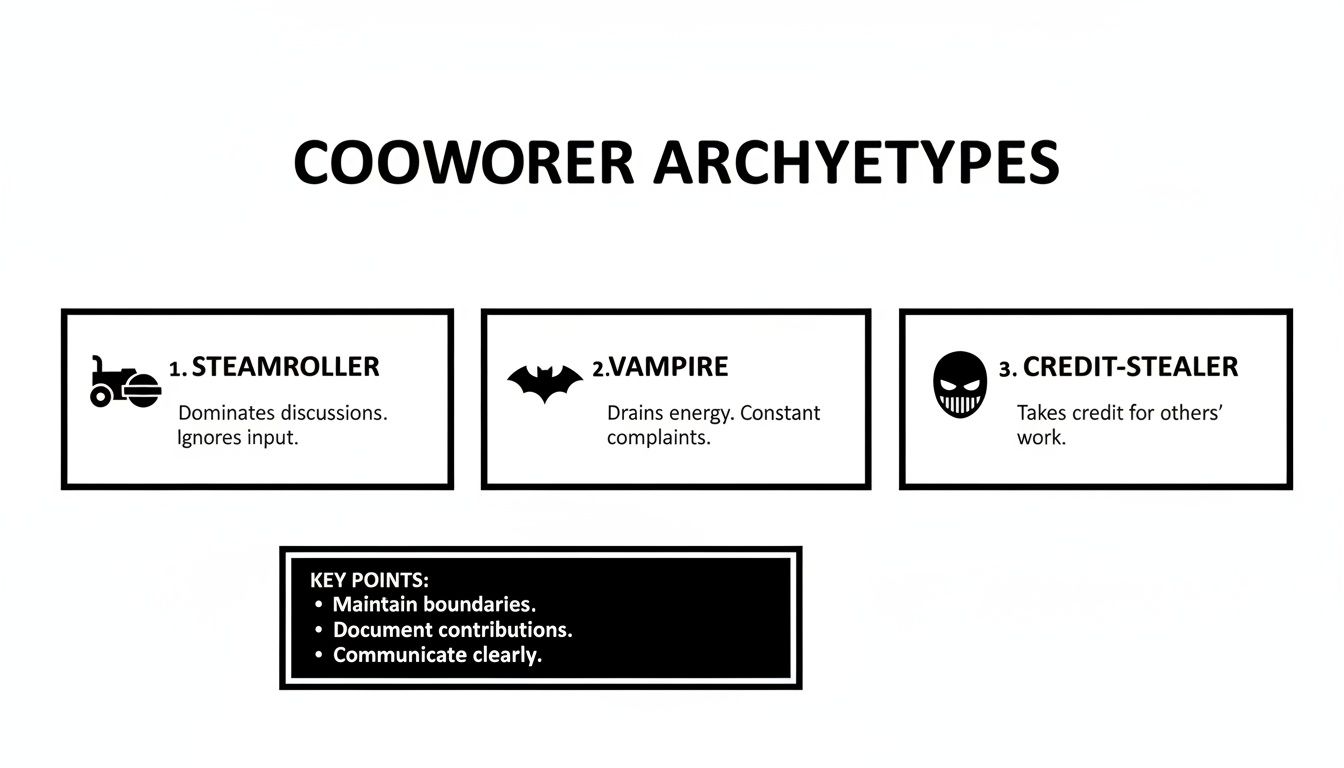
The person who always talks over you in meetings (Steamroller) might just be a Type 8 trying to maintain control. The key is always to look past the what and try to understand the why .
"To effectively communicate, we must realize that we are all different in the way we perceive the world and use this understanding as a guide to our communication with others." - Tony Robbins
Enneagram Communication Cheat Sheet
To make this even more practical, here’s a quick cheat sheet for tailoring your communication on the fly. Remember, you're just looking for clues to their type, not trying to be a therapist.
| Coworker's Enneagram Type (Likely) | Core Fear to Avoid Triggering | Effective Communication Tactic | Example Phrase |
|---|---|---|---|
| Type 1: The Reformer | Being seen as bad or corrupt | Appeal to shared high standards and the "right" way to do things. | "I know we both want this project to be perfect. Can we look at this section again to make sure it's as strong as possible?" |
| Type 2: The Helper | Being unwanted or unworthy of love | Acknowledge their helpfulness and frame your needs as a request. | "You're always so good at [skill]. I could really use your help with this part if you have a moment." |
| Type 3: The Achiever | Being worthless or failing | Focus on efficiency, goals, and winning outcomes. Keep it concise. | "Here's the bottom line: This approach will help us hit our Q3 target faster. What are your thoughts?" |
| Type 4: The Individualist | Having no identity or significance | Acknowledge their unique perspective and speak with authenticity. | "I haven't heard anyone else suggest that. Can you tell me more about your thinking behind that idea?" |
| Type 5: The Investigator | Being useless or incapable | Come prepared with data and logic. Give them space to process. | "I've pulled the numbers on this, and they show X. I'll send them over for you to review before we discuss." |
| Type 6: The Loyalist | Being without support or guidance | Be clear, consistent, and reassuring. Address potential risks. | "Let's walk through the worst-case scenarios so we can have a solid plan B in place. I've got your back on this." |
| Type 7: The Enthusiast | Being trapped in pain or deprived | Keep it positive and future-focused. Frame it as an opportunity. | "I have an exciting idea for how we can solve this. Imagine if we could..." |
| Type 8: The Challenger | Being controlled by others | Be direct, confident, and stand your ground respectfully. | "To make that happen, I will need X and Y. I can take the lead on this." |
| Type 9: The Peacemaker | Loss of connection; fragmentation | Be patient and collaborative. Invite their opinion gently. | "I want to make sure everyone's voice is heard on this. What's your take on it?" |
Think of this table as your field guide. It’s not about putting people in boxes, but about having a better map to navigate conversations more successfully.
Building Your Adaptability
Learning to flex your communication style is more than just a survival tactic; it's a massive career advantage. Did you know that personality clashes are now behind a staggering 49% of workplace disputes ? That number has shot up since 2008, costing teams countless hours and draining morale. Fascinating workplace conflict statistics show that teams that collaborate and compromise perform better, while those who avoid or dominate sink.
At the end of the day, this is all about boosting your own emotional intelligence. When you can read a situation and adjust your approach, you become the person everyone wants on their team. To go even deeper, check out our guide on how to increase your emotional intelligence .
This isn’t about being fake. It's about being effective. It's about expanding your toolkit so you can build better bridges, maintain your boundaries, and make your workday a whole lot less stressful.
Setting Boundaries Without Starting an Office War
Let's be honest, the idea of setting a boundary with that coworker probably makes your palms sweat. You're picturing the awkward silence, the passive-aggressive Slack messages, maybe even a full-on cold shoulder in the breakroom. But here's the thing: setting a boundary isn't an attack. It's an act of professional self-preservation. Think of it like putting on your own oxygen mask first.

You aren't building a fortress; you're just drawing a clear, kind line in the sand that says, "Hey, my productivity and peace of mind live over here." One of the most critical skills you can develop for navigating tricky workplace dynamics is knowing how to set healthy boundaries without causing a scene. It's a muscle, and the more you use it, the stronger it gets.
This isn't just about feeling less stressed, either. It’s a massive business concern. The global conflict resolution market is set to explode, projected to hit USD 9.52 billion by 2025. That number tells a story: companies everywhere are desperate for people who can handle these situations gracefully. And the training pays off—a whopping 76% of employees who learn these skills report better outcomes at work.
The Anatomy of a Good Boundary
A really effective boundary isn't a demand; it's just a calm statement of your needs. It's friendly but firm, and it works wonders when you pair it with a simple, positive alternative. It's like a recipe.
You state the issue clearly, explain its impact on your work (not your feelings), and then suggest a better way forward.
Let's break it down with a classic office dilemma.
Real-World Example: Mike vs. Chatty Cathy
Mike, a software developer, was hemorrhaging deep-focus time. His coworker, "Chatty Cathy," was a genuinely nice person but had an uncanny knack for popping by his desk for unscheduled, 30-minute monologues about her weekend, her cat’s latest antics, and her quest for the perfect sourdough starter. Mike was getting buried, and his deadlines were starting to feel the heat.
Instead of snapping or just slapping on his headphones and ignoring her, he used a simple script. The next time Cathy swung by, he smiled and said:
"Hey Cathy, I really enjoy our chats. To hit my deadline on the new feature, I need to block out 10 AM to noon for pure focus time. How about we grab a coffee at lunch instead? I want to hear about that new recipe!"
See what he did there? It's a masterpiece of workplace diplomacy. It wasn't about her being annoying; it was about his deadline. He affirmed their connection ("I enjoy our chats") while clearly stating his professional need ("I need to block out... focus time"). The killer move was offering an alternative ("How about we grab coffee?"), which showed he still valued her as a person and a colleague.
Scripts You Can Steal Today
You don't need to invent this stuff from scratch. Having a few go-to phrases in your back pocket can make the whole process feel way less intimidating.
Here are a few you can adapt for your own office drama:
• For the Chronic Task-Dumper: • "I'd love to help, but my plate is completely full with Project X right now. Have you tried asking [Another Person] or speaking with [Manager's Name] about prioritizing this?" This works perfectly when a colleague tries to offload their responsibilities onto you.
• For the Office Gossiper: • "You know, I'm really trying to stay out of office politics and just focus on my work. Anyway, did you see the latest numbers on the marketing campaign?" This is a polite way to change the subject when someone tries to pull you into negative talk.
• For the Slack Overloader (after hours): • "Thanks for sending this over! I'm offline for the day, but will jump on this first thing in the morning." This sets a clear boundary about your work hours without being confrontational.
See the pattern? Each script is polite, professional, and completely non-confrontational. They protect your time and energy without putting the other person on the defensive. You're just stating your reality and redirecting the flow. It’s a professional superpower that makes navigating tricky coworker dynamics infinitely easier.
So you’ve tried everything. You’ve been patient. You’ve set boundaries. You’ve even tried to speak their language. And still… nothing. Let’s be real: sometimes, no matter how skilled you are at managing personalities, a difficult coworker situation is just too much to handle on your own.
Knowing when to call for backup—meaning your manager or HR—is a critical skill. This isn't about tattling or giving up. It's about recognizing when a problem has grown beyond a simple personality clash and is starting to poison the well for everyone.
Think of it this way: you wouldn't try to fix a burst pipe with a roll of duct tape. Escalating is for the serious issues that are genuinely hurting productivity, tanking team morale, or veering into dangerous territory.
The “Do Not Pass Go” Moments: When to Escalate Immediately
Some things are just not okay, period. If you see or experience any of the following, don't hesitate. Don't second-guess yourself. Go straight to your manager or HR.
• Harassment or Discrimination: • Any behavior targeting someone’s race, gender, religion, age, orientation, or disability is an immediate red flag. For example, if a coworker consistently makes inappropriate jokes about a colleague's accent, that's harassment.
• Threats or Bullying: • This one’s a no-brainer. Overt threats, subtle intimidation, or a pattern of targeted bullying are serious offenses. An example would be a coworker cornering you and saying, "You'd better not mess up this project, or you'll regret it."
• Work Sabotage: • Is a colleague intentionally deleting your files, lying to clients about your progress, or actively trying to make you fail? That's not competition; it’s sabotage, and it needs to be shut down. For instance, you discover a colleague has been deleting key slides from your presentation before you present.
• Unethical or Illegal Stuff: • If you witness someone stealing, committing fraud, or doing anything else that breaks the law, it’s way above your pay grade to handle alone. An example is seeing a coworker falsifying expense reports.
These scenarios are precisely why companies have HR departments and formal policies. You have a right to a safe, professional workplace, and it’s time to let the system do its job.
The point of escalating isn’t to get someone fired. It’s to solve a problem that’s hurting your work, your team, and ultimately, the company.
How to Build Your Case (and Not Sound Like You're Whining)
Here’s a hard truth: walking into your manager's office and just venting is the fastest way to be dismissed. To get results, you need to approach this like a professional, not a plaintiff. You need a calm, documented, and objective case.
Before you even think about booking that meeting, start a log. Seriously. Write everything down. This isn't for drama; it's to create a factual record that strips the emotion out of the situation. For a deeper look at how to frame these conversations, digging into different workplace conflict resolution strategies can give you some fantastic, structured ways to present your evidence.
Your log doesn't need to be a novel. Keep it simple, factual, and focused.
Here’s a simple template to follow for each incident:
| Element to Document | Example |
|---|---|
| Date & Time | October 26, 2:15 PM |
| What Happened | In the team meeting, Alex called my sales projections "completely unrealistic and amateurish." He didn't offer any data or constructive feedback to back this up. |
| Impact on Work | It derailed the meeting for about 10 minutes as we got off-topic and it undermined my authority with the two new hires in the room. |
| Witnesses | Sarah Jenkins and Mike Chen. |
After you've logged a few of these, a clear pattern will emerge. Now, you're not just complaining. You're presenting evidence. The conversation transforms from, "I can't stand working with Alex," to, "This recurring behavior is costing the team time and creating a negative dynamic. Here are three specific examples."
See the difference? One is a personal gripe. The other is a business problem that needs a solution.
Your Action Plan for a More Peaceful Workday
Alright, let's flip the script. Dealing with difficult coworkers often feels like you're playing defense, just trying to survive the day. It’s time to go on offense—not against them, but for your own sanity. Instead of just reacting to the chaos, you're going to build a workday that’s resilient, positive, and focused on what actually matters: you.

This isn't about some magical personality transplant for them. It's about building an invisible forcefield around yourself to deflect their nonsense and reclaim your headspace. Your mental energy is your most valuable professional asset, so let's start protecting it like Fort Knox.
Practice Emotional Detachment
Here’s the ultimate power move: stop letting their drama live rent-free in your head. Emotional detachment is the art of observing their antics without absorbing them. It’s the quiet confidence of knowing their negativity, their nitpicking, or their sky-is-falling drama is a them problem, not a reflection of your worth.
A ridiculously simple but effective way to start is with a mental "bubble." When the office gossip starts their daily broadcast, literally picture their words bouncing off an invisible shield around you. It sounds silly, but this tiny mental trick creates just enough distance for you to respond politely without getting sucked into the vortex.
Your peace is your priority. You are not required to RSVP to every conflict you're invited to. Choosing to disengage is a sign of strength, not weakness.
Focus on Your Circle of Control
You can’t control your coworker's terrible mood, but you can absolutely control your own projects, your goals, and where your career is headed. Pour your energy into the stuff that actually propels you forward. The more you focus on crushing your own work, the smaller and more insignificant their disruptions will feel.
• Celebrate your wins. • Seriously. Did you nail that presentation? Get a glowing email from a client? Take a second to give yourself a mental high-five. For example, after a successful client call, take a moment to acknowledge your hard work before diving into the next task.
• Keep a "brag file." • Create a private doc where you log your accomplishments. It’s an incredible confidence booster and gives you concrete proof of your value, completely separate from any office drama. For instance, copy and paste that positive client email into your file to review on days you're feeling discouraged.
If things get really tough and the stress starts to pile up, knowing your rights is a huge part of self-care. Understanding options like mental health leave in Ontario can be a crucial lifeline. Being aware of the support available to you is a powerful form of self-advocacy.
Think of it this way: every frustrating interaction is a free masterclass in patience, communication, and boundary-setting. You're not just surviving the workday; you're building a more resilient, unflappable version of yourself.
Got More Questions? We've Got Answers
Even with the best game plan, some situations with difficult colleagues are just plain thorny. It’s one thing to have a strategy, but it’s another thing entirely when you're in the thick of it.
Let's break down a few of the stickiest scenarios that people ask about all the time.
What If the Difficult Coworker Is Actually My Boss?
Oh, this is the big one. When the person driving you nuts is the one who signs your performance reviews, the rules of the game change. This calls for the subtle art of "managing up."
Your goal is to guide your boss toward a better way of working together, but you have to frame everything in terms of business goals. Emotion has to leave the room.
Instead of saying, "You're stressing me out with these last-minute projects," try a more strategic approach: "I'm committed to delivering top-notch work on Project X. To make that happen and meet your standards, getting the assignment by noon would be a game-changer for my workflow."
Also, document everything . Every shifting deadline, every vague verbal request—write it down. This isn't about building a case against them; it's about creating a factual record that turns a complaint into a professional, solution-oriented discussion. It’s your safety net. For example, after a verbal request, send a follow-up email: "Hi [Boss's Name], just to confirm our conversation, you've asked me to prioritize the new report and shift the deadline for the presentation to Friday. Please let me know if I've misunderstood."
I Already Tried Talking to Them, and It Did Nothing. Now What?
Ugh, this is so frustrating. You took the high road, communicated like an adult, and... crickets. If your boundaries are being treated like suggestions, it's time for a new tactic. The talking phase is over; the reinforcing phase has begun.
This means their behavior now needs to have a consequence, and that starts with meticulous documentation. Get a notebook or a private doc and log every single incident.
• Date and time • it happened.
• What was said or done? • Be specific and quote if you can.
• How did it impact your work? • (e.g., "Lost 45 minutes of focus," or "Had to rush the final report, risking errors.")
• Were there any witnesses?
After you've logged a few of these, you're no longer in a "he said, she said" situation. You have a documented pattern of behavior that's hurting the business. That’s the kind of evidence that gets a manager or HR to sit up and listen.
How Do I Keep My Sanity Working with Someone So Negative?
Your mental energy is a precious resource. Don't let a workplace Eeyore drain it all. The single most powerful skill you can develop here is emotional detachment .
You have to consciously tell yourself, "Their negativity is about them, not me. It's their storm, not my rain." It's not about being cold; it's about building a psychological shield.
Practically speaking, create some distance. Limit your conversations to the bare essentials—keep them short, sweet, and strictly about work. And here's the real key: go out of your way to connect with the positive, supportive people in your office. Build your "work-life firewall" so one person's bad mood doesn't get to burn down your whole day. For instance, if the negative coworker sits near you, make a point of having lunch with a more positive colleague in the breakroom or going for a short walk to clear your head.
Ready to decode the personalities in your office and build stronger connections? Enneagram Universe offers a free, in-depth personality assessment to help you understand yourself and others on a deeper level. Take the test and unlock your path to better relationships at Enneagram Universe .