A Practical Guide to Conflict Management Skills for Managers that Elevates Teams

Let’s be honest. For a lot of managers, conflict management skills feel less like a core competency and more like a trip to the dentist—unpleasant, but necessary. The real job is about hitting targets and shipping projects, right?
Wrong. Turning simmering tension into a productive conversation is a high-stakes business strategy. It’s what keeps small disagreements from blowing up projects and sending your best people running for the exit.
Why Ignoring Workplace Conflict Is a Ticking Time Bomb
You know that feeling when you walk into the office and the air is just… thick? The silence in the breakroom is a little too loud, and the emails are a little too short. That’s not just you being paranoid. That’s the sound of your team’s focus, creativity, and morale quietly dissolving.
Ignoring it is like hearing a faint ticking sound in the walls and deciding it’s probably just a clock. Spoiler: it’s rarely just a clock.

Too many leaders hope that office squabbles will just sort themselves out. But unresolved conflict isn’t a weed; it’s a fire. A tiny spark left to smolder can quickly spread, engulfing entire departments in a blaze of resentment and dysfunction.
The Real Cost of "Letting It Go"
This isn't just about bad vibes; it's about cold, hard cash. I once worked with a San Francisco tech firm where two brilliant engineers were at a stalemate. One was obsessed with building a perfectly clean, scalable architecture. The other was hell-bent on a faster launch to beat a competitor. Their manager, wanting to avoid the "awkward" conversation, just let them be.
The result? Weeks of duplicated work, code that wouldn't integrate, and a month-long delay on a critical product update. The cost wasn't just two senior salaries down the drain; it was lost market share and a team dynamic so fractured it took a whole quarter to fix. This stuff happens every day .
"Conflict is not just a 'people problem' handled by HR; it's an operational problem that directly impacts output, innovation, and profitability. When managers avoid it, they are effectively sanctioning inefficiency."
The data is even more sobering. A study across nine countries found that U.S. employees waste an average of 2.8 hours per week on conflict. Do the math. That adds up to a staggering $359 billion in lost time for American companies—all from arguments, gossip, and disputes that festered.
From Firefighter to Architect
The best managers I know have made a crucial mental shift. They don't just put out fires; they build fireproof structures. They create an environment where it's actually okay to disagree, because people know there's a process for handling it constructively.
When you nail this, you’re doing more than just keeping the peace. You’re cultivating:
• Psychological Safety: • The holy grail. It’s when your team feels safe enough to say, "I disagree," without fearing they'll be sidelined. This is where real innovation is born.
• Stronger Bonds: • Getting through a tough, honest conversation can actually bring people closer. It reinforces that the team’s mission is bigger than any single ego.
• Better Decisions: • When you encourage and respectfully debate different viewpoints, you almost always land on a smarter solution.
Ultimately, this is all about trust. When your team trusts you to handle disagreements fairly and directly, they'll bring their best, most challenging ideas to the table. We dive deep into creating this foundation in our guide to building trust in a team .
The goal isn't to create a workplace with zero conflict—that’s not only impossible, but it's undesirable. The goal is to reframe it as an opportunity for your team to get clearer, stronger, and more collaborative.
The Real Reason Most Managers Dread Playing Referee
Let's be honest. If the thought of sitting two feuding team members down in a conference room makes your palms sweat, you're not just being dramatic. That knot in your stomach is real, and it’s one of the most common anxieties good leaders face. Most of us got into management to build things and hit goals, not to be a workplace therapist or a schoolyard monitor.
But that feeling of being totally unprepared isn't just in your head—it's backed by some pretty stark numbers. A huge gap exists between the need for skilled mediators and the actual training managers get.
When researchers assessed over 70,000 up-and-coming leaders, a jaw-dropping 49% flat-out failed to show they could manage conflict effectively. Even worse? Only 12% were highly proficient. It's a massive blind spot in modern leadership.

This lack of preparation is what sends well-meaning managers straight into traps that almost always pour gasoline on the fire.
The Traps We All Fall Into
Without a solid game plan, we default to our gut instincts. The problem is, our instincts are often dead wrong when it comes to conflict. They're quick fixes that feel good in the moment, but let the real problem fester and grow into something much uglier.
Here are a few of the most common missteps I've seen (and made myself!):
• The "Just Work It Out" Approach: • This is the classic head-in-the-sand move. You tell two grown adults to just be adults, hoping the problem will magically vanish. It never does. What it • really • does is send a clear message: "I'm not willing to have tough conversations." And that just chips away at your team's trust.
• Jumping to Quick Conclusions: • In the rush to get back to "real work," it's tempting to listen to one side, pick a winner, and lay down the law. • For example, • a project manager complains that an analyst is holding up the timeline. Instead of investigating, you immediately reprimand the analyst, only to find out they were waiting on critical data from the project manager's own department. This shortcut almost guarantees you’ll alienate at least one person and completely ignore the real cause.
• Mistaking Silence for Agreement: • This one is subtle but so destructive. Imagine you're leading a heated debate over a new project in your Chicago office. One of your best engineers, who is brilliant but quiet, says nothing. You assume they're on board. In reality, they have huge reservations but don't feel safe speaking up, which leads to them quietly sabotaging the project later.
"A manager's biggest mistake in a conflict is thinking the loudest voice holds the whole truth and silence means yes. The real story is always hiding in the space between."
A lot of the time, our dread comes from our own inner monologue. Those little voices whispering, "I'm not qualified for this," or "What if I make it worse?" can be paralyzing. It's a lot like overcoming limiting beliefs in other parts of life; you have to dismantle the mental roadblocks before you can move forward.
It's Okay to Struggle (Seriously)
Look, the point here isn't to beat ourselves up. It's to validate that feeling of being thrown into the deep end without a life jacket. Dealing with human emotions, egos, and crossed wires is messy, complicated work.
Just admitting you're not alone in this struggle is the first real step. The anxiety you feel is actually a good sign—it means you care about your people and your company's culture. Think of it as a starting point, not a weakness.
The best part? Conflict resolution is not some magical talent only a few people are born with. It's a practical, learnable skill, just like building a budget or managing a project timeline. Once you see the common pitfalls, you can start shifting from being reactive and anxious to proactive and confident. And this guide is going to give you the tools to do exactly that.
Your Toolkit for Turning Arguments into Agreements
Alright, let's ditch the theory and get our hands dirty. You know why you need to step in when your team is at odds, but the real question is how . This is your playbook for turning those tense, awkward moments into productive breakthroughs.
We're not talking about magic words that make everyone instantly hold hands and sing Kumbaya. This is about having a solid, reliable framework to keep conversations from flying off the rails, especially when emotions are boiling over. Think of it as your secret weapon for turning friction into forward motion.
It's Time to Redefine "Active Listening"
First, can we all agree to retire the old idea of active listening? It's not just about nodding your head and robotically repeating the last few words someone said. That's not listening; that's just... creepy.
Real active listening is a full-contact sport. It's about making the other person feel so profoundly heard and understood that their defensiveness just melts away. Your goal isn't to wait for your turn to talk; it's to grasp their perspective so completely that you could argue their point for them. This single skill is the foundation of everything else, and mastering the art of active listening will change the game for you.
Here's how you actually do it:
• Listen for the Feeling, Not Just the Facts: • Stop parroting their words. Dig deeper and acknowledge the emotion driving them. Instead of, "So, you're saying the report was late," try something like, "It sounds like you were incredibly frustrated when the report was late, maybe because you were worried we'd miss that client deadline." See the difference?
• Ask "How" and "What," Not "Did You": • Ditch the yes/no questions. They're conversational dead ends. Instead, use open-ended questions that start with "What," "How," or "Can you tell me more about..." This cracks the door open for them to elaborate and gives you the real story. • For example, • instead of "Did you get my email?", ask "What are your thoughts on the proposal I sent over?"
• Learn to Love the Awkward Pause: • Silence can feel like an eternity, but it's pure gold. When someone finishes a thought, just wait. Count to three in your head before you jump in. It gives them space to add that one last critical thought and shows you’re actually processing what they said, not just reloading your own argument.
Scripts to Kick Off Those Conversations You're Dreading
Let's be honest, the hardest part is often just starting the conversation without immediately putting everyone on edge. Barking, "You two need to figure this out," is a fantastic way to make things 100% worse.
You need a better opener. The perfect opening line is neutral, focuses on an observation (not a judgment), and points toward a shared goal. You're framing this as a collaborative effort to solve a business problem, not an intervention in personal drama.
A great opening script does three things: it states a neutral observation, expresses a desire to support, and proposes a clear, low-pressure next step. You're positioning yourself as a coach, not a referee.
Here are a few back-pocket scripts you can steal and adapt:
• When a project is going sideways: • "I've noticed some tension around the Q3 report, and I want to make sure you both have what you need to get it across the finish line. Can we find • 15 minutes • to chat about how we can align our efforts?"
• When communication has broken down: • "It seems like there might be a disconnect in how we're sharing client feedback. I'd like to help us find a system that works for everyone. Are you both free to brainstorm a new approach tomorrow morning?"
• When work styles are clashing: • "I can see you both have different—and equally valuable—ways of tackling this project. I want to make sure we're using both of your strengths. Let's talk through the workflow and make sure it's a smooth process for everyone."
Notice how none of these places blame? They're all about a shared, work-related outcome and invite people to solve a problem with you. The more you understand how different personalities react to stress, the better your scripts will be. Diving into some different workplace conflict resolution strategies can give you a serious leg up here.
A Tale of Two Teammates
Let's see this in action. Meet Sarah, a meticulous marketing analyst in New York who lives and breathes data, spreadsheets, and precise ROI. Then there’s David, a big-picture creative director who runs on bold ideas, gut feelings, and brand vibes. They’re oil and water.
Their latest fight is over a new campaign. Sarah insists the chosen imagery will tank, based on past performance data. David fires back that her data-first approach is killing creativity and will produce a campaign so boring it's invisible. Their manager, Maria, overhears them getting heated in a team meeting.
The Old Maria: Would have sighed and said, "Okay, guys, let's just find a middle ground." (This solves nothing and makes both of them feel dismissed).
The New, Toolkit-Equipped Maria: Pulls them aside later. She uses a script: "Sarah, David, I can see you're both incredibly passionate about making this campaign a success. It looks like we're just misaligned on the best way to get there. Can the three of us meet this afternoon to map out a solution that's both creative and effective?"
In the meeting, Maria puts her active listening skills to work.
She starts with Sarah: "Tell me more about your concerns with the imagery. What specifically is the data showing us?"
Then she turns to David: "Help me understand your vision for the brand's feel here. What emotion are you trying to evoke with this creative?"
By letting each person fully lay out their case without interruption, Maria uncovers the real issue. It isn’t about the pictures. Sarah is afraid of wasting the budget on a campaign that flops. David is afraid their brand is becoming bland and data-driven. These are two completely valid, competing fears.
This is where Maria works her magic. She reframes the problem: "So our challenge is to find a campaign concept that feels fresh and exciting, while also being grounded in data that gives us confidence it will work. How can we achieve both ?"
Instantly, the dynamic shifts. It’s no longer Sarah vs. David. It’s Sarah, David, and Maria vs. the problem. And that is where brilliant work happens.
Using The Enneagram To Decode Conflict Styles
If you've ever tried a one-size-fits-all approach to office disputes, you know how spectacularly that can backfire. What calms one person down might just send another through the roof.
This is where a tool like the Enneagram becomes your secret weapon. Forget thinking of it as just another personality quiz; it’s a practical roadmap to understanding what really drives your people—especially when tensions are high.
It’s not about slapping labels on everyone. It’s about getting a cheat sheet for empathy. The Enneagram reveals the core motivations and deep-seated fears that fuel behavior under stress. For a manager, that insight is pure gold. It lets you skip the surface-level drama and get right to the heart of what's at stake for each person.
Why Personality-Driven Conflict Management Is a Game-Changer
Picture this: two of your best people are at each other's throats. One is a Type 1 (The Perfectionist) , who is livid that a project went out with sloppy, careless errors. The other is a Type 7 (The Enthusiast) , who feels totally micromanaged and creatively suffocated by the constant nitpicking.
Your gut reaction might be to tell them to "find a compromise." Bad move. You’ll solve nothing. The Type 1 will still feel their fundamental need for quality and order has been trampled, while the Type 7 is now convinced their greatest fear—being trapped in a negative, boring grind—is coming true.
A much smarter play is to tap into their inner worlds. You can reassure the Type 1 that their high standards are valued and promise to help build a better review process. In the same breath, you can tell the Type 7 that their innovative spark is crucial and find ways for them to create freely without sacrificing quality.
See the difference? You’re speaking their language.
At its core, your conflict toolkit should be built on a simple, powerful process: listen, frame, and act.
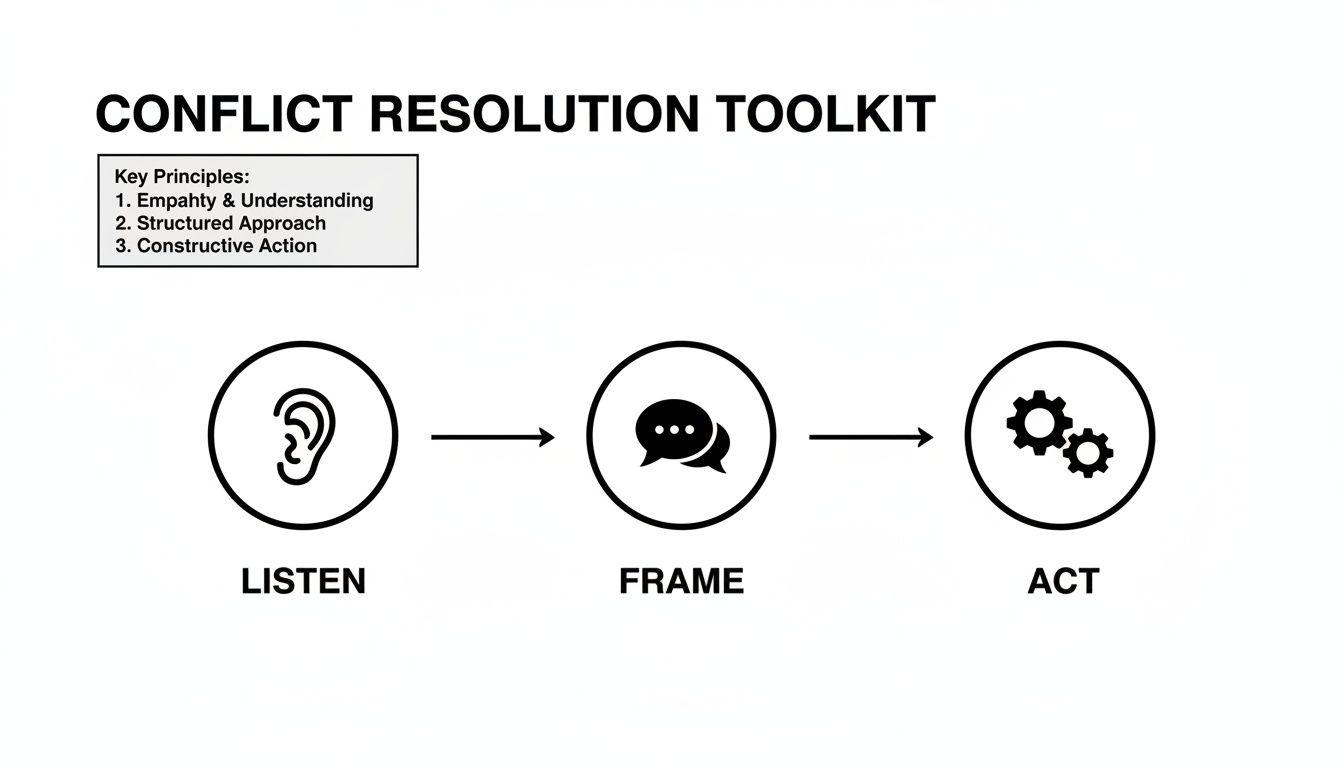
This simple framework gives you a path forward, from truly hearing the issue to shaping the conversation and, finally, to taking real, concrete steps toward peace.
Navigating The 9 Enneagram Types In A Disagreement
Every Enneagram type has predictable triggers and responds to specific de-escalation tactics. Knowing these patterns ahead of time is like walking into a negotiation with the other person’s playbook.
Let’s run through a couple of the trickier types:
• Dealing with a Type 8 (The Challenger): • These folks are all about autonomy, directness, and control. In a conflict, their biggest fear is being controlled or steamrolled. The only way in is to be straight-up. No sugarcoating. Try something like, "I respect your ownership of this. My goal isn't to undermine you, but to find a solution. What do you need from me to feel secure moving forward?"
• Mediating with a Type 2 (The Helper): • Their entire world is built on being needed and appreciated. For them, conflict feels like a brutal personal rejection. They need reassurance, stat. Start with, "I really value how much you pour into this team. Your support means everything. Let's talk this out so we can get back on track."
“Conflict is rarely about the topic at hand. It's almost always about an underlying, unmet need. The Enneagram gives you a map to find that need."
By tweaking your language, you show people you respect their worldview. Their defenses drop, and suddenly, they’re open to a solution. Deepening your knowledge with resources on the Enneagram for business leaders can give you an even richer playbook for these delicate moments.
To make this immediately useful, I've put together a quick-reference guide. Think of it as your in-the-moment cheat sheet for diagnosing and responding to conflict based on your team's unique personalities.
Enneagram Conflict Response Quick Guide
Here’s a breakdown of what typically triggers each Enneagram type and how you, as their manager, can guide them back to common ground.
| Enneagram Type | Common Conflict Trigger | Effective Management Approach |
|---|---|---|
| Type 1 The Reformer | Perceived sloppiness, ethical breaches, or others not following the rules. | Appeal to their sense of fairness and high standards. Acknowledge the "right" way to do things and focus on creating a better system. |
| Type 2 The Helper | Feeling unappreciated, taken for granted, or having their help rejected. | Start with reassurance and appreciation. Frame the resolution around maintaining positive relationships and meeting the team's needs. |
| Type 3 The Achiever | Public failure, obstacles to their goals, or feeling inefficient and unproductive. | Focus on the shared goal and a successful outcome. Frame the conversation around efficiency and winning as a team. Avoid public criticism. |
| Type 4 The Individualist | Feeling misunderstood, dismissed as "too emotional," or being forced into conformity. | Acknowledge their unique perspective and feelings. Give them space to be heard fully before jumping to solutions. |
| Type 5 The Investigator | Intrusions on their time and energy, feeling incompetent, or having demands made without enough information. | Provide data and logic. Give them time to process alone. Approach them calmly and factually, respecting their boundaries. |
| Type 6 The Loyalist | Unpredictability, lack of clear guidance, or feeling unsupported by authority. | Be transparent and clear about the plan. Offer reassurance and worst-case scenario planning to build their sense of security. |
| Type 7 The Enthusiast | Feeling trapped, limited, bored, or forced to dwell on negative issues. | Keep the conversation future-focused and solution-oriented. Frame the resolution around creating new possibilities and positive outcomes. |
| Type 8 The Challenger | Feeling controlled, betrayed, or that their power is being challenged. | Be direct, confident, and respectful. Do not try to control them. Frame the solution in terms of mutual strength and respect. |
| Type 9 The Peacemaker | Pressure, tension, and direct confrontation that disrupts their inner harmony. | Create a calm, non-threatening environment. Mediate gently and ensure their voice isn't lost. Focus on restoring harmony for everyone. |
Once you start using this lens, you stop being a referee in a frustrating game and become a skilled coach. You understand what makes each player tick. And what's more, you can turn a dreaded confrontation into a genuine opportunity to build a stronger, more connected team.
Turning Conflict Management Theory Into Instinct
Reading about conflict management is one thing. Actually feeling cool and confident when two of your best people are throwing daggers with their eyes is a whole other ballgame. The goal isn't just to know what to do; it's to build the muscle memory so you can act on instinct when things get tense.
This is your personal training gym for building that conflict management muscle. Forget boring lectures. We're talking about a simple, actionable plan to move these skills from your head to your gut, making your response proactive and steady, not reactive and stressed.
Start with Practical Role-Playing
The single fastest way to get comfortable with uncomfortable conversations is to practice them when the stakes are low. Don’t just think about it—grab a trusted peer, mentor, or even your partner and run through a few scenarios.
You need to feel the awkwardness, find your words, and get feedback before a real conflict blows up in your face.
Try these classic manager headaches on for size:
• The Budget Battle: • You’re the mediator. Your sales lead needs more travel budget, but your marketing lead needs it for a critical ad campaign. Let your partner really dig in and defend their position. See how it feels.
• The "That's Not My Job" Standoff: • Practice a chat with two team members who are passing the buck on a crucial task nobody wants. Your mission? Guide them to a place of shared ownership without just laying down the law.
• The Chronically Defensive Employee: • Time to address a recurring issue, like chronic lateness, with an employee who always has a list of excuses. Practice staying calm, firm, and laser-focused on the behavior, not the justifications.
Make Reflection a Habit
After any disagreement, big or small, take five minutes to journal. Seriously, just five minutes. This isn't about writing a novel; it's a quick, honest debrief with yourself. Self-reflection is the secret sauce that turns raw experience into genuine wisdom.
Use these prompts to get started:
• What was the • real • issue simmering under the surface?
• At what point did the conversation get heated (or productive)? Why then?
• What's one thing I would do differently next time?
This simple habit trains your brain to spot patterns, recognize your own triggers, and refine your approach over time. You’ll be amazed at what you uncover.
"Confidence in conflict doesn't come from avoiding it. It comes from having a game plan, practicing the moves, and learning from every single round."
Seek Honest Feedback
Here's a tough truth: you can't see your own blind spots. After you’ve handled a real-world disagreement, find a mentor or a trusted manager you respect and ask for their unvarnished opinion.
Be specific. Don't just ask, "How did I do?" Instead, try something like, "I had to talk to Sarah about her negative tone in team meetings. I tried to focus on the impact it had on the team. Did that come across clearly, or did it sound like I was attacking her personally?" This kind of targeted feedback is pure gold for your growth.
The power of practice is undeniable. It's shocking that approximately 60% of U.S. employees have never received basic conflict management training, but the results for those who have are staggering. An incredible 95% of those who complete such training report it positively helped them navigate workplace disputes. If you're curious, you can explore more on the transformative impact of conflict resolution programs and see how they equip leaders with these vital skills.
Answering Your Burning Conflict Questions
Alright, you've got the theory down, you understand the Enneagram, and you have a game plan. But we all know that when the heat is on, theory goes out the window. Real-world conflict is messy. It's full of curveballs and those "what now?" moments.
Let's get into the nitty-gritty and tackle the questions that inevitably pop up when you're trying to put out a fire.
What's The Very First Thing I Should Do When A Conflict Blows Up?
Hold on. I know your first instinct is to grab everyone involved, shove them into a conference room, and force a resolution. Don't do it. That’s just asking for a public brawl.
Your first, and most important, move is to talk to each person separately and in private . This one simple action completely changes the game.
It gives each person a safe space to tell their side of the story without getting defensive or cut off. Your job in these initial chats isn't to play judge and jury. It’s to shut up and listen. Absorb their perspective, understand their frustration, and let them vent. For example, if two designers are arguing heatedly over a logo, pull them aside individually. Listen to Designer A's concerns about brand consistency and Designer B's points about modernization. This allows you to gather all the facts without them interrupting each other.
By giving each person the floor one-on-one, you instantly lower the emotional temperature. You're also gathering the crucial intel you'll need to guide a productive group conversation later on.
How Do I Deal With A Conflict When I'm Actually Part Of The Problem?
This is a tough one. It’s incredibly awkward, but pretending the power dynamic doesn't exist is a rookie mistake. You're the boss, and that fact is the elephant in the room. You have to address it head-on.
Kick off the conversation by immediately leveling the playing field. Try something like, “Look, I know I’m your manager, but for this conversation, I need us to be equals. My goal here is to solve this with you.” This signals you're putting fairness ahead of your title.
From there, stick to a few ground rules:
• Talk about your own feelings: • Use "I" statements. Instead of pointing fingers with "You missed the deadline again," try "I'm feeling concerned about our project timeline." It’s about your experience, not their failure.
• Focus on the problem, not the person: • Frame the whole thing as a shared business challenge. It's "us vs. the problem," not "me vs. you."
• Call in a referee: • If the tension is thick enough to cut with a knife, prove you’re serious about a fair outcome. Ask an HR partner or another manager you both trust to facilitate the conversation. It shows you care more about getting it right than • being • right.
What If I've Tried Everything And The Team Is Still A Toxic Mess?
Look, sometimes you can do everything right and still fail. You can mediate, set clear expectations, and offer all the support in the world, but the conflict just keeps festering and poisoning the whole team. When that happens, your job description changes. You’re no longer a mediator; you’re a decision-maker.
At this point, you have to be decisive to protect your team’s well-being and ability to get work done. Document every single thing you've done —every conversation, every agreement made (and broken), and every follow-up. Then, it’s time to lay down clear, firm, and non-negotiable consequences for the ongoing bad behavior.
This could mean a formal Performance Improvement Plan (PIP), moving people around to create some space, or, in the worst cases, getting HR involved for a formal intervention. Remember, your ultimate responsibility is to the health of the entire team, even when it means making an incredibly difficult call about one or two individuals.
Getting a handle on the unique motivations driving your team is the secret to stopping conflict before it even starts. The Enneagram is an incredible tool for seeing what really makes people tick. Find out your own type and encourage your team to do the same with the free, in-depth assessment from Enneagram Universe . Take the first step toward building a more self-aware and collaborative team today at Enneagram Universe .