Compassion vs Pity: Navigating the Critical Difference

Let's be real: we've all been there. You see a friend going through a tough time, and you want to say the right thing. But are you offering genuine support, or just feeling sorry for them? This is the tricky tightrope we walk between compassion and pity. While they can look alike from a distance, they couldn't be more different at their core.
At its heart, compassion is about connection. It's about seeing someone in their struggle, recognizing their humanity, and feeling with them as an equal. Pity, on the other hand, is about separation. It's a sad headshake from a safe distance, a feeling of being sorry for someone.
One empowers, the other diminishes. One says, "I see you, and we're in this together." The other whispers, "Oh, you poor thing," creating a subtle hierarchy where you're on top and they're at the bottom. The difference isn't just in the words; it's in the entire energy of the interaction.
A Tale of Two Responses
So, what does this look like in the wild? Imagine your co-worker, David, just got laid off.
• The Pity Response (Practical Example): • You rush over and say, "Oh, David, that's just horrible! I feel so bad for you. You poor guy, that company was a mess anyway." You mean well, but all David hears is that he's a victim who needs to be saved. It reinforces his powerlessness.
• The Compassionate Response (Practical Example): • You take a breath and say, "Wow, David, I'm so sorry to hear that. That's incredibly tough. Take your time, but when you're ready, I'd love to hear what's on your mind. No pressure, but I'm here if you need to vent or want a second pair of eyes on your resume." This honors his pain while trusting his resilience.
See the difference? One is a reaction to misfortune; the other is a response to a human being.
This distinction is everything. It shapes the health of our relationships and our own capacity for growth. To make it crystal clear, let's break it down side-by-side.

Compassion vs. Pity At a Glance
Sometimes, you need a quick cheat sheet to tell these two apart in the moment. This table breaks down the core differences in mindset, action, and impact.
| Attribute | Pity | Compassion |
|---|---|---|
| Mindset | Looks down from above | Connects on the same level |
| Focus | Their misfortune ("Poor you") | Their humanity ("I'm with you") |
| Feeling | Detached sorrow, feeling sorry for them | Shared emotion, feeling with them |
| Outcome | Creates distance, makes them feel small | Builds connection, empowers them |
| Action | Passive sympathy or unsolicited advice | Active listening, offering genuine help |
Ultimately, pity keeps people stuck. Compassion is the force that helps them move forward, knowing they aren't walking alone.
How Pity and Compassion Actually Rewire Your Brain
Ever wonder why a moment of pity can feel so hollow, while genuine compassion feels so connecting? It's not just in your head—or, well, it is in your head, but it goes much deeper than a fleeting feeling. These two responses trigger completely different circuits in our brains, physically changing how we think, feel, and grow.
Think of it this way: your brain is constantly learning. When you respond with pity, you're teaching it one lesson. When you choose compassion, you're teaching it a far more powerful one.
Pity is a trap. When someone gets pitied, their brain tends to hear, "You're helpless, and I agree." This reinforces neural pathways tied to shame and inferiority, essentially locking them into a victim mindset . It's like the brain’s problem-solving software just shuts down, stuck on a loading screen of powerlessness.
The Fork in the Neurological Road
Compassion, on the other hand, is the ultimate brain-booster for resilience. It lights up the parts of the brain associated with love, connection, and empathy—like the insula and anterior cingulate cortex. It sends a powerful message: "You're human, I see your struggle, and we're in this together."
The difference isn't just a feel-good platitude; it has real, measurable consequences. A 2024 analysis found that self-pity is linked to a shocking 40% higher rate of depression . Meanwhile, practicing self-compassion can improve our ability to manage our emotions by as much as 35% . The science is clear: the emotional habits we build directly impact our mental health.
Let's See This in Action
Imagine a manager, Sarah, whose team member, Mark, just missed a huge deadline, putting a whole project at risk.
• The Pity Response (Practical Example): • Sarah pulls him aside and says, "Oh, Mark, you poor thing. I know you're swamped. Don't you worry, I'll take these key tasks off your plate so you can breathe." It sounds nice, right? But the subtext is, "You can't handle this." Mark walks away feeling incompetent, and the rest of the team quietly resents having to pick up the slack.
• The Compassionate Response (Practical Example): • Instead, Sarah says, "Mark, I can see you're disappointed about the deadline. That's understandable. Let's sit down and walk through what happened. I want to understand the roadblocks you hit so we can create a new game plan together. What do you need from me to get us back on track?" This response validates his struggle but empowers him to find a solution. It builds trust, not dependency.
Learning to make this shift from pity to compassion is a cornerstone of high emotional intelligence. When you understand what’s happening in the brain, you can consciously choose the response that builds people up instead of quietly tearing them down. If you're ready to master these kinds of skills, you'll want to check out our guide on how to increase your EQ .
Your Enneagram Type's Secret Default: Pity or Compassion?
If you’re using the Enneagram for real self-discovery, you’ve got to get honest about your emotional autopilot. The whole compassion vs. pity debate gets intensely personal when you see it through the lens of your type, revealing the automatic, and often unconscious, ways you show up in your relationships.
Each Enneagram type has its own flavor of expressing—or totally bungling—these two powerful emotions. Your type’s deep-seated motivation is what decides whether you offer a hand-up (that’s compassion) or a handout from a pedestal (that’s pity). Pinpointing these knee-jerk reactions is your first real step toward building connections that don't just feel good, but are good.
This is what’s happening in the brain when these two responses fire off.
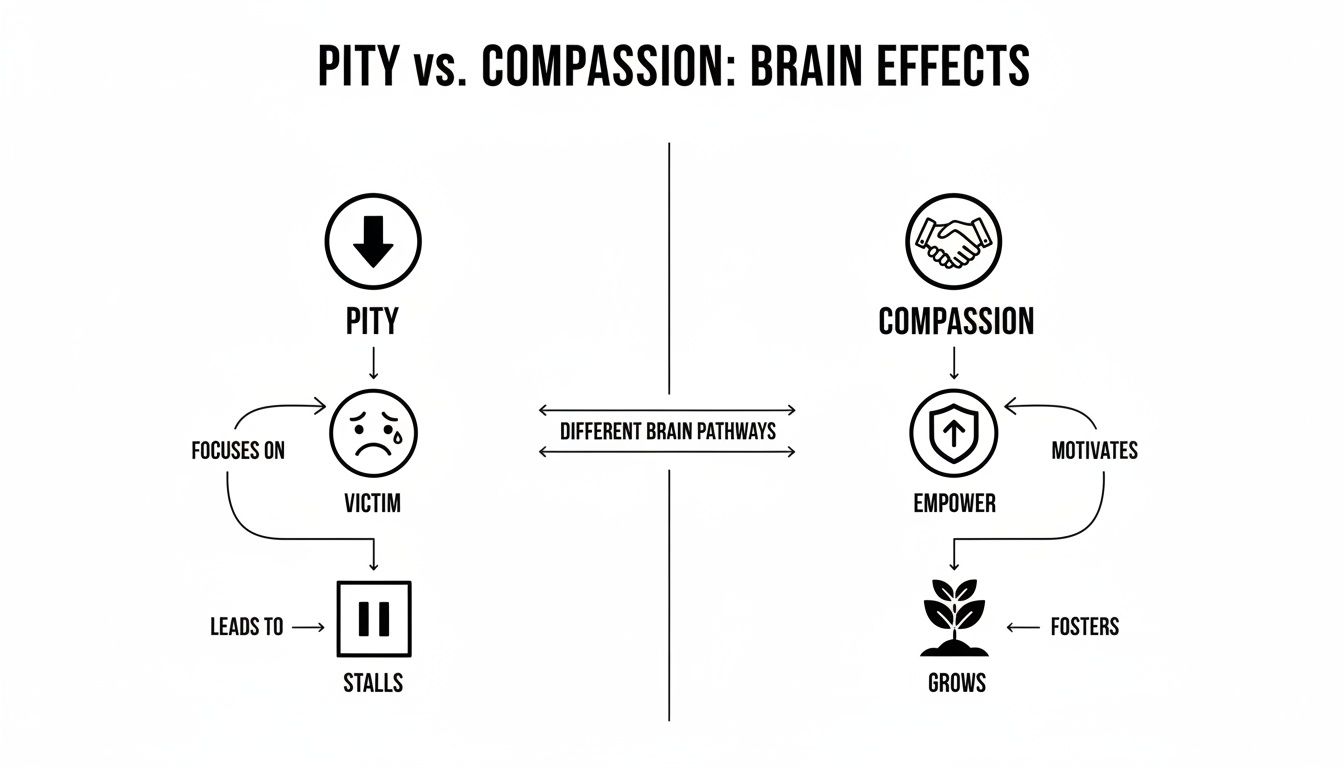
It’s pretty clear, right? Pity keeps people stuck in a story where they’re the victim, stalling out any real progress. Compassion, on the other hand, flips the script and fuels growth.
How the 9 Types Show Up in a Crisis
Let’s get practical. Imagine a friend, Alex, just got laid off and is completely drowning in financial stress. Here are practical examples of how different Enneagram types might show up.
The Helper (Type 2): A Two might rush in, declaring, "Oh, you poor thing, don't you worry about a single thing! I'll cover your rent this month." It sounds incredibly generous, but it can easily come from a deep-seated need to be needed, which ends up making Alex dependent. It’s pity dressed up as help, and it perfectly reinforces the Two’s identity as the indispensable giver. We talk more about this pattern in our full guide to the Enneagram Type 2 personality .
The Challenger (Type 8): Forget the hand-holding. An Eight is going to cut right to the chase. Their response would be blunt and all about action: "Okay, this is awful. Let's list your contacts, I'll make some calls, and we're getting your resume blasted out by Friday." This is a kind of tough-love compassion. It fully respects Alex’s strength while offering a bulldozer to clear the path.
The Individualist (Type 4): A Four is at risk of diving headfirst into the feeling with Alex. They might say, "I know exactly how crushing that is. When I was in that dark place..." Suddenly, the conversation can become less about Alex’s pain and more a reflection of the Four’s own relationship with suffering. It's a blurry, tricky line between shared empathy and self-referential pity.
Shifting from Autopilot to Action
The magic of the Enneagram is that once you see your pattern, you can choose a better way. A self-aware Type 2 can learn to pause and ask, "What kind of support would actually feel empowering to you right now?" instead of just writing a check. A mindful Type 8 can learn to say, "This must feel terrible," before jumping into battle mode.
Here are a few more practical examples for other types:
• Type 1 (The Reformer): • The pity trap for a One is fixating on the injustice ("That company was so unethical!"). Their compassionate move is to help Alex create a killer budget and a meticulously structured job-search plan.
• Type 5 (The Investigator): • A Five’s pity can look pretty detached—analyzing the economic trends behind the layoff. Real compassion is when they use their research superpowers to find valuable leads and insider contacts to empower Alex’s search.
• Type 9 (The Peacemaker): • The Nine's default can be a kind of passive pity, offering a placating, "Don't worry, it will all work out," just to sidestep the uncomfortable feelings. True compassion for a Nine means sitting with Alex in that messy discomfort, listening without trying to fix or smooth it over.
When you recognize your own default setting, you can start using your Enneagram insights to intentionally shift from a fleeting reaction of pity to a powerful, connecting act of compassion.
The Ripple Effect in Your Relationships
Make no mistake: choosing between pity and compassion isn't just a mental exercise. It sends shockwaves through your relationships, defining whether they flourish or fizzle out. This single distinction can determine the entire future of a friendship, a family bond, or a romantic partnership.
Think of pity as the quiet poison in a relationship. It creates a subtle but toxic power dynamic: one person becomes the capable "fixer," and the other is demoted to the "broken" one. This can make the person on the receiving end feel patronized, small, and utterly powerless. Over time, that feeling curdles into resentment, eating away at the very trust a healthy connection needs to survive.

Compassion , on the other hand, is all about partnership. It’s the voice that says, "I see you're hurting, and I see your strength to get through this. I’m right here beside you, not to carry you, but to walk with you." This approach builds an unbreakable foundation of mutual respect and deepens intimacy. It creates a safe harbor where you both can be real and vulnerable, without ever fearing judgment.
Chronic Illness: A Relationship Stress Test
Let’s put this into a real-world context. Picture a couple, Maya and Tom. Their world gets turned upside down when Tom is diagnosed with a chronic illness, bringing a new reality of fatigue and unpredictability into their home. Here are two practical examples of how that can play out.
A Partnership Built on Pity (Practical Example): In this scenario, Maya goes into overdrive. Her immediate reaction is, "Oh, you poor thing. Don't you lift a finger. I'll take care of everything." She starts canceling their plans without even asking him and takes over every single chore, wrapping him in cotton wool. While she thinks she's being loving, Tom starts to feel less like a partner and more like a patient—a burden. He begins to resent her well-meaning pity because it robs him of his sense of self.
A Partnership Built on Compassion (Practical Example): Now, let's rewind. This time, Maya’s first move is to just sit with Tom. She takes his hand and says, "Okay, this is our new normal. We’re going to figure it out together. What does a good day look like for you now? And on the bad days, what’s the best way I can support you?"
See the difference? This compassionate approach keeps them on the same team, battling the illness together instead of each other. They adapt their lives as a unit, discovering new ways to connect. Tom feels seen, respected, and empowered. Maya feels like a true partner, not a martyr. Their bond doesn't just survive; it grows stronger and more resilient. This is a powerful lesson in what it takes to foster a lasting connection. To dive deeper into this, check out our guide on building relationship skills .
From Pity to Power: Your Guide to Cultivating Real Compassion
So, you're ready to ditch that hollow feeling of pity and step into the power of genuine connection? Fantastic. But let's be real: moving from pity to compassion isn't like flipping a switch. It's more like training a new muscle—one that requires patience, intention, and a bit of practice.
The good news? Anyone can build this muscle. It’s not about suddenly becoming some perfect, saintly figure. It’s about taking small, deliberate steps to see people as equals, which empowers them and you along the way.

Tune In with Active Listening
The journey away from pity starts with one simple action: closing your mouth and opening your ears. Pity is always itching to jump in with quick-fix solutions and snap judgments. Compassion, on the other hand, just wants to understand. That’s where active listening comes in.
Practical Example: A friend is melting down about a recent breakup. Your pity impulse is to immediately say, "Well, here's what you should do..." Instead, just create space. Let them talk, vent, and stumble through their thoughts. Your quiet presence is often a far more powerful gift than your advice because it says, "I respect your experience."
Ask Questions That Empower, Not Diminish
Pity loves to make assumptions. It whispers things like, "Oh, you must be devastated." Compassion stays curious and asks questions that hand the power right back to the person who's struggling.
Practical Examples: Next time, try these simple shifts:
• Instead of saying: "You poor thing, let me take care of that."
• Try asking: " • What would feel most helpful to you right now? • "
• Instead of reacting with: "I'm so sorry, that's just awful."
• Try asking: " • I'm here for you. What's on your mind? • "
This approach honors their ability to navigate their own life. It positions you as an ally walking beside them, not a savior swooping in from above.
Protect Your Energy with Healthy Boundaries
There's a common fear that deep compassion inevitably leads to burnout. That only happens when you confuse compassion with sponging up someone else's pain. The secret to sustainable compassion is setting healthy boundaries.
Practical Example: You might say to a friend, "I can give you my full attention for the next 20 minutes before I have to run," or, "I care about you so much, but I don't have the capacity to solve this for you." Protecting your energy isn't selfish. It’s the very thing that ensures you can keep showing up for others from a place of genuine strength. And just as importantly, you have to cultivate self-compassion to make sure your own well never runs dry.
Untangling the Knot: Your Compassion and Pity Questions Answered
Even when you get the definitions straight, telling compassion and pity apart in the heat of the moment can feel like trying to nail Jell-O to a wall. Let's dig into some of the most common head-scratchers people run into when they're trying to put these ideas into practice.
Can You Feel Both Pity and Compassion at the Same Time?
Oh, absolutely. In fact, this is one of the biggest tripwires. It’s incredibly common to feel that initial flash of pity—that gut-level reaction of, "Oof, that poor soul." The magic isn't in avoiding that feeling; it's in what you do next.
Practical Example: You see a news story about a family who lost their home in a fire. Your first feeling might be a distant sorrow (pity). But then you take action—donating to their fundraiser or sharing a link for aid. That shift from passive feeling to active support is moving from pity to compassion.
How Can I Be Compassionate Without Getting Totally Drained?
This is where boundaries become your absolute best friend. Compassion doesn't mean you have to hoist someone else's entire emotional world onto your shoulders. That's a recipe for burnout. Real compassion is about offering support from a place of strength, not sacrifice.
You can be an incredible, compassionate listener without making yourself responsible for "fixing" their problems. Sometimes the most powerful acts of compassion are simply validating their feelings, offering a bit of practical help, or pointing them toward useful resources—all of which protect your own energy.
When dealing with tricky family dynamics, for example, having a solid framework can make all the difference. Using a compassionate guide to talking to parents about getting help helps you navigate these delicate conversations from a place of support, not control. Understanding this distinction is key to a constructive outcome.
Is It Actually Wrong to Feel Pity for Someone?
Pity isn't inherently "bad" or "wrong"—it's just a raw human emotion. The trouble starts when we act from a place of pity, because it almost always comes across as condescending and creates a chasm in the relationship.
The real issue is when pity becomes your default setting for relating to someone's pain. The aim isn't to surgically remove the feeling of pity from your emotional toolkit. It's to consciously upgrade it into compassion, which is far more connecting, respectful, and genuinely helpful for everyone involved.
Ready to decode your own emotional patterns and build stronger, more authentic relationships? The Enneagram Universe assessment is your first step. Discover your type, learn your unique strengths, and get actionable insights to move from pity to real compassion. Take our free, scientifically validated test today at Enneagram Universe .