Solving Communication Problems in the Workplace for Good

Ever feel like your team is playing a corporate game of telephone? You know, the one where a simple request gets passed along and ends up as something completely unrecognizable? That's the sound of communication problems in the workplace , and it's not just frustrating—it's a silent killer of productivity and profit.
The Silent Epidemic Costing Your Business Millions
Think back to the last project that went completely off the rails. Was it a lack of skill or a bad strategy? I doubt it. Chances are, it was a simple misunderstanding that snowballed into a full-blown catastrophe.
It starts small. A vague email from a manager in New York to a developer in Austin. A critical update is buried in a chaotic Slack channel. Two departments are accidentally building the same thing. For example, the marketing team might launch a new product campaign without realizing the product development team pushed the release date back by a month, wasting budget and creating customer confusion. These aren't just minor hiccups; they're the tiny cracks that eventually cause major organizational earthquakes. When communication breaks down, teams stumble, deadlines slip, and even your best people start to feel disconnected and frustrated. It's an invisible tax on every single thing your company does.
The Staggering Financial Drain
Let's talk numbers, because they're absolutely mind-boggling. Poor communication isn't just an HR issue; it's a massive financial leak. Recent research reveals that U.S. companies are collectively hemorrhaging $1.2 trillion annually due to communication breakdowns.
Think about it on a smaller scale. A single senior employee earning 200,000 can cost their company around ** 54,860** every year, wasting an average of 63 workdays trying to decipher unclear directions and deal with misaligned expectations. If you want to dive deeper, you can explore the full financial impact of these communication gaps to really see how the costs add up.
This isn't just fuzzy math. It’s a direct hit to your bottom line.
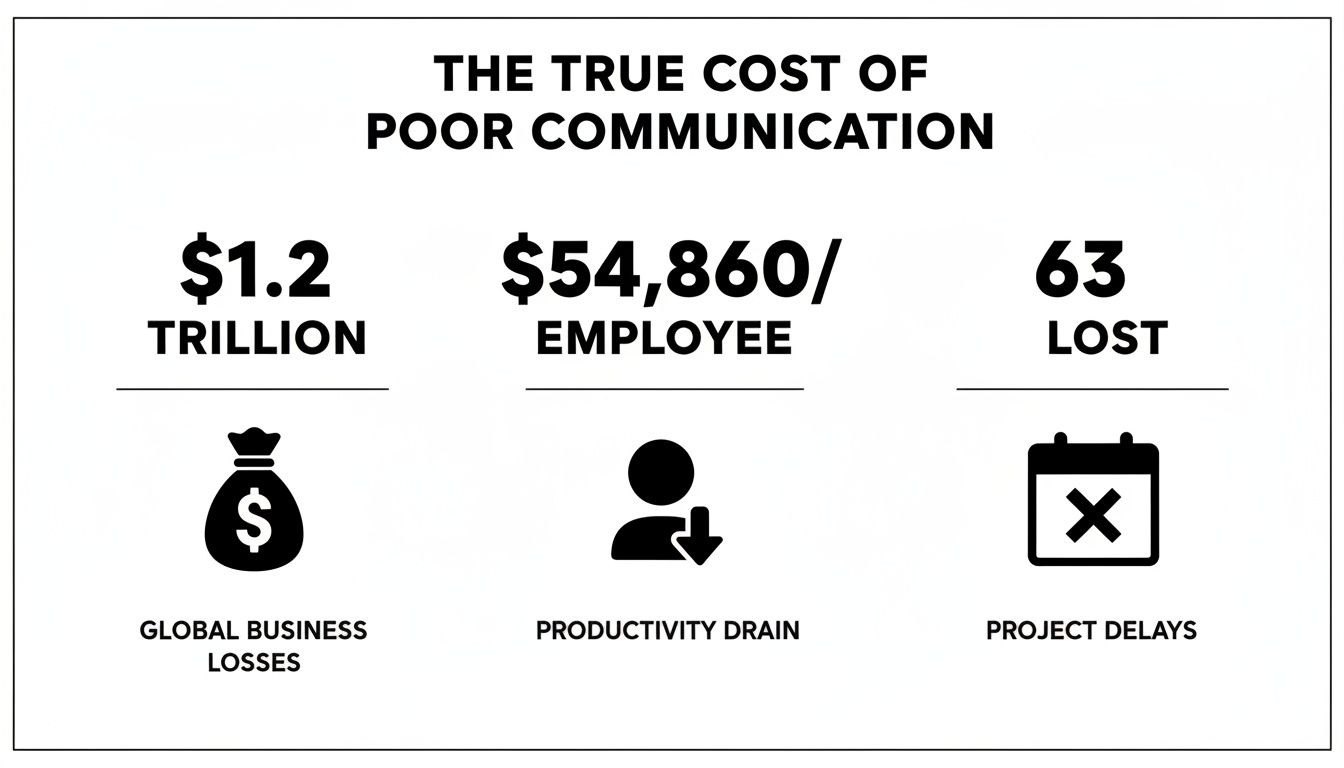
As the data clearly shows, what feels like a minor misstep is actually a firehose of cash flowing right out the door, day after day.
How Small Frictions Create Big Problems
So, where does all that money go? It gets eaten up by the friction caused by everyday communication failures. These little moments of confusion compound over time, creating a ripple effect that touches every corner of your business.
Let’s look at a few common scenarios that probably sound all too familiar.
The Real Cost of Common Communication Failures
We often overlook the "small" communication issues, but their cumulative cost is staggering. The table below breaks down how seemingly minor problems translate into major financial and productivity drains for a typical mid-sized company.
| Communication Problem | What It Looks Like in Practice | Annual Cost (Example) |
|---|---|---|
| Vague Instructions | A manager asks for a report "ASAP" without defining the scope or deadline. The employee spends hours gathering the wrong data, leading to rework. | $15,000 in wasted salary and lost productivity per team. |
| Team Silos | The marketing team in Chicago launches a campaign, completely unaware the sales team in Miami is developing a similar initiative. | $50,000+ in duplicated effort, conflicting messaging, and missed collaboration opportunities. |
| Lack of Feedback | An employee consistently misses the mark but never receives clear, constructive feedback. They become disengaged and their performance suffers. | $45,000 in lost productivity, plus the high cost of turnover if they leave. |
| Inefficient Meetings | A one-hour meeting with ten people has no clear agenda. Everyone leaves confused about next steps. | $100,000+ a year in wasted salary for time spent in unproductive meetings. |
| Email Overload | Critical information gets lost in a sea of CC's and reply-alls, leading to missed deadlines and confused priorities. | $25,000 per employee in productivity lost to sorting and managing a cluttered inbox. |
These aren't just hypothetical costs; they're the real-world consequences of letting communication slide. Each one represents a leak in your organization's resources, and plugging them starts with recognizing they exist.
"The single biggest problem in communication is the illusion that it has taken place."
This isn't just a clever quote to hang on the wall; it’s a daily reality in most offices that directly translates into lost revenue and untapped potential.
This guide isn't just another fluffy article about "talking better." It’s a practical blueprint for figuring out why your messages get lost in translation and for building a workplace where clarity isn't just a goal—it's the engine that drives success.
Why Your Current Communication Strategy Is Failing
If you could fix your team's communication issues by just adding another Slack channel or scheduling more meetings, you wouldn't be reading this. Let's be honest: most of the go-to "solutions" just add more noise to an already broken system. It’s like trying to fix a clogged pipe by cranking up the water pressure—you don't get a better flow, you just get a bigger mess.
Your current strategy is probably failing because you're treating the symptoms, not the disease. You're tackling communication like it's a logistics problem when, at its core, it's a human problem.

The Myth of More Technology
So many leaders fall for it. They see a communication breakdown and immediately think a shiny new app or platform will magically solve everything. But throwing more tech at the problem often just fuels the fire, leading to that soul-crushing "death by Slack" feeling. The constant pings, the endless notifications, the conversations scattered across a dozen channels—it all creates the illusion of connection while actually sabotaging focus and clarity.
For instance, a project manager might post a critical deadline change in a busy channel, but the lead developer misses it because they've muted notifications to concentrate on coding. The deadline passes, and suddenly the project is in crisis mode, all because the technology made it too easy for information to get lost in the noise.
This isn't just a hunch; it's a well-documented headache. Research shows that 24% of companies point to unfit internal technology as a major communication barrier. It gets worse when you factor in the sheer volume of messages, which 19% of companies say is a primary issue. Important directives just get buried in the digital avalanche. If you want to dive deeper, you can discover more insights about these workplace communication barriers and see just how big the problem is.
At the end of the day, technology is just an amplifier. It makes good communication habits faster and bad ones more chaotic.
When Leadership Creates a Vacuum
Another massive failure point? A leadership vacuum. When leaders are unclear, inconsistent, or just plain quiet, they create a void. And that void gets filled—fast—with anxiety, rumors, and wild speculation. People are left guessing about company priorities, team goals, and even how they're performing in their own roles.
A practical example is when a company announces a "strategic reorganization" with no follow-up details. Employees immediately start whispering about layoffs, leading to a week of panicked speculation and zero productive work. The leader's silence, intended to prevent premature announcements, actually caused more disruption than the news itself.
This absence of direction forces teams into silos. They start making assumptions that lead to duplicated work, missed deadlines, or projects that completely miss the mark. A leader who doesn't provide clear, consistent direction is like a ship captain who refuses to tell the crew their destination. Everyone is rowing hard, but they’re not all rowing in the same direction. This isn't just bad management; it's a systemic failure that destroys trust and grinds momentum to a halt.
Without clear direction from the top, teams are forced to navigate by rumor and assumption—a recipe for organizational chaos and wasted effort.
This isn't just about the big, all-hands announcements, either. It’s in the day-to-day. A lack of regular feedback leaves employees feeling disconnected and undervalued. It's no surprise that poor people manager communication skills are a significant barrier in 18% of organizations . The leader is often the broken link in the chain.
The Clash of Communication Styles
Maybe the biggest reason one-size-fits-all strategies are doomed is that they completely ignore the most important variable: people. Everyone has a unique communication style, shaped by their personality, their background, and what drives them. Ignoring those differences is like handing out the same size shoe to the entire team and then asking them to run a marathon. It’s just not going to work.
Think about this classic workplace scenario:
• The Manager: • She's direct and all about the facts. She wants a bullet-point summary of the project status. "Just give me the bottom line," she says, tapping her pen.
• The Employee: • He's more indirect and context-driven. To him, the "why" is just as important as the "what." He starts with the background story, explaining all the nuances he thinks are critical for making the right call.
See the problem? Neither of them is "wrong," but their styles are on a collision course. The manager feels like her time is being wasted with fluff. The employee feels like his careful analysis is being dismissed and that his boss is about to make a rash decision.
This tiny, everyday mismatch, when multiplied across an entire company, is the root cause of so many chronic communication breakdowns. It's proof that a single, rigid communication playbook is destined to fail.
Unlocking Your Team's Communication Code
Here’s a little secret most managers miss: The majority of communication problems in the workplace have almost nothing to do with communication. They’re about motivation. We get so hung up on what people are saying that we completely ignore the far more important question: why are they saying it that way?
What if you could finally decode the hidden motivations driving your team's behavior? Imagine getting a user manual for each of your colleagues. That's what the Enneagram provides. It's not another fluffy personality quiz; it’s a powerful diagnostic tool for understanding the core drives that shape every single interaction at work.
The Enneagram gets right to the heart of our fundamental fears and desires—the stuff running in the background that quietly dictates how we act, react, and communicate. Cracking this code is the key to finally solving those nagging, persistent misunderstandings. If you're ready to go deeper, our guide on using the Enneagram at work is a great place to start.
From Frustration to "Aha" Moments
Let's get real for a second. Think about your typical team meeting, probably filled with a few classic personality types who mean well but are running on completely different operating systems.
You’ve got Sarah, the manager. She's a Type One , "The Reformer," and her whole world revolves around being good, right, and balanced. Her biggest fear is making a mistake. So, when she sends an email, it’s going to be precise, detailed, and perfectly structured. For her, quality is everything.
Then there's Ben, a creative on her team. He's a Type Seven , "The Enthusiast," who is motivated by the need to be happy and satisfied. He’s terrified of being bored or stuck. He communicates in big, exciting ideas, all about future possibilities. His emails are energetic and visionary… but maybe a little light on the details.
See the problem? It’s a constant source of friction. Sarah thinks Ben is sloppy and irresponsible. Ben thinks Sarah is a nitpicky micromanager who’s killing his vibe. They aren't having a communication problem; they're having a motivation clash. Sarah is wired for correctness, and Ben is wired for excitement. Without this insight, they're just going to drive each other crazy forever.
The Dynamics of Misunderstanding in Action
This kind of thing plays out in a million different ways across any office. It’s not just about one-on-one chats; it’s about the entire team dynamic. A blind spot to these core drivers is the fuel that keeps most communication problems in the workplace burning.
Consider another classic pairing:
• The Type Eight "Challenger": • This person needs to be in control of their own life and destiny. They're direct, decisive, and assertive. They respect strength and can't stand being controlled.
• The Type Nine "Peacemaker": • This person is driven by a need for inner stability and peace. They are agreeable, accommodating, and will do almost anything to avoid conflict and keep the peace.
So what happens when these two have to work together? Let's say David, the Type Eight manager, needs a decision on a huge project. In a tense meeting, he asks his team lead, Maria, a Type Nine, for her straight opinion. Maria senses the tension and immediately goes into peacemaking mode. "Well, both options have some really great points," she says, hoping to keep everyone calm.
David doesn't hear collaboration—he hears weakness and indecisiveness. He gets frustrated, makes the call himself, and leaves Maria feeling completely steamrolled. He needed a strong stance, but she was trying to preserve group harmony. Both were acting exactly as their personalities dictated, and the result was a total communication breakdown.
This is the 'aha' moment: The problem isn't that Maria is a 'bad' communicator. The problem is that David doesn't understand that her communication style is driven by a deep-seated need to avoid conflict, not a lack of conviction.
Developing clear and confident speaking abilities is a cornerstone of effective workplace communication, helping to overcome common hurdles. For those looking to build this essential capability, improving speaking skills through practical exercises can provide a huge boost in confidence for any personality type.
When you start seeing these interactions through the lens of motivation, you can finally move from judgment to understanding. You stop labeling people as "difficult" or "ineffective" and start seeing them as individuals with unique drivers. This shift in perspective is the first, most important step toward building a team that doesn't just talk, but truly connects.
How Poor Communication Fuels Burnout and Turnover
Bad communication doesn't just sink projects; it sinks people.
Think of your team's energy and motivation like a gas tank. Every vague instruction, every missed update, every piece of unclear feedback is a tiny, almost invisible leak. Over time, those little leaks drain the tank completely, leaving your best people with nothing left to give. This isn't just a fluffy metaphor—it's the daily grind that turns passionate employees into disengaged statistics.
The link between chronic misunderstanding and the tidal wave of employee stress is crystal clear. When people feel unheard, undervalued, or just plain confused all the time, their sense of psychological safety evaporates. This constant state of uncertainty is a fast track to total exhaustion and, eventually, the decision to just walk away.

The Human Cost of Feeling Unheard
Let me tell you about Alex. He was a whip-smart project manager at a bustling tech firm in San Francisco, bursting with ideas and ready to make an impact. But within a few months, the cracks started to show. Not in his work, but in the way the company communicated.
His manager would toss out feedback like, "This needs more polish," with zero specifics. Deadlines would suddenly change, announced in a last-minute Slack message that sent Alex scrambling to redo his entire plan. He felt like he was on an island, completely disconnected from leadership and never quite sure if his work was hitting the mark or even mattered.
The breaking point? A huge project he’d poured his heart into for weeks. He followed the initial instructions to the letter. Then, in a casual meeting, a senior leader mentioned that the project’s core goals had shifted... a month ago. No one had bothered to tell Alex. That night, he updated his resume.
Alex didn't quit because the work was hard. He quit because the emotional weight of feeling invisible and constantly having to redo his work became too much to bear.
The Psychological Toll of Ambiguity
Alex’s story is what happens when communication breaks down. A lack of clarity isn't just inefficient; it’s a massive source of anxiety. When your team doesn't know what’s expected of them, they're trapped in a state of low-grade fear, constantly worried they’re about to step on a landmine.
This ambiguity is a direct pipeline to burnout and turnover. The numbers are frankly terrifying: a recent study found that a staggering 63% of employees are thinking about quitting, with shoddy internal communication being a key reason. On top of that, 43% of employees say they've already hit a wall with burnout, stress, and fatigue directly caused by these communication failures.
When communication is clear, people feel secure. They feel empowered. When it’s a mess, they feel anxious and waste a ridiculous amount of mental energy just trying to figure out what's going on—energy that should be focused on their actual jobs.
And let's not forget the soul-crushing impact of constant rework. It grinds down even the most motivated people. Nobody enjoys spending their days redoing tasks that should have been done right the first time.
Fixing these communication gaps isn't just a smart business move; it’s a moral one. It’s about creating an environment where people feel seen, respected, and safe enough to bring their best selves to work.
Your Enneagram-Powered Communication Playbook
Alright, so you’ve got a handle on the why behind your team’s communication styles. That’s a fantastic start, but let's be honest—insight without action is just fancy trivia. It’s time to roll up our sleeves and put those "aha!" moments to work.
This isn't about vague advice like "just be a better listener." We're talking about specific, practical scripts and frameworks you can use tomorrow to turn communication breakdowns into breakthroughs. The goal is to tailor your message so it actually lands with the person you’re talking to, hitting their core motivations instead of their tripwires.

Giving Feedback That Actually Works
Let’s face it: giving feedback is one of the trickiest tightropes to walk in any workplace. A one-size-fits-all approach is a recipe for disaster because different personalities need to hear things in completely different ways.
How to Give Feedback to a Type 2 (The Helper):
A Type 2's deepest fear is being unloved or unwanted. If you lead with criticism, even if it's 100% constructive, they can hear it as a personal rejection. It shuts them down. To get through, you absolutely must affirm their value first.
• Lead with genuine appreciation: • "Maria, I am so blown away by your dedication to our clients. The positive reviews we get are a direct result of how supported you make them feel."
• Frame the feedback as a way to amplify their impact: • "To help you make an even bigger difference, I want to find a way to streamline the reporting process. It would free you up to do more of the client-facing work you excel at."
• Finish with reassurance: • "I’m so grateful you're on this team. Your contribution here is massive."
Getting Buy-In from Different Personalities
It’s the same story when you’re trying to get a "yes" on a new project. The best idea doesn't always win. The best communicated idea does. You have to speak your audience’s language.
How to Get Buy-In from a Type 5 (The Investigator):
The Type 5 is driven by a need for competence and understanding; they dread feeling helpless or overwhelmed by demands. You can't win them over with sheer enthusiasm. You have to appeal to their intellect and give them space.
• Arm them with data upfront: • Don't spring it on them. Send the research, the project plan, and the numbers • before • the meeting. This respects their need to process information privately and thoroughly.
• Stick to the logic: • "Based on the Q3 performance metrics, this strategic pivot is projected to boost efficiency by • 15% • . I’ve attached the data that backs this up."
• Give them room to think: • End the conversation with, "Take some time to dig into this. I'd really value your perspective on any potential holes you see once you've had a chance to analyze it." This speaks directly to their desire for mastery.
For leaders who want to weave these strategies into the very fabric of their management style, the next step is crucial. Our comprehensive guide on using the Enneagram for business leaders dives much deeper into these advanced frameworks.
Adapting Your Message on the Fly
Now for the real test. Imagine a client throws a last-minute curveball, forcing a major project pivot. Delivering this news poorly could ignite chaos. A smart approach, however, can turn panic into purpose.
The table below shows how you can frame the exact same message for three different personalities to keep everyone calm, cool, and collected.
Adapting Your Message for Different Personalities
| Enneagram Type | What They Need to Hear | Example Message Framing | What to Avoid |
|---|---|---|---|
| Type 1 (The Reformer) | Clarity on the 'new right way'. They need to know the revised plan is principled, orderly, and still meets high standards. | "Team, the client has updated their requirements. To uphold our standard of excellence, we're shifting our approach. Here is the new, detailed project plan and the revised quality checklist." | Ambiguity or chaos. Presenting the change as disorganized triggers their fear of making a mistake. |
| Type 3 (The Achiever) | How this pivot leads to a win. Motivated by success, they need to see the new path to victory and how it makes them look good. | "Good news! The client just gave us a huge opportunity to deliver even more value. This pivot puts us in a prime position to crush it and lock in a long-term partnership. Let's make this happen." | Dwelling on the setback or the extra work. This feels like a threat to their successful image. |
| Type 6 (The Loyalist) | Reassurance and a clear plan. Motivated by security, they fear being left without support or guidance. They need to feel safe. | "I know this change is sudden, but I have a clear plan to get us through it. I’m here to support you 100%. Here are the immediate next steps, and we’ll have daily check-ins to make sure we're on track." | Downplaying their worries or being vague. This sends their worst-case-scenario thinking into overdrive. |
See how that works? By taking a beat to consider who you're talking to, you can transform a potentially volatile announcement into a focused call to action.
This isn't about becoming a master manipulator or memorizing nine different scripts. It's about developing communication agility.
It's about learning to recognize what people really need to hear to feel seen, respected, and ready to jump in. That, right there, is the secret to solving communication problems before they ever start.
Building a Culture of Intentional Communication
Teaching individuals new skills is a fantastic start, but it's a bit like patching holes in a leaky dam. If you want a truly lasting fix, you have to rebuild the entire structure. Shifting your team from a culture of accidental miscommunication to one of intentional clarity is the final boss in this whole game, and it’s a battle leaders absolutely have to win.
This isn’t about scheduling more meetings or creating stricter email policies. Not at all. We're talking about a fundamental shift in how your entire organization values and practices communication. It’s about turning communication from a fuzzy "soft skill" into a core business strategy with a massive, tangible ROI. The goal is to create a system where clear, effective communication is the default setting, not a desperate Hail Mary pass.
Real, sustainable change is built on three pillars that completely transform how your teams interact day-to-day.
Turn Your Leaders into Communication Coaches
First things first: your leaders need to stop being just managers and start being communication coaches. Their job isn't just to assign tasks and check boxes anymore. It's to model crystal-clear communication, spot friction between team members, and actively guide people toward better habits. A manager who can’t translate high-level company strategy into a clear, motivating direction for their team is a serious bottleneck.
A practical example is a manager noticing that their direct, to-the-point feedback is causing a conflict-averse employee to shut down. Instead of getting frustrated, the manager-as-coach sits down with them and says, "I've noticed my feedback style might not be landing well. How can I share this information in a way that feels more supportive for you?"
"Communication is not just a soft skill; it’s the linchpin of effective management."
This means training them to see the personality clashes we’ve been talking about, to adapt their message on the fly for different people, and to create an environment of psychological safety. You know, a place where people actually feel comfortable asking for clarification instead of just nodding along. A leader’s most important job is making sure their team has the information and context they need to knock it out of the park.
Create a 'Communication Charter'
Next up, you have to kill the ambiguity around how your team actually talks to each other. A Communication Charter is a simple but incredibly powerful document that lays out which channel to use for which purpose. Think of it as your secret weapon against the chaos of constant notifications and lost information.
Here’s what that might look like for a tech company:
• Slack: • This is for urgent, quick-fire questions and real-time collaboration that needs a fast response. Think "fire alarm" stuff.
• Email: • Use this for formal announcements, talking to clients, and documenting big decisions that need a clear paper trail.
• Asana (or your PM tool): • This is the • single source of truth • for all things related to a project—status updates, deadlines, and task assignments. No more "Did you see my message about that?"
Just defining these simple rules of engagement can dramatically cut down on the noise and make sure critical information always gets where it needs to go.
Weave These Insights into Your Team Rituals
Finally, you need to bake these personality insights into the very fabric of your team's daily routines. Don’t let the Enneagram be a one-and-done workshop that everyone forgets about in a week. Turn it into a practical tool you use during project kickoffs, retrospectives, and team-building events.
For example, you could start a project kickoff meeting by asking, "Okay team, we have a really tight deadline on this one. What does each person need to feel supported and do their best work right now?" This tiny change invites people to voice their needs upfront, heading off the exact kind of misunderstandings that derail projects down the road.
By building this self-awareness into your core processes, you can genuinely transform your team's dynamics. For a deeper dive, our guide on how to improve workplace culture gives you a detailed roadmap.
At the end of the day, great communication is a hard, measurable business skill. When you build an intentional culture around it, you're not just fixing problems—you're unlocking the massive, untapped potential of your team.
Got Questions? We’ve Got Answers.
Still scratching your head about how to fix those nagging communication breakdowns at work? You're not alone. Let's tackle some of the most common questions that pop up.
So, What's the #1 Thing That Wrecks Workplace Communication?
If you had to point a finger at one single culprit, it’s this: a major mismatch in communication styles , fueled by expectations nobody ever talks about. We all walk around thinking our way of communicating is the default, the “right” way.
Think about it. You might have a super-direct manager from Chicago who just wants the bottom line, fast. To her, a colleague’s long, detailed emails feel like a waste of time. But that same colleague sees the manager's clipped, two-word replies as rude and unhelpful. Neither is wrong, but their clashing assumptions create a constant source of friction.
How Do I Actually Get Through to a Difficult Manager?
First, put on your detective hat. Your mission is to figure out what makes them tick. Watch them closely. Do they get excited when you hand them a spreadsheet full of data, or do they prefer a quick, informal chat to get the lay of theland? The secret is to adapt your style to match their preference.
Next, make clarity your superpower. Don't be afraid to gently confirm what you're hearing. A simple, "Okay, just so I'm crystal clear, our main focus is getting those Q3 sales leads up. Right?" works wonders. It forces everyone onto the same page and leaves no room for error.
Pro tip: After a big conversation, send a quick recap email. It creates a paper trail of what was agreed upon and kills any future "But I thought you meant..." arguments.
Can We Just Buy Some New Software to Fix Everything?
Ah, if only it were that easy. Here’s the hard truth: technology is an amplifier, not a solution . It takes good communication habits and makes them faster, and it takes bad habits and turns them into a full-blown category five hurricane.
Throwing a tool like Slack at a team that's already confused just makes the chaos happen in real-time. The software can't fix a culture of guesswork. The real fix is creating a team communication charter that spells out exactly what tool we use for what. That way, everyone knows where to go for what they need, every single time.
Ready to stop guessing and start understanding what really drives your team? The first step is to decode their communication DNA. Take the Enneagram Universe free personality assessment to get the inside scoop on everyone's core motivations and unlock real strategies for making your team click. Find your type today at Enneagram Universe .