10 Transformative Classroom Team Building Activities for 2026

Forget the flimsy trust falls and awkward human knots. While classic icebreakers have their place, today’s classrooms demand something more substantial to build a truly cohesive and collaborative learning environment. We're moving past temporary fun and into the realm of deep, sustainable teamwork. This isn't just about getting along; it's the foundational work that creates psychological safety, encourages academic risk-taking, and fuels genuine social-emotional growth. True team building transforms a room of individual students into a unified force, ready to tackle complex problems and support one another through challenges.
This listicle is your practical guide to that transformation. We're ditching the generic advice for a curated collection of powerful classroom team building activities designed to foster profound understanding, empathy, and effective collaboration. Each strategy is structured, actionable, and enriched with a unique lens: the Enneagram. This powerful personality framework helps you and your students understand the core motivations behind their behaviors, unlocking a new level of classroom management and peer-to-peer connection. To truly foster deep team building, it's essential to integrate social emotional learning (SEL) into daily classroom practices. For valuable insights and resources on this topic, consider exploring these essential resources for books about social emotional learning .
Get ready to explore activities that go beyond the surface. We will cover everything from Enneagram-informed conflict resolution circles to type-based peer mentoring systems. These aren't just games; they are strategic tools to build a resilient, high-functioning, and supportive team. Let’s dive into actionable strategies that create lasting bonds and elevate the learning experience for every single student.
1. Enneagram Type-Based Small Group Discussions
Ready to move beyond trust falls and icebreakers? This activity transforms classroom dynamics by using the Enneagram, a powerful personality framework that reveals the core motivations behind why people do what they do. Instead of just observing behaviors, students learn to understand the underlying drivers of their peers, fostering a profound sense of empathy and collaboration. This is one of the most transformative classroom team building activities for developing deep, authentic connections.
The process involves students discovering their Enneagram type and then engaging in structured discussions. You can group them by type to explore shared experiences or mix types to highlight diverse perspectives on topics like handling stress during finals, approaching group projects, or resolving conflicts. The goal isn't to label anyone but to create a common language for understanding.

How to Implement It
To get started, have students take a reliable assessment like the one from Enneagram Universe. Once types are identified, facilitate discussions with targeted prompts. For example, a high school class could use Enneagram insights to build project teams that balance the analytical depth of Type Fives with the optimistic energy of Type Sevens. A practical example would be a literature circle where a mixed-type group discusses a character's motivations. The Type Four might explore the character's hidden feelings, while the Type Eight analyzes their quest for power, leading to a richer, more comprehensive understanding for everyone.
Pro-Tips for Success
• Establish Ground Rules: • Emphasize that Enneagram types are explanations for behavior, not excuses. The framework is a tool for growth, not a box to hide in.
• Go Deeper than the Number: • Use concepts like Wings and Triads to add nuance. This avoids oversimplifying students into just nine categories and shows the dynamic nature of personality.
• Visualize the Community: • Create a classroom display showing the Enneagram symbol with student names or avatars placed on their type. This serves as a constant visual reminder of the classroom's diverse makeup.
• Debrief Effectively: • After each discussion, guide a reflection. Ask, "What did you learn about your own motivations today?" and "What surprised you about a different Enneagram type?"
By understanding their peers' core motivations and fears , students learn to communicate more effectively, appreciate differences, and build a truly cohesive and supportive classroom team.
2. Type-Motivated Challenge Projects
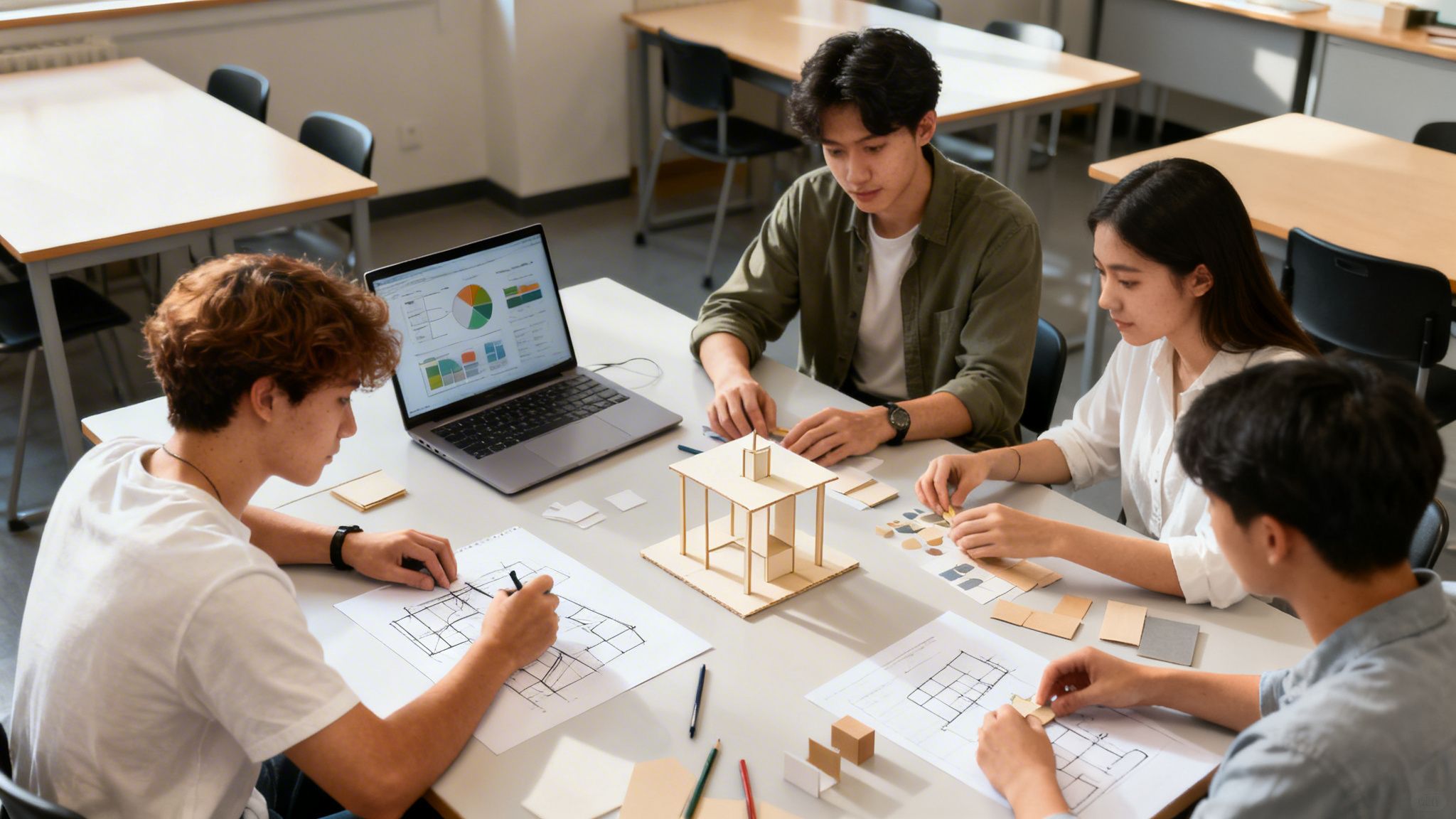
This activity turns typical group projects into dynamic challenges by assigning roles based on students' Enneagram-driven motivations. Instead of forcing students into ill-fitting tasks, you align their responsibilities with their natural strengths. This approach transforms classroom team building activities by showing students firsthand how a team thrives when every member operates from a place of authentic engagement and skill.
The core idea is to structure a project where different Enneagram types can shine. For instance, in a classroom sustainability challenge, Type Threes are empowered to lead efficiency initiatives, Type Fours drive the creative awareness campaign, and Type Eights champion the project's overall mission. By leveraging these intrinsic drives, students become more invested, productive, and appreciative of their peers' unique contributions.
How to Implement It
Start with a complex, multi-faceted project, like organizing a school-wide charity event or designing a new student-led club. Present the different roles needed for success: logistics coordinator (appeals to Sixes), creative director (Fours), lead researcher (Fives), and community outreach manager (Twos). Guide students to select roles that resonate with their Enneagram type, using their Enneagram Universe reports to identify their core strengths and motivations. For example, in a history project about the American Revolution, a Type One could be in charge of ensuring historical accuracy, while a Type Seven could create an engaging, forward-thinking presentation about its modern-day impact.
Pro-Tips for Success
• Offer Choice with Guidance: • Allow students to select their primary role but encourage them to take on a secondary role outside their comfort zone for skill development.
• Prevent Typecasting: • Rotate roles across different projects throughout the year. This ensures every student, for example, gets a chance to lead and to support, preventing them from being boxed into a single function.
• Visualize Contributions: • Create a project "dashboard" that visibly celebrates Type-specific achievements. Highlight how the Type One’s attention to detail prevented errors or how the Type Nine’s consensus-building resolved a team conflict.
• Debrief with Purpose: • After the project, lead a reflection focused on synergy. Ask, "How would this project have suffered if we only had a team of Type Sevens?" This reinforces the value of diverse perspectives.
By aligning tasks with innate motivations, you don’t just complete a project; you build a cohesive unit where every student feels seen, valued, and essential to the group’s success.
3. Enneagram-Informed Conflict Resolution Circles
Transform classroom squabbles from disruptive events into powerful learning opportunities. This activity uses the Enneagram to reframe conflict, moving beyond surface-level disagreements to address the root motivations and fears driving student behavior. Instead of just managing what happened, students learn to understand why it happened, cultivating deep empathy and equipping them with sophisticated emotional intelligence. This is one of the most impactful classroom team building activities for building a resilient and self-aware community.
The process involves gathering students in structured "resolution circles" when conflicts arise. Guided by the Enneagram, the focus shifts from blame to understanding. For instance, a Type Eight student's aggressive pushback might be reframed as a fear-based need for control, while two competitive Type Threes can be seen as driven by a shared need for acknowledgment. This insight allows for collaborative, win-win solutions rather than punishment.
How to Implement It
When a conflict emerges, facilitate a circle where each party can speak without interruption. Use the Enneagram as a lens to explore the situation. For example, if a Type Two student is perceived as overbearing, the discussion can explore their motivation to be helpful and needed, leading to new boundaries that honor their intentions while respecting others' autonomy. A practical example: two students argue over project direction. One is a Type One who needs it done "the right way," and the other is a Type Seven who wants to explore a fun, creative tangent. The circle helps them see that both goals (quality and innovation) are valid and find a solution that incorporates both perspectives.
Pro-Tips for Success
• Train Peer Mediators: • Use reliable assessments from a source like Enneagram Universe to equip student mediators with the credibility and knowledge to guide these circles effectively.
• Create a Safe Space: • Establish a neutral ground rule that everything shared within the circle is for understanding, not judgment. This encourages vulnerability and honesty.
• Use Type-Specific Language: • Encourage students to use "I statements" paired with the core emotions of their type (e.g., "As a Four, I felt insignificant when..." or "As a Six, I felt anxious because...").
• Document Resolutions: • Create simple, written agreements that acknowledge each party's Enneagram-based needs, making follow-up more personalized and effective.
By integrating Enneagram wisdom, students not only resolve immediate issues but also build lasting skills. The principles used here are powerful and extend far beyond the classroom, mirroring many professional workplace conflict resolution strategies .
4. Type-Based Peer Mentoring and Buddy Systems
Forget random pairings that fizzle out. This activity creates powerful peer mentoring relationships by strategically matching students using Enneagram compatibility. By understanding core motivations, you can pair a student who naturally offers stability with one who needs it, or a goal-oriented leader with a peer who needs help with focus. This intentional approach transforms a simple buddy system into one of the most effective classroom team building activities for fostering genuine support and individual growth.
The system works by pairing students with complementary Enneagram types. For example, a steady, patient Type Nine could be an amazing mentor for an anxious and questioning Type Six, providing a calming presence. Similarly, an organized and principled Type One could help a creative but scattered Type Four structure their ideas. The goal is to leverage natural strengths to create a supportive and balanced partnership that helps both students thrive.
How to Implement It
Start by identifying student Enneagram types through a reliable assessment. Use compatibility insights to make initial pairings. For instance, in a high school leadership program, you might pair an ambitious Type Three mentor with an enthusiastic Type Seven mentee to help them channel their energy and follow through on projects. In an elementary "buddy class," an older, nurturing Type Two could be paired with a younger, withdrawn Type Five to help them feel more connected and included during lunch and recess.
Pro-Tips for Success
• Train Your Mentors: • Equip mentors with knowledge about their own type's potential blind spots. A Type Three mentor, for example, should be mindful not to push their mentee based on external validation alone.
• Set Meaningful Goals: • Work with mentees to create goals that align with their type's core desire, whether it's achieving security (Type 6), feeling valuable (Type 3), or maintaining peace (Type 9).
• Provide Structure and Supervision: • Schedule regular check-ins with mentors to troubleshoot challenges and celebrate small wins. This reinforces the program's value and supports the mentors.
• Plan for Graduation: • Establish clear exit criteria for the partnership. This allows the mentee to develop independence and potentially become a mentor themselves, creating a sustainable cycle of peer support.
By using Enneagram insights to create these purposeful connections, you build a classroom culture where students not only support each other but also learn to appreciate the unique strengths found in different personality styles.
5. Communication Style Workshops Using Enneagram Triads
Ever wondered why some students jump straight to action, others need to process every detail, and a third group focuses on how everyone feels? This workshop demystifies those differences by introducing the Enneagram Triads: Instinctive (Types 8, 9, 1), Feeling (2, 3, 4), and Thinking (5, 6, 7). This approach goes beyond basic communication tips, teaching students to recognize and adapt to these core decision-making centers in themselves and others. It’s one of the most practical classroom team building activities for reducing friction and building mutual respect.
The activity involves teaching the three Triads as distinct communication styles. Students learn how each center processes information, makes decisions, and reacts under pressure. This framework equips them with a powerful lens to understand why a peer might prioritize logical consistency (Thinking) over emotional harmony (Feeling) or immediate action (Instinctive), leading to more effective and empathetic collaboration.
How to Implement It
Start by introducing the three Triads and their core concerns: control and impact for Instinctive types, connection and image for Feeling types, and certainty and security for Thinking types. A practical example: during a debate on school uniforms, Feeling types might focus on how uniforms impact self-expression, Thinking types could research data on safety and cost, and Instinctive types might argue about issues of personal freedom and control. Recognizing these different approaches helps students build a more complete argument.
Pro-Tips for Success
• Visualize the Triads: • Create posters for each Triad, outlining its strengths, challenges, and core questions. This serves as a quick reference during group work.
• Normalize Differences: • Teach students the phrase, “I’m accessing my [Triad] center right now.” This simple script gives them a non-judgmental way to explain their perspective.
• Build Balanced Teams: • Intentionally create mixed-Triad project groups. Afterward, lead a debrief session focused on how their different styles created a more robust outcome.
• Model the Language: • Use Triad terminology in your own classroom management. For example, say, "Let’s use our Thinking center to analyze this problem before we jump to a solution."
By understanding the Enneagram Triads, students learn that different approaches are not just valid but valuable. They develop the agility to communicate across these styles, transforming potential conflicts into opportunities for deeper collaboration and creating a more dynamic classroom team.
6. Enneagram-Based Strengths Spotting and Affirmation Circles
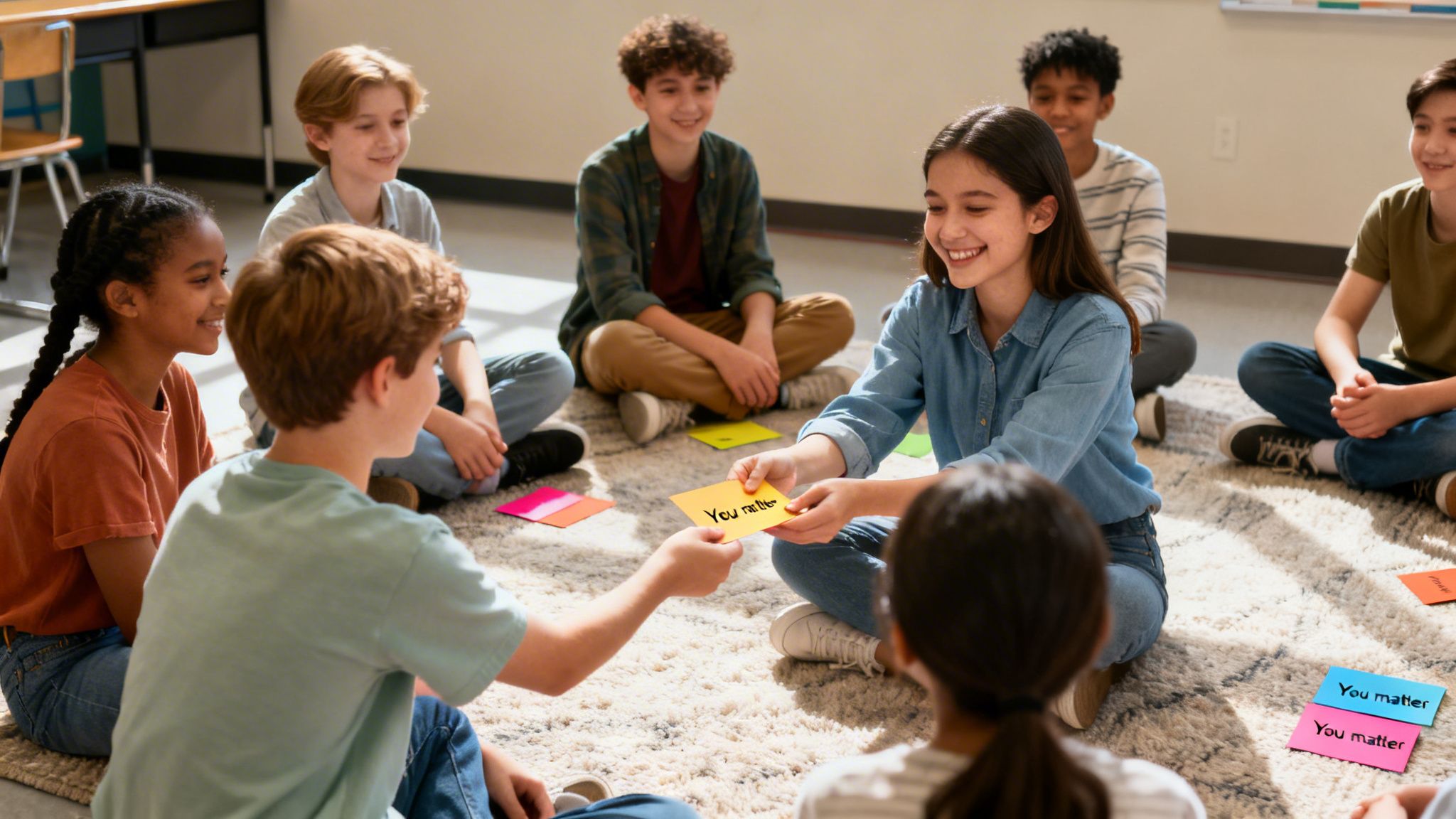
This activity takes compliments to a whole new level by moving from generic praise to specific, meaningful acknowledgment. Using the Enneagram, students learn to see and affirm the unique, type-based strengths of their peers. Instead of saying "you're smart," a student might say, "I appreciate how your Type Five mind sees details no one else does." This practice builds profound self-esteem and fosters a culture where every student’s core gifts are recognized and valued, making it one of the most impactful classroom team building activities for creating a supportive environment.
The core idea is for students to sit in circles and, armed with knowledge of the Enneagram, share affirmations grounded in each person's type. This teaches them to look beyond surface-level traits and appreciate the underlying motivations and natural talents of their classmates. The goal is to create an atmosphere where students feel truly seen for who they are, strengthening peer relationships and building a resilient classroom community.
How to Implement It
Start by facilitating small group circles where students have learned each other's Enneagram types. You can implement a weekly spotlight where one student is the focus, and peers share type-aligned observations about their positive contributions. For example, a classmate might tell a Type Two, "Your ability to sense when someone needs help makes our group feel so supported." Another powerful method is having students create "Type Appreciation" cards for each other, detailing the specific strengths they value, such as writing on a card for a Type Six: "Thanks for always thinking ahead and making sure our project has a backup plan. It makes me feel less stressed!"
Pro-Tips for Success
• Model Authentic Affirmations: • Start by giving an example yourself. Say something like, "I really appreciate Michael's Type One integrity; I can always count on him to do the right thing." This sets the tone for specificity.
• Frame it as "Noticing Gifts": • Emphasize that this isn't about flattery but about genuinely recognizing the unique talents each person brings. This encourages authenticity and deepens the impact.
• Ensure Full Participation: • For larger classes, use small groups to ensure every student receives meaningful attention. You could also use a rotating schedule for individual spotlights so no one is left out over time.
• Debrief the Experience: • After the circle, lead a discussion about how it felt to both give and receive such specific affirmations. Ask questions like, "What did you learn about your own strengths through the eyes of others?"
By focusing on the inherent strengths of each Enneagram type, this activity helps students build a powerful vocabulary for kindness and appreciation, transforming the classroom into a place of mutual respect and genuine connection.
7. Type-Aligned Classroom Roles and Responsibilities Assignments
Forget the random chore wheel that assigns the most organized student to water a plant and the born leader to sharpen pencils. This approach strategically assigns classroom roles based on students' Enneagram types, matching responsibilities to their core motivations and natural strengths. It transforms mundane tasks into meaningful contributions, ensuring that roles are intrinsically motivating and teaching the class that every type of leadership is valuable. This is one of the most practical classroom team building activities for building a community where everyone feels seen and effective.
The process involves aligning jobs with the inherent gifts of each type. Instead of a one-size-fits-all approach, you create roles that allow students to shine. For instance, a detail-oriented Type One might manage homework accountability, while an empathetic Type Two could lead a welcoming committee for new students. This teaches students to leverage their strengths and appreciate the unique skills of their peers, fostering mutual respect and operational harmony.
How to Implement It
After students discover their type using a resource like Enneagram Universe, co-create a list of classroom needs and potential roles. A middle school class could design a "Justice Committee" led by Type Eights to ensure fairness in group work, while Type Fives run the research and fact-checking hub. In an elementary setting, Type Nines might be designated "Peace Keepers" to help mediate playground disagreements, and Type Sevens could be the "Celebration Committee" planners for class parties.
Pro-Tips for Success
• Establish Balanced Roles: • Design roles that stretch students slightly. A Type Seven, who loves big ideas, could be paired with a Type Six to help plan the concrete safety details for a class event.
• Celebrate Contributions Publicly: • Acknowledge students by their role. For example, "A big thank you to our Type Four Aesthetics Team for making our classroom look so inspiring today!"
• Involve Students in Design: • Ask your class, "What does a Type Two 'Friendship Helper' do? What does success look like for them?" This gives them ownership over the system.
• Debrief and Re-Align: • Check in periodically to see if roles still fit. As students grow, their interests may change. A debrief can help re-align responsibilities with their evolving skills.
By matching roles to their core motivations and fears , you empower students to contribute authentically, building a classroom team where everyone has a vital and fulfilling part to play.
8. Enneagram-Informed Cooperative Learning Structures
Take your cooperative learning from good to great by using the Enneagram as a strategic design tool. This approach moves beyond random grouping and uses personality insights to create student teams that are intentionally balanced for both academic success and interpersonal growth. Instead of just hoping for collaboration, you architect it by understanding how different personality types process information, tackle problems, and contribute to a group. This method makes standard structures like jigsaw or think-pair-share some of the most effective classroom team building activities available.
The core idea is to use Enneagram type composition to optimize group dynamics. For example, in a jigsaw activity, you can ensure each "expert" group has a diverse mix of types, meaning the information will be understood and later taught from multiple angles: analytically, creatively, and practically. The goal is to leverage each student's natural cognitive and emotional strengths, turning potential friction into a powerful learning advantage.
How to Implement It
Start by identifying student Enneagram types using a reliable assessment. When designing a project, strategically form groups. For a history debate, you might pair a detail-oriented Type One with an assertive Type Eight and a mediating Type Nine to ensure the argument is well-researched, forcefully presented, and considers multiple viewpoints. Provide role cards that align with type strengths, such as asking a Type Five to be the "Lead Researcher" or a Type Two to be the "Team Facilitator." For a lab experiment, you could group a cautious Type Six (safety monitor), a driven Type Three (timekeeper), and a curious Type Five (data analyst) for an efficient and thorough outcome.
Pro-Tips for Success
• Make Strengths Explicit: • Create role cards that explain how each Type's contribution strengthens the group. This validates every student's approach and provides a clear purpose.
• Normalize Differences: • Teach students to say, "I'm using my Type Seven optimism to keep us motivated!" This helps them own their strengths and appreciate their peers' diverse approaches.
• Rotate Groupings: • Intentionally mix up the groups for different units. This ensures students learn to collaborate with all nine types, building their adaptability and empathy.
• Debrief with Intention: • Guide a reflection after group work. Ask, "How did our group's specific mix of Types help us solve the problem?" and "What challenges arose from our Type dynamics?"
By purposefully structuring groups, you teach students how different personalities can collaborate to achieve a common goal, a skill they will use long after they leave your classroom. These dynamics mirror professional environments, offering valuable insights into how the Enneagram functions in a work setting and preparing them for future success.
9. Enneagram-Informed Restorative Class Meetings and Agreements
This activity moves beyond a top-down list of classroom rules and empowers students to co-create their own community agreements. By using the Enneagram as a shared language, students discuss norms, address conflicts, and define what a healthy classroom culture looks like from nine different perspectives. This approach builds deep buy-in and teaches democratic problem-solving, making it one of the most effective classroom team building activities for fostering genuine respect and accountability.
The process involves regular class meetings where students collaboratively define core values like fairness, creativity, and safety through the lens of their Enneagram types. For instance, a discussion on "respect" might reveal that for a Type Nine, it means avoiding conflict, while for a Type Eight, it means being direct and honest. The group then works to create an agreement that honors both needs, building a truly inclusive environment.
How to Implement It
Start by teaching the basics of the Enneagram so students have a common vocabulary. Then, facilitate a restorative meeting using a talking circle format to establish initial agreements. For example, when creating project guidelines, a Type One’s need for fairness can lead to clear rubrics, a Type Three’s drive for efficiency can ensure realistic timelines, and a Type Seven’s desire for fun can inspire creative presentation options. When establishing rules for classroom discussion, the group might agree to "allow time for silent reflection" to support the internal processing of Type Fives, and to "make space for passionate viewpoints" to honor the expression of Type Fours.
Pro-Tips for Success
• Create a Visual Charter: • Document the co-created agreements on a large poster. Frame each rule by referencing the Enneagram needs it honors, such as, "We value direct feedback (for our 8s) delivered with kindness (for our 2s)."
• Use Structured Protocols: • Implement formats like round-robin discussions or talking circles to ensure all voices are heard, preventing more assertive types from dominating the conversation.
• Frame Conflicts as Learning: • When a disagreement arises, use the next class meeting to address it as a community learning opportunity. Ask, "Which of our agreements was challenged here, and how can we strengthen it?"
• Revisit and Revise: • Community needs evolve. Schedule time each quarter to review the agreements. Ask students if the rules still serve the group or if they need to be adjusted as the team matures.
By using Enneagram insights to build their social contract, students learn to navigate diverse perspectives and advocate for both their own needs and the well-being of the group, creating a resilient and self-aware classroom team.
10. Health Level-Informed Scaffolding and Differentiation
Forget one-size-fits-all support. This advanced approach uses the Enneagram Health Levels to provide hyper-targeted scaffolding and differentiation, meeting students exactly where they are on their emotional and developmental journey. Instead of just knowing a student's type, you understand their Direction of Stress (where they go in unhealthy states) and Direction of Growth (their path to health). This allows you to respond to their actual needs in real-time, making it one of the most impactful classroom team building activities for fostering resilience and individual growth.
The core idea is to recognize when a student’s behavior signals a move into stress and provide the right support to guide them back toward health. A Type 7 student who suddenly becomes scattered and escapist mid-semester isn't just "being lazy"; they're showing signs of stress. By providing structure and helping them focus, you address the root cause, not just the symptom. This nuanced understanding transforms classroom management into genuine mentorship.
How to Implement It
Start by familiarizing yourself with the Stress and Growth arrows for each Enneagram type. When you notice a student exhibiting stress behaviors, intervene with targeted support. For a Type 1 student becoming rigid and overly critical under pressure, the teacher can model self-compassion and introduce activities that embrace nuance and flexibility. A practical example: if a helpful Type Two student becomes resentful and starts complaining about being unappreciated (a move to Eight in stress), you could offer them a leadership role that is explicitly acknowledged by the class, meeting their core need to be valued and redirecting their energy positively.
Pro-Tips for Success
• Use Empathy, Not Judgment: • Frame stress behaviors as signals for help. Say, "I notice when you're stressed, things get tough in this way. Let's work together on it," instead of a punitive response.
• Teach Self-Awareness: • Introduce Health Level concepts in age-appropriate terms. Talk about "stress-mode" and "growth-mode" so students can learn to recognize these patterns in themselves.
• Celebrate Growth Explicitly: • When a student demonstrates a growth behavior, acknowledge it. For a Type 4 moving toward Type 1's principled action, you might say, "I love how you channeled your feelings into organizing that service project."
• Adjust Scaffolding: • As students move toward health and show more self-regulation, gradually reduce support to foster independence and confidence.
Enneagram Classroom Team-Building: 10-Item Comparison
| Activity | Implementation Complexity 🔄 | Resource Requirements ⚡ | Expected Outcomes 📊 | Effectiveness ⭐ | Ideal Use Cases 💡 |
|---|---|---|---|---|---|
| Enneagram Type-Based Small Group Discussions | Medium 🔄🔄 (assessment + facilitation) | Medium ⚡⚡ (assessments, teacher prep) | Increased self-awareness; improved empathy & communication | ⭐⭐⭐⭐ | SEL lessons, team-building, intro to Enneagram |
| Type-Motivated Challenge Projects | High 🔄🔄🔄 (careful role design) | High ⚡⚡⚡ (planning, differentiated resources) | Higher engagement; authentic leadership; better project quality | ⭐⭐⭐⭐ | Project-based learning, capstones, leadership labs |
| Enneagram-Informed Conflict Resolution Circles | High 🔄🔄🔄 (trained facilitators needed) | High ⚡⚡⚡ (mediator training, time) | Reduced repeat conflicts; restored relationships; empathy | ⭐⭐⭐⭐⭐ | Restorative justice, serious disputes, school climate work |
| Type-Based Peer Mentoring & Buddy Systems | Medium 🔄🔄 (matching + training) | Medium ⚡⚡ (mentor training, coordination) | Greater belonging; faster integration; mentor skill development | ⭐⭐⭐⭐ | Transition programs, peer support, retention efforts |
| Communication Style Workshops (Triads) | Medium 🔄🔄 (workshop design) | Low–Medium ⚡⚡ (materials, classroom time) | Reduced miscommunication; adaptable cross-style skills | ⭐⭐⭐⭐ | Debate, collaborative projects, communication curricula |
| Enneagram-Based Strengths Spotting & Affirmation Circles | Low 🔄 (simple format) | Low ⚡ (cards, short sessions) | Boosted self-esteem; peer recognition; stronger cohesion | ⭐⭐⭐⭐ | Community building, SEL check-ins, small groups |
| Type-Aligned Roles & Responsibilities Assignments | Medium 🔄🔄 (role inventory + choice) | Low–Medium ⚡⚡ (role guides, monitoring) | Increased engagement; reliable role fit; leadership for quiet students | ⭐⭐⭐⭐ | Daily routines, classroom management, leadership practice |
| Enneagram-Informed Cooperative Learning Structures | High 🔄🔄🔄 (complex grouping + roles) | Medium ⚡⚡ (planning, role cards) | Improved academic outcomes; richer collaboration; clearer interdependence | ⭐⭐⭐⭐ | Jigsaw labs, literature circles, STEM teams |
| Enneagram-Informed Restorative Class Meetings & Agreements | High 🔄🔄🔄 (ongoing facilitation) | Medium ⚡⚡ (meeting time, visuals) | Shared norms; community ownership; fewer behavioral issues | ⭐⭐⭐⭐ | Classroom governance, norm-setting, conflict prevention |
| Health Level-Informed Scaffolding & Differentiation | Very High 🔄🔄🔄🔄 (nuanced observation + training) | High ⚡⚡⚡ (professional development, counseling support) | Targeted support; reduced mislabeling; accelerated growth toward health | ⭐⭐⭐⭐⭐ | Individual interventions, counseling-collaboration, behavior supports |
Building Your Collaborative Classroom, One Activity at a Time
And there you have it, a veritable treasure chest of classroom team building activities designed to transform your learning space from a collection of individuals into a cohesive, collaborative powerhouse. We've journeyed through Enneagram-informed conflict circles, designed type-motivated challenge projects, and explored how understanding our core motivations can redefine everything from classroom jobs to peer mentoring. It’s a lot to take in, but remember, this isn't about implementing all ten ideas by next Tuesday.
The true magic lies in the intentionality behind the fun. These aren't just icebreakers to kill time; they are carefully constructed experiences. Each activity is a stepping stone, helping students build the essential muscles of empathy, self-awareness, and mutual respect. When you facilitate a Communication Style Workshop or a Strengths Spotting Circle, you are actively teaching students to see the value in perspectives different from their own, a skill far more valuable than any single test score.
Your First Steps Toward a More Connected Classroom
Feeling inspired but a little overwhelmed? That's perfectly normal. The key is to start small and build momentum. Think of it as a pilot program for a more collaborative culture. Here’s a simple, actionable plan to get you started:
• Assess the Vibe: • Take a moment to diagnose your classroom's current social climate. Are there frequent misunderstandings? Do certain students dominate conversations while others hang back? Your observations will point you toward the most impactful starting activity. For a class struggling with cliques, a • Type-Based Peer Mentoring • system could be revolutionary. For a group that avoids difficult conversations, the • Conflict Resolution Circles • offer a safe, structured entry point.
• Pick Your "One Thing": • Choose just one activity from this list that excites you and addresses a clear need in your classroom. Don't try to boil the ocean. Perhaps you start with assigning • Type-Aligned Classroom Roles • because it’s a simple, low-stakes way to help students shine in their natural areas of strength.
• Introduce the "Why": • Don't just spring a new activity on your students. Frame it. Explain • why • you're doing this. You might say, "We're going to try something new to help us understand each other better, which will make our group projects (and our whole year) way more fun and a lot less frustrating." When students understand the purpose, their buy-in skyrockets.
The Lasting Impact of True Teamwork
Let's be clear: integrating these deeper classroom team building activities does more than just make group work go smoothly. You are fundamentally shaping how your students will navigate the world. You are equipping them with a sophisticated emotional toolkit they will carry into future classrooms, college dorms, workplaces, and families.
By championing this work, you are creating an environment where psychological safety is the norm, allowing for greater academic risk-taking and deeper learning. Students who feel seen, heard, and valued are students who are ready to engage, question, and create. This isn't just about building teams; it's about building confident, compassionate, and capable human beings. Your classroom becomes a living laboratory for the kind of collaboration and understanding our world so desperately needs. So, take a deep breath, pick your first activity, and get ready to watch your classroom community flourish.
Ready to unlock the foundational insights that power these activities? The Enneagram Universe assessment provides the clear, comprehensive framework you need to give your students a shared language for understanding themselves and each other. Discover your students' core motivations and start building a truly collaborative classroom today at Enneagram Universe .