Can Your Personality Type Change? The Surprising Truth About Who You Are

So, let's get straight to the big question: Can your personality type actually change ? The short answer is no, not really. Your core personality type, like your Enneagram number, is the anchor. But—and this is a big but—how you live out that type can change so profoundly you might feel like a completely different person. That's where the real journey of growth begins.
Your Personality Isn't Set In Stone
For decades, the old-school thinking was that your personality was "set like plaster" by age 30 . This idea, from the legendary psychologist William James, basically said that once you hit adulthood, the person you are is the person you'll be. Thankfully, modern research paints a much more hopeful and flexible picture.
We now have the incredible science of neuroplasticity , which shows us that our brains are constantly being rewired by our thoughts, choices, and life experiences. While the fundamental blueprint of your personality might be fixed, the way you behave, react, and see the world is absolutely up for renovation.

Types vs. Traits: Getting the Language Right
To really wrap your head around this, we need to draw a clear line between a personality type and a personality trait . They sound similar, but they operate on completely different levels.
Think of your personality type—your Enneagram number, for instance—as your brain's core operating system (OS) . It's the deep, underlying architecture that dictates your core motivations, your deepest fears, and how you fundamentally make sense of the world. You don't just swap out your OS.
Personality traits, however, are like the software and apps you install on that OS. They're your habits, attitudes, and day-to-day behaviors. And just like on your computer, you can always delete old programs that are causing you to crash, install new ones, and run updates to improve performance.
A massive meta-study looked at data from nearly 50,000 people and found that key personality traits absolutely shift over a lifetime. The research, which you can read more about in this summary of the landmark personality study, showed that people generally become more conscientious and emotionally stable as they mature. This blows that old "set in plaster" theory right out of the water.
This distinction is crucial. It means your core drive doesn't change, but your expression of it can and should evolve.
To make this crystal clear, here’s a breakdown of the key differences:
Personality Type Vs Personality Trait What Is Actually Changing
| Aspect | Personality Type (e.g., Enneagram) | Personality Trait (e.g., Big Five) |
|---|---|---|
| What it is | The core "why" behind your actions; your fundamental motivation and fear. | The "what" and "how" of your actions; your observable behaviors and tendencies. |
| Stability | Generally stable and fixed throughout life. It's your foundational wiring. | Fluid and changeable. They evolve with age, experience, and intentional effort. |
| Analogy | Your computer's Operating System (OS). | The software and apps you run on that OS. |
| Example | Enneagram Type 3: Core motivation is to be valuable and worthwhile. | Traits like "ambitious," "hard-working," or later, "mindful" and "balanced." |
Essentially, you can't change the OS, but you have complete control over the apps you choose to run.
A Real-World Example: The Achiever Who Learned to Rest
Let's make this concrete with a practical example. Imagine Michael, a classic Enneagram Type 3, The Achiever. He's a marketing exec in New York City, and his entire world revolves around climbing the corporate ladder. He works 60-hour weeks, and his self-worth is directly tied to his last promotion or the praise he gets from his boss. This is his default programming, his Type 3 OS in action.
Then, burnout hits. Hard. He’s exhausted, empty, and realizes the constant chase for external validation is a dead end. Through some soul-searching and therapy, Michael decides to consciously "install a new app" for personal well-being.
He starts leaving the office at 5 PM sharp. He takes up hiking on weekends in the Hudson Valley and rediscovers what it feels like to do something just for the joy of it, not for a trophy. Most importantly, he starts prioritizing real, unplugged time with his family.
So, has Michael magically stopped being a Type 3? Not at all. His core desire to feel valuable and worthwhile is still firing away in the background. But he has radically changed how he meets that need. He’s no longer running the "workaholism" app. He's upgraded to the "balanced life" app, and it’s running beautifully on the same Type 3 operating system.
Michael’s story is a perfect example of how you can express your core type in a much healthier, more fulfilling way. Your type isn't a life sentence; it's a starting point.
How Major Life Events Can Shake Up Your Type

While your core Enneagram type doesn't just up and change, life has a funny way of throwing you into situations that demand a new approach. The big stuff—a new career, a cross-country move, marriage, or a painful loss—acts like a pressure cooker for personal growth. These aren't just things that happen to you; they force you to adapt, rewire old habits, and sometimes see the world through a whole new lens.
Think of your core type as your home base. It’s your default setting. But when a major life event sends you on an unexpected journey, you can't always pack the same old bag. You're pushed out of your comfort zone, forced to develop skills and coping mechanisms that weren't your go-to before. This is where we see the most dramatic shifts in how a personality shows up .
Stepping Into the Unknown
Let’s look at a practical example. Take Sarah, a classic Enneagram Six from a small town in Ohio. Her entire life was built around a need for security. She was a master planner—cautious, loyal, and always prepared for the worst-case scenario. Her world was safe and predictable.
Then, a gut-wrenching breakup turned everything upside down. On a whim, she did something totally out of character: she booked a solo road trip through America's national parks. Suddenly, her carefully constructed safety nets were gone. Sarah had to talk to strangers, navigate unfamiliar roads in Utah, and solve problems all by herself. By the time she came home, she was visibly more adventurous, self-reliant, and open to just letting things happen.
When Your Career Demands a New You
It's not just personal trials that trigger these shifts; a new job or community can be just as powerful. Here's another practical example: I once worked with a client named David, a brilliant but withdrawn Enneagram Five. At his old job as a data analyst, he was a lone wolf, hoarding knowledge and dodging team projects like the plague.
Then, he landed a job at a mission-driven tech startup in Austin, where the culture was intensely collaborative. To keep up, David had to start sharing his ideas, mentoring junior devs, and jumping into daily brainstorms. It was exhausting at first. But over time, something clicked. He started to feed off the group's creative energy and found a new kind of satisfaction in seeing his expertise help the whole team win.
He was still a Five, driven by a need for competence and knowledge. But he learned to channel that drive into a more communicative and engaged way of being, eventually becoming a respected leader in his new environment.
It’s Not Just a Feeling—It’s Science
These stories aren't just nice anecdotes; they're backed by solid psychological research. Big life events really do recalibrate our personality traits. In fact, a huge meta-analysis of 44 studies found that starting a new relationship gives life satisfaction a major boost, and getting married tends to increase conscientiousness. On the other hand, events like divorce were shown to slightly decrease extraversion and conscientiousness, proving just how much our experiences shape us.
For example, when the kids finally leave the nest, it can be a massive catalyst for change. It's a period that requires huge adaptation, and many people discover new passions and strengths while Overcoming Empty Nest Syndrome . Life's biggest moments aren't just milestones on a timeline—they're the workshops where our personalities get refined and reshaped.
The Surprising Perks of Getting Older
We all know the stereotype: the grumpy old man, shaking his fist and yelling at kids to get off his lawn. But what if I told you the science says the exact opposite is more likely to happen? The surprising truth is that aging often makes us better, kinder, and more emotionally put-together people.
Psychologists have a fascinating term for this: the maturity principle . It's one of the most solid—and frankly, most hopeful—findings in personality research, and it gets right to the heart of our question: “Can your personality type change?”
The maturity principle isn't just wishful thinking. It’s a consistent trend showing that as we navigate life, most of us naturally become more agreeable, more conscientious, and more emotionally stable. Think of it as a slow, steady software update for your personality.
One massive study of 132,515 adults between the ages of 21 and 60 caught this exact upgrade in action. The data was crystal clear: conscientiousness and agreeableness steadily climbed with every passing decade, while neuroticism—that tendency toward anxiety, worry, and moodiness—took a nosedive. As we get older, we just get better at handling things. You can dig into the fascinating details of how our personalities evolve in adulthood on apa.org .
From Cutthroat Competitor to Wise Mentor
Let’s bring this to life with a practical example. Picture Jessica, a classic Enneagram Type 8, The Challenger, working as a lawyer in Chicago in her twenties. She’s an absolute force of nature in the courtroom—hyper-competitive, relentlessly driven, and not afraid to steamroll anyone standing between her and a win. Her assertiveness is her superpower, but man, does it spill over into aggression.
Now, let’s jump forward twenty years. Jessica is a partner at her firm. She’s every bit as powerful and direct, but something fundamental has shifted. She’s no longer the hotshot trying to prove her worth; she's a respected mentor. She now uses her formidable strength to protect and guide her junior associates, not just to score a personal victory. Her fire is now channeled into advocating for her team, and her bluntness is tempered with a hard-won patience and wisdom.
So, did Jessica stop being a Type 8? Not at all. She's still driven by that core need to be in control of her own life and destiny. But maturity allowed her to express that drive in a much healthier, more constructive way. She went from using her power for personal dominance to using it for collective empowerment.
How Maturity Connects to Enneagram Health
This natural maturing process clicks perfectly with the Enneagram’s idea of the Levels of Health . Each of the nine types has a whole spectrum of behaviors, ranging from unhealthy (when we're stressed out and reactive) to healthy (when we're present and self-aware). The simple act of living, gathering experience, and getting older is a powerful engine that helps us climb those levels.
Here's a practical example: take an Enneagram Type 4, The Individualist. In their younger, less healthy days, a Four might be a famously moody artist in Brooklyn, feeling self-absorbed and chronically misunderstood. It’s easy for them to get lost in a melancholic daydream about all the things missing from their life.
But as that Four matures and becomes healthier, they can blossom into someone with breathtaking creativity and emotional depth. They learn to channel their unique point of view into beautiful art, compassionate connection, and authentic self-expression. They move from a place of self-pity to a deep appreciation for both the beauty and tragedy of life, becoming a source of inspiration for everyone around them. This is proof that aging isn't a decline; it’s a journey toward becoming the very best version of yourself.
So, if your core Enneagram type is your "home base," how do you ever actually grow or change? This is where the Enneagram really shines. It doesn't just slap a label on you and call it a day. Instead, it hands you a dynamic, living map for personal development, complete with built-in mechanics that show you exactly how you'll stretch and evolve.
Your core type is like your hometown—it's where you're from, and it shapes you deeply. But you're not stuck there forever! The Enneagram provides a personal GPS with pre-programmed routes for when life gets tough or when you're thriving. These routes are your Wings and your Stress and Security paths.
Your Wings: The Flavor of You
Your Wings are the two numbers directly beside your core type on the Enneagram symbol. If you're a Type 9, for instance, your wings are Type 8 and Type 1. While you can access both, one of them is usually more dominant, adding a unique "flavor" to your core personality.
• A • 9w8 • ( • Nine with an Eight-wing • ) will blend the peace-seeking nature of a Nine with the assertive, can-do energy of an Eight. They tend to be more grounded and direct than other Nines.
• A • 9w1 • ( • Nine with a One-wing • ) mixes that same Nine harmony with a One's principled, orderly approach. These Nines are often more idealistic and organized.
Think of your dominant wing not as a second personality, but as the secret ingredient in your favorite recipe—it adds nuance and depth. Getting to know your wing often feels like a lightbulb moment, explaining a part of yourself you could never quite put your finger on. To dive deeper, check out the specifics of Enneagram wings in our detailed guide .
Emergency Exits and Scenic Routes: Stress and Security
Now for the really fun part. Your type isn't an island; it's connected by lines to two other numbers on the symbol. These are your Stress and Security Paths —the predictable directions you'll head in when you're under pressure versus when you're feeling safe and confident. This isn't about your type changing, but about it stretching in predictable ways.
This diagram gives a great high-level view of this journey, moving from our initial youthful reactions toward a more mature and integrated wisdom.
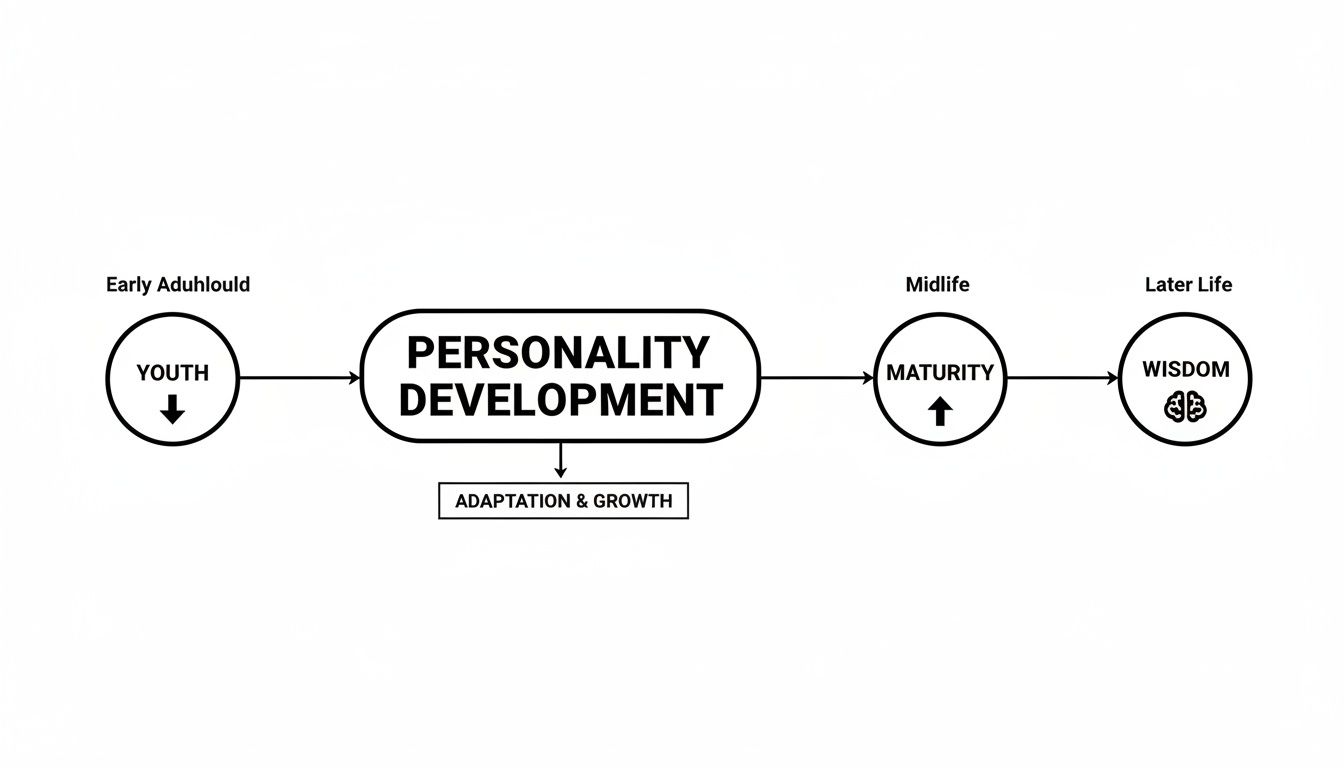
This shows us that our personalities are designed to evolve. The Enneagram paths just give us the specific roadmap for our own unique journey.
Let’s make this real with a Type 1, The Reformer. A Type 1 is principled, responsible, and has a powerful inner critic driving them toward perfection. Their paths connect them to Type 4 and Type 7.
• Stress Path (to Type 4): • Let’s use a practical example. When a Type 1 is under a lot of stress—feeling like their hard work is being ignored or that things are hopelessly flawed—they take on the unhealthy traits of a Type 4. Imagine Karen, a dedicated Type 1 project manager in Seattle. Her project gets completely derailed by things she can't control. Suddenly, she’s not just frustrated; she's moody, withdrawn, and feels deeply misunderstood. It's a classic unhealthy 4-ish despair that things will never be right.
• Security Path (to Type 7): • On the flip side, when that same Type 1 feels secure and appreciated, she moves toward the healthy side of Type 7. After a huge project launch goes off without a hitch, Karen feels a sudden rush of joy and lightness. She might even book a spontaneous weekend trip to Portland, embracing the fun-loving, adventurous spirit of a healthy Seven. It’s a complete shift in energy.
These movements are the key to your growth. The stress path is your early-warning system, showing you the exact unhealthy patterns you fall into. And the security path? That’s your North Star, pointing to the exact qualities you need to cultivate to become a more balanced, whole person. For our Type 1, learning to embrace the joy and spontaneity of Seven is the perfect antidote to her rigid perfectionism.
Did Your Type Change, Or Did You Just Get Healthier?
Have you ever looked in the mirror after a few years of serious personal growth and barely recognized the person staring back? It’s a wild feeling. This often sparks a big question for Enneagram enthusiasts: if you feel like a whole new person, can your personality type actually change ?
The short answer is... kind of, but not in the way you think. It's more like looking in a funhouse mirror. The reflection is warped and different, sure, but the person looking into it is still you.
This mix-up between changing your core Enneagram type and simply becoming a healthier, more integrated version of yourself is one of the most common hurdles in self-discovery. The truth is, your fundamental wiring doesn't change, but how you live out that wiring can—and should—evolve dramatically.
The Volume Dial Analogy
Think of your core Enneagram type as a song that’s always playing in the background of your life. That melody—your deepest motivation and fear—is a constant. You can't just swap it out for a different track.
What you can do, however, is step up to the mixing board. You have a volume dial for every single trait associated with your type.
When you're stressed or just not paying attention, the volume on those unhealthy patterns gets cranked to eleven. But as you grow and feel more secure, you can dial up the healthy aspects, creating a completely different soundscape.
From People-Pleaser to Altruist
Let's make this real with a practical example. Meet Marcus, an Enneagram Type 2, The Helper, who is a beloved high school teacher in Texas. His core motivation is to be loved and wanted.
In his less healthy days, this motivation drove him to be a compulsive people-pleaser. He was terrified of being rejected, so "no" wasn't in his vocabulary. He’d over-commit to everything—coaching, tutoring, parent meetings—then feel secretly resentful when his "help" wasn't appreciated enough. His pride puffed up around the idea that everyone needed him. The volume on his co-dependency was maxed out.
Now, fast forward. Marcus has done the work. He's learned to set boundaries, to check in with his own needs first, and to anchor his self-worth internally. He still loves helping people, but it’s no longer a desperate bid for approval. It’s a genuine act of altruism. He’s shifted from a prideful people-pleaser into a truly compassionate and self-caring person.
So, did he stop being a Type 2? Absolutely not. The song of "wanting to be loved" is still playing. But he’s remixed it from a chaotic, needy ballad into a beautiful, balanced symphony. He isn’t a new type; he’s just a healthy Two.
This is exactly how profound growth can feel like your personality has changed, when it has really just blossomed. If you're curious about where you fall on this spectrum, you can explore the Enneagram levels of health and get a clearer picture of your own journey.
A Checklist for Real Growth
So, how can you tell if that feeling of massive change is from genuine growth within your type, or if you might have been mistyped from the start? Run through this checklist with a practical mindset:
• Does your core fear still resonate? • A Type 2's core fear is being unwanted. Even as a healthy Two, Marcus will still be sensitive to rejection—he’s just learned how to handle it without abandoning himself. If your original core fear feels totally foreign to you now, you might have been mistyped.
• Are your motivations the same, but your actions are different? • A healthy Type 3 still wants to be valuable and successful. But now, they might define success as being a present parent instead of just a high-earning workaholic. The "why" is the same, but the "how" has matured.
• Do you feel more free, not more restricted? • Real growth is expansive. It gives you more choices and frees you from those old, knee-jerk reactions. If you feel like you’re trying to shove yourself into a new box, you might just be trying on another type's costume instead of growing in your own skin.
• Do you still see your old unhealthy patterns pop up under stress? • When the pressure is on, our old habits love to make a cameo. A healthy Marcus might feel a flash of people-pleasing panic during a conflict, but now he can spot it and choose a better response. This is a fantastic sign you're growing within your true type.
Your Next Steps On The Path Of Self-Discovery
Okay, so we’ve established that your personality isn’t set in stone. That’s great, but knowing that is only half the battle. Now comes the fun part: turning that insight into action. The Enneagram isn't just a party trick—it's a dynamic map for your personal journey. Let's talk about how to actually use it.
You might be wondering, "When should I re-test my Enneagram type?" It’s a great question. A good rule of thumb is to check in after a major life earthquake—think a big career shift, getting married, a painful loss, or even after a period of intense personal work like therapy. These moments can really shake up your usual patterns and priorities, making a fresh look at your type incredibly revealing.
Getting An Accurate Snapshot
Of course, not all tests are built the same. If you want a truly precise, up-to-date snapshot of your inner world, you need a tool that does more than just skim the surface.
This is exactly why the Enneagram Universe assessment was created. It's designed to dig past your surface-level behaviors and get right to your core motivations—the why that drives what you do. This gives you an astonishingly clear picture of where you are right now.
Think of it as getting a new, updated blueprint of your psyche. It helps you see how far you've come and points directly to your next big opportunities for growth. We're moving beyond asking "can your personality type change?" to actively shaping our own evolution.
This is the whole game. It’s not about erasing your personality and becoming someone new. It's about adding new tools and perspectives to your toolbox. For anyone serious about rewiring their thought patterns, therapeutic methods like Cognitive Behavioural Therapy provide a fantastic, structured way to do just that, and they pair beautifully with Enneagram work.
Practical Exercises For Your Type
Knowledge is great, but action is what creates change. Once you have a fresh read on your type, you can start using small, targeted exercises to nudge yourself toward growth.
Here are a few real-world, practical examples for Americans on their own unique paths:
• For the Anxious Type 6: • Imagine a project manager in Chicago who lives in a constant state of "what if." A simple • 5-minute mindfulness practice • each morning, just focusing on her breath, can help pull her out of future anxieties and anchor her firmly in the present.
• For the Cynical Type 5: • An academic researcher from Boston might notice he's becoming a bit too detached, seeing the negative in everything. By keeping a • gratitude journal • —just jotting down three specific things he was thankful for each day—he can start retraining his brain to notice and appreciate the good around him.
• For the People-Pleasing Type 2: • A nurse in Atlanta is feeling completely burnt out from saying "yes" to every single request. Her new practice? Before agreeing to anything, she takes a beat and asks herself: "Do I actually have the energy for this? Am I saying yes out of genuine care, or am I just afraid of letting them down?"
Self-discovery isn’t a destination you arrive at; it's a road you walk your whole life. By checking in with yourself regularly and trying out practices like these, you start using the Enneagram as it was meant to be used: as a powerful tool for becoming more fully yourself. If you’re ready to go deeper, our guide on how to become more self-aware has even more strategies to explore.
Got Questions About Personality Change? Let's Dig In.
Alright, let's tackle some of the big questions that pop up on this journey. It's totally normal to wonder what all this means for you and whether you're "doing it right." So, here are some straight-up answers to the things people ask most when we talk about whether your personality can really change.
I Tested as a Different Enneagram Type This Time. Was My First Result Wrong?
Not necessarily! It’s actually pretty common to get a different result on a second (or third) go-around, and it can mean a few things. You might be seeing a new number because you’ve genuinely grown and are showing up in the world differently now.
For example, a practical case: a Type 7 who has gone through a tough year might test as a 1, because they've moved to their stress point and become more rigid and critical. It’s also possible you were in a real pressure-cooker situation during your first test, which can make you look a lot like your stress number. Or, hey, maybe you just know yourself a whole lot better now.
Think of it like updating your glasses prescription. Your eyes are still your eyes, but the new lenses give you a much clearer picture of where you are today. The test is a tool, but your own self-reflection is always the most important part of the equation.
Can Therapy or Coaching Actually Change My Personality Type?
Nope. A great therapist isn’t going to magically turn you from a chill Type 9 Peacemaker into a full-throttle Type 8 Challenger. But what therapy will do is fundamentally change how you express your personality. It’s an amazing tool for moving into the healthier, more resourceful levels of your own core type.
How Often Should I Retake a Personality Test to See If I’ve Changed?
It’s tempting to keep checking in, but try to resist the urge to use it like a daily horoscope. Taking a test too often will just capture your mood of the moment, not any real, lasting shifts.
A good rule of thumb? Re-test after a major life event—a new career, getting married, a big move—or after you've put in a year or two of dedicated personal growth work. A practical example would be retaking the test a year after starting a demanding new leadership role in California that forced you to develop new skills. Think of a quality assessment as a deep-dive check-in for those big milestones, not a daily report card. That’s where you’ll see the truly meaningful insights.
Are Some Personality Types More Likely to Change Than Others?
This is a great question. While your core Enneagram type is for life, some types can look more like chameleons because their fundamental wiring makes them adapt to their environment. We see this most often with the "attachment" types.
• Type 3 Achievers: • These folks are masters of mirroring what others value, shaping their persona to be seen as successful and impressive. A practical example is a Type 3 moving from a buttoned-up D.C. political job to a creative startup in L.A. and seemingly changing their entire personality overnight.
• Type 9 Peacemakers: • They have a knack for unconsciously merging with the opinions and desires of others to keep things smooth and harmonious. For instance, a Type 9 might adopt the hobbies and even speech patterns of a new partner.
From the outside, this can look like a total personality shift, but it’s really just their core strategy in action. True, lasting change for any type comes from conscious self-awareness, not just running on autopilot.
Ready to get a clear, up-to-date picture of where you are right now? The free assessment from Enneagram Universe can give you that snapshot. It's built to look past surface behaviors and get right to your core motivations, giving you a precise blueprint for becoming the very best version of yourself. Start your journey of self-discovery here .