Master Your Traits: The Big Five Personality Trait Guide

Ever wonder what really makes you, you? We're often drawn to personality systems that put us into a neat little box, but the Big Five offers something different—a powerful, scientifically-grounded look at the core ingredients of human personality.
Instead of a fixed "type," think of your personality as a spectrum. The Big Five model measures five key dimensions—Openness, Conscientiousness, Extraversion, Agreeableness, and Neuroticism (easily remembered by the acronym OCEAN ).
Your Introduction to the Big Five Personality Trait Model
If you’ve ever felt like a personality label just didn't quite capture your whole story, the Big Five is a breath of fresh air. It’s less like a sorting hat and more like a unique recipe. We all share the same five basic ingredients, but it's the specific measurements—a dash more of this, a little less of that—that create your distinct flavor.
Think of this framework as a personal map to your inner world. Once you see where you land on each of the five traits, you'll gain incredible clarity on everything from your career choices and relationship dynamics to your own path of personal growth. Forget the dry, academic jargon. Let’s break down what these traits actually look like in real life.
So, What Is the Big Five Model, Really?
In the world of psychology, the Big Five is the gold standard. It’s the most widely accepted and scientifically proven model for understanding personality, often called the OCEAN model. It's built on five core dimensions:
• Openness to Experience: • This is your inner artist and adventurer. Are you always chasing new ideas, foods, and travel spots, or do you find deep comfort in your tried-and-true routines? For example, a person high in openness might love trying exotic cuisines and visiting modern art museums, while someone low in openness prefers their favorite hometown diner and classic landscape paintings.
• Conscientiousness: • Think of this as your inner project manager. It’s all about how you manage your impulses. Are you the person with the color-coded calendar, or do you thrive in organized chaos, working in brilliant, spontaneous bursts? A highly conscientious person might start packing for a trip a week in advance, using a detailed checklist. A less conscientious person might throw things in a bag an hour before leaving for the airport.
• Extraversion: • This is all about where you get your energy. Does a buzzing party leave you feeling alive and recharged, or do you need a quiet night with a good book to feel like yourself again? An extrovert might make five new friends at a backyard barbecue, while an introvert might spend most of their time having a deep one-on-one conversation with a close friend.
• Agreeableness: • This trait reflects your natural orientation toward others. Are you the group's peacemaker, quick to find harmony and compromise? Or are you comfortable playing devil's advocate and challenging the consensus? For instance, a highly agreeable person might immediately agree to a restaurant choice to make others happy, while a less agreeable person would voice their opinion if they dislike the food there.
• Neuroticism: • Sometimes called Emotional Stability, this is about how you weather life’s storms. When things get stressful, do you tend to stay calm and carry on, or are you prone to worry and overthinking every "what-if"? A person high in neuroticism might lose sleep for days worrying about a big presentation, whereas someone low in neuroticism would feel confident after preparing and sleep soundly the night before.
To help you get a quick sense of these traits, here's a simple breakdown.
The OCEAN Model at a Glance
This table gives a bird's-eye view of the five traits, summarizing what it looks like to score high or low on each dimension.
| Trait (OCEAN) | High Scorer Characteristics | Low Scorer Characteristics |
|---|---|---|
| Openness | Curious, imaginative, artistic, loves variety | Practical, conventional, prefers routine |
| Conscientiousness | Organized, disciplined, detail-oriented, dutiful | Spontaneous, flexible, can be disorganized |
| Extraversion | Outgoing, energetic, assertive, sociable | Solitary, reserved, enjoys quiet time |
| Agreeableness | Cooperative, trusting, compassionate, helpful | Competitive, skeptical, can be challenging |
| Neuroticism | Anxious, moody, sensitive to stress | Emotionally stable, calm, resilient |
Remember, there's no "good" or "bad" score here. Each end of the spectrum comes with its own unique strengths and challenges.
A Quick Trip Through History
The journey to the Big Five started with a beautifully simple idea and a massive amount of work. Back in the 1930s, pioneers Gordon Allport and Henry Odbert decided to read the dictionary—literally. They sifted through it to find every single word used to describe personality, ending up with a list of around 18,000 terms.
Over the decades, other researchers painstakingly analyzed and grouped these words, noticing that they kept clustering around five core themes. By the 1980s, psychologists like Paul Costa and Robert McCrae had chiseled this mountain of data into the five-factor model we know today. What’s amazing is that this structure holds up across more than 50 different cultures and languages. For a more detailed look, BrainWorks Behavioral Health offers a great deep dive into the Big Five traits.
This guide is your compass for that map. Whether you're a leader hoping to build a stronger team or just someone on a quest for self-knowledge, understanding where you fall on these five spectrums is a game-changer. It gives you a practical way to lean into your strengths and navigate your challenges with a lot more confidence.
Let's get started.
Bringing the Big Five to Life with Real-World Examples

Okay, let's get real. Theory is great, but to really get the Big Five, you have to see these traits in the wild. It’s one thing to read a definition; it’s another to see it play out in the conference room, at a dinner party, or even in your own head.
So, let's ditch the textbook talk and meet a few people. Think of these as character sketches that show what it actually means to score high or low on each of the OCEAN traits. As you read, you’ll probably start seeing your friends, your family, and definitely yourself in these descriptions. And that's the whole point!
Openness to Experience: The Innovator vs. The Optimizer
First up is Openness . Picture two American tech entrepreneurs, Sarah and David, both trying to build the next big thing. Sarah is pure, high-octane Openness . She’s the innovator, a walking "what if?" Her office is a beautiful chaos of whiteboards covered in scribbles, and her business plan seems to pivot every other Tuesday. She’ll try a bonkers new marketing campaign just to see what happens, even if it blows up in her face. The unknown is her playground. For instance, she might suggest the team attend an avant-garde art installation to spark new ideas for user interface design.
David, her friendly rival, scores low on Openness. He's the optimizer. He couldn't care less about reinventing the wheel; he's obsessed with making the current wheel perfectly round, frictionless, and more profitable. He leans on proven business models, trusts hard data from established markets, and loves a good, old-fashioned, predictable process. Instead of a radical redesign, David would implement A/B testing on button colors to see which one increases conversions by a fraction of a percent.
Sarah is chasing lightning in a bottle. David is building a perfectly engineered hydroelectric dam. Both can lead to incredible success, but they’re taking fundamentally different roads to get there.
Conscientiousness: The Architect vs. The Artist
Now let's talk about Conscientiousness . Meet Liam, an accountant whose spreadsheets are basically masterpieces. Scoring off-the-charts high on this trait, his world is a symphony of organization. Every task is logged, every deadline is sacred, and his personal calendar is a thing of color-coded beauty. For example, he pre-schedules all his bill payments for the year and has his tax documents organized in labeled folders by February. You give Liam the details because you know, with absolute certainty, that nothing will ever fall through the cracks.
Working down the hall is Maya, a marketing genius who scores low in Conscientiousness. Her desk looks like a craft store exploded. She’s a whirlwind of brilliant, chaotic energy—having game-changing ideas in the shower and forgetting them by the time she finds a pen. For her, a practical example is paying her electric bill the day she gets a shut-off notice, fueled by a burst of adrenaline. She’s spontaneous and flexible, but her last-minute scrambles and forgotten appointments can drive her more structured colleagues up the wall.
Liam is the architect, building the unshakeable foundation. Maya is the artist, painting the unpredictable masterpiece on top of it.
Extraversion: The Networker vs. The Coder
Next is Extraversion , which is all about how you manage your social energy. Chloe, a sales director, is the poster child for high Extraversion. She walks into a networking event and lights up, feeding off the energy of the crowd. She floats from group to group, making effortless connections, and leaves feeling more juiced up than when she arrived. A practical example is her voluntarily signing up to represent the company at a three-day trade show, seeing it as an exciting opportunity rather than a chore. For her, being with people is like plugging into a charger.
Then there’s Ben, the lead coder on her team. He's a classic introvert, scoring low on Extraversion. For him, that same networking event would be a special kind of torture. He does his most brilliant work in blissful solitude, and he’d much rather have one deep conversation than a dozen superficial ones. For instance, after a long team meeting, he puts on noise-canceling headphones to retreat to his quiet cave and recharge his batteries.
Chloe is the company's ambassador to the world. Ben is the quiet engine making it all run. You can't succeed without both.
Agreeableness: The Mediator vs. The Challenger
What about Agreeableness ? This trait is all about your instinct for social harmony. Take Emily, an HR manager who scores high on the trait. She’s the office peacemaker—compassionate, cooperative, and a master at finding the win-win. Her default setting is to trust people and her primary mission is to make sure everyone feels heard and valued. For example, during a team dispute over project roles, she'll schedule a meeting to help everyone find a compromise that feels fair.
Now, consider Jessica, a sharp-as-a-tack trial lawyer who scores low in Agreeableness. She's not here to make friends; she's here to win. She’s competitive, naturally skeptical, and completely at home with confrontation. Her job is to find the weak spot in an argument and press on it, without worrying about whose feelings might get ruffled. A practical example is her cross-examining a witness by pointing out inconsistencies in their story, a task that would make a highly agreeable person deeply uncomfortable. It can seem harsh, but her willingness to challenge everything is her superpower.
Emily is a bridge-builder. Jessica is a stress-tester, making sure those bridges are strong enough to hold weight.
Neuroticism: The Worrier vs. The Rock
Finally, we have Neuroticism , which is really about emotional sensitivity and stability. Mark, a marketing lead, scores high here. He’s the worrier. He triple-checks every detail, frets about what could go wrong, and takes criticism to heart. A practical example is him rehearsing his part of a team presentation ten times, imagining all the tough questions the CEO might ask. While it can make him anxious, this heightened sensitivity means he often catches potential problems that everyone else misses. His worrying is a form of quality control.
His deskmate, Alex, scores low in Neuroticism and is the team’s anchor. He’s the rock—calm, cool, and unflappable. When a server crashes mid-launch, Alex doesn't spiral. He just takes a deep breath, calmly assesses the mess, and starts figuring out a fix. His practical approach is to immediately start a group chat with the engineering team to troubleshoot, rather than dwelling on the disaster. He rolls with the punches, and his steady vibe keeps the rest of the team from freaking out.
Mark's sensitivity is the smoke detector, warning of potential fires. Alex’s stability is the firefighter, calmly handling the flames when they do appear.
Why Conscientiousness Is a Career Superpower

While every part of the OCEAN model is important, there's one big five personality trait that quietly dominates the professional world: Conscientiousness . If Openness is the brilliant artist and Extraversion is the charismatic salesperson, Conscientiousness is the powerhouse CEO who makes sure the business actually runs.
It's not about being the loudest person in the room; it's about being the most reliable. Highly conscientious people are the ones with the color-coded calendars, the detailed project plans, and an unstoppable drive to see things through. They just get things done.
The Doer vs. The Dreamer
Let’s watch this play out with two startup founders. First up is Ethan, a textbook creative genius who is low in Conscientiousness. His ideas are dazzling, but his follow-through? Not so much. Deadlines feel more like suggestions, and his project board is a graveyard of half-finished masterstrokes. A practical example: he'll buy all the equipment for a new podcasting project but never actually record the first episode.
Then we have Maria, who scores off-the-charts in Conscientiousness. She might not have Ethan's firehose of wild ideas, but every single project she takes on is planned with surgical precision and executed flawlessly. A practical example: for her new podcast, she creates a 12-week content calendar, batch-records six episodes, and has them scheduled to release before she even announces the launch. Her team hits its marks, her reputation is sterling, and while Ethan is chasing his next shiny object, Maria is methodically building a profitable empire.
This isn’t just a feel-good story—the numbers tell the same tale. Across almost every industry, high Conscientiousness is the single best predictor of career success. Some research shows it can account for up to 23% of the difference in job performance, making it a more powerful predictor than IQ in some fields. These are also the people with 15-20% lower rates of absenteeism who snag about 10% more promotions. You can see more on the real-world impact of this and other traits in a detailed breakdown of the Big Five personality theory on PositivePsychology.com .
Cultivating Your Inner CEO
The best part? Conscientiousness isn't a fixed factory setting. Think of it more like a muscle you can train. If you see a little more of the dreamer Ethan in yourself than the doer Maria, you’re not doomed. You can build these habits without snuffing out your creative fire.
Here are a few ways to start building that "get it done" muscle:
• The Two-Minute Rule: • If a task takes less than two minutes (firing off a quick email, saving a file), do it right then and there. This tiny habit is a secret weapon against overwhelming clutter.
• Time Blocking: • A to-do list is just a wish list. A calendar is a plan. Block out specific, non-negotiable time for your most important work. For example, block 9-10 AM every Monday for "Weekly Planning" so it becomes a fixed appointment with yourself.
• Define "Done": • Before you even start, get crystal clear on what a finished project looks like. A clear finish line is the ultimate motivator and stops you from getting lost in the weeds. For a report, "done" might mean "final draft submitted to manager, including all three requested charts."
Knowing this can also point you toward work environments where you’ll thrive. For example, conscientious people are naturals in the world of remote jobs , where self-discipline and accountability are the name of the game. By turning these small actions into consistent habits, you start building the framework that turns your biggest career goals into your proudest achievements.
How the Big Five Shapes Your Relationships
Ever feel like your relationships have their own secret language? One person's idea of a fun night is another's personal nightmare, and a simple disagreement can somehow spiral into a major conflict. The big five personality trait model gives us a decoder ring for these social mysteries.
Our personalities are the invisible force shaping how we connect with friends, family, and romantic partners. Your unique blend of traits doesn't just sit there—it actively mixes and reacts with the traits of others, creating a special kind of chemistry. Sometimes it sparks, and sometimes, well, it fizzles.
Harmony or Friction: The Chemistry of Trait Combinations
Let's talk about Agreeableness . If you're someone who scores high here, you’re likely the go-to peacemaker. You’re cooperative, trusting, and would rather do anything than start a fight. Now, pair that person with someone lower in Agreeableness—someone more assertive and skeptical. This could be a brilliant match! You might soften their sharp edges, while they could teach you how to stand your ground.
But it can also be a recipe for frustration. You might feel steamrolled, while your partner feels like you're a pushover. The key isn't that one of you is "right" and the other is "wrong." It's about seeing the trait-based tension for what it is. A practical example: when deciding on a vacation, the high-agreeableness partner says, "Whatever you want is fine!" while the low-agreeableness partner gets frustrated, wanting a real opinion to debate.
This awareness lets you reframe everything. Instead of thinking, "Why are they being so impossible?" you can shift to, "Ah, their low Agreeableness means they need more hard evidence to be convinced. I'll try that." Suddenly, you’re problem-solving instead of fighting.
The Extrovert and the Introvert: A Classic Love Story
Let's watch the push-and-pull of Extraversion play out with a couple we all know. Meet Emily and Ben. Emily is bursting with Extraversion; she recharges by being around people. Her perfect Friday night is a packed restaurant, a big party, or anything with a social buzz.
Ben, on the other hand, scores low on Extraversion, making him a classic introvert. For him, a party is a massive energy drain. He recharges with quiet, focused time, either alone or just with Emily. His ideal Friday involves a movie on the couch and zero small talk.
Without understanding this core difference, their weekends would be a constant battle. Emily would feel held back, and Ben would feel his need for peace was completely ignored. But once they see it's about personality, not personal attacks, they can find a middle ground.
• The Weekend Deal: • They agree to one social outing on Saturday, with the promise of a quiet, cozy Sunday to recharge.
• The Party Compromise: • Ben agrees to go to the party, but only for an hour. Emily gets her social fix, and Ben doesn't get totally depleted.
• Divide and Conquer: • Emily has a girls' night out, and they dedicate the next day to a shared hobby they both truly love.
This isn’t about one person winning. It’s about honoring each other’s fundamental energy needs. As you begin to see these patterns in your own life, you might want another layer of insight. Our guide on Enneagram types in relationships is a great next step, exploring the deeper motivations that drive these behaviors.
How Other Traits Weave into Our Connections
The other traits are just as powerful in shaping our bonds. Openness , for instance, is all about the kinds of experiences you share. A couple high in Openness might spend their money on spontaneous trips to new countries, while a couple lower on the trait could find deep comfort and joy in their annual trip to the same beloved lake house.
Neuroticism dramatically influences a relationship’s emotional climate. A partner high in Neuroticism often needs extra reassurance and clear communication to feel secure. For example, they might appreciate a quick "thinking of you" text during the day. In contrast, their low-Neuroticism partner can be a wonderfully steadying anchor during life’s storms.
And then there's Conscientiousness , which dictates how you run your shared life. Two highly conscientious people might have a home that runs like a Swiss watch. But when one is a meticulous planner, and the other is more spontaneous, they’ll have to consciously negotiate everything from who pays the bills to whether the dishes get done now… or later.
By seeing how the Big Five plays out in your life, you can stop judging and start getting curious. That simple shift is the real secret to building stronger, kinder, and more resilient relationships.
Combining the Big Five and the Enneagram for Deeper Insight
If you’ve spent any time with the Enneagram, you know it gets to the heart of things. It’s the map to your inner world, revealing the why behind your choices—your secret fears, your deepest desires, and the engine that drives your life. But what about the how ? How do all those internal rumblings actually show up in your day-to-day life?
That's where the Big Five personality model walks in and changes the game. Think of it this way: the Enneagram is your soul's blueprint, and the Big Five is the finished building people see from the street. When you put them together, you get the complete architectural plans of you .
How Your “Why” Becomes Your “How”
Every Enneagram type has a core motivation, a fundamental drive that pushes and pulls them. This inner motivation often translates into a surprisingly predictable set of external behaviors, which is exactly what the Big Five measures. Seeing how they connect is like watching your personality unfold from the inside out.
Let's get specific with a few examples:
• Enneagram 3 (The Achiever): • Threes are fueled by a need to feel valuable. How does that look on the outside? It often appears as high • Conscientiousness • (they’re incredibly organized and goal-driven) and high • Extraversion • (they know how to work a room). Their inner fear of worthlessness powers an external machine of productivity and charm.
• Enneagram 9 (The Peacemaker): • Nines just want everyone to get along, seeking a world of inner and outer peace. This core desire frequently shows up as a high score in • Agreeableness • . They are the ultimate team players—cooperative, easygoing, and allergic to conflict. Their • why • (avoiding tension) creates a • how • that makes social situations smoother for everyone.
• Enneagram 6 (The Loyalist): • The loyal and security-oriented Six can be a bit more complex. Their constant scanning for danger and what-if scenarios often results in high • Neuroticism • . At the same time, their deep commitment to their people can look like high • Agreeableness • and a strong sense of duty ( • Conscientiousness • ).
Of course, this isn't a strict one-to-one conversion. It's more of a fascinating set of tendencies. Your Enneagram type is the emotional engine, and your Big Five traits are the car it's driving.
This combination is pure gold for personal growth. Ever wonder why you procrastinate? It's a low-Conscientiousness behavior, but the Enneagram tells you the root cause. A Type 7 might put things off to avoid feeling bored and trapped, while a Type 4 might delay because the project just doesn't feel meaningful enough.
Big Five vs. Enneagram: What They Each Reveal
The real magic happens when you stop seeing these two systems as competitors and start seeing them as collaborators. Each one illuminates a different side of you. It's a lot like looking at other personality pairings, such as the fascinating contrasts you find when comparing the Enneagram and the MBTI .
To make it crystal clear, here’s a breakdown of what each framework brings to your journey of self-discovery.
Big Five vs. Enneagram: What They Each Reveal
| Aspect | Big Five (OCEAN) | Enneagram |
|---|---|---|
| What It Measures | Observable behavioral traits and tendencies. | Core motivations, fears, and unconscious drives. |
| Core Question | "How do I typically act?" | "Why do I act that way?" |
| Focus | Describes the "what" of your personality. | Explains the "why" of your personality. |
| Structure | A spectrum of five independent traits. | Nine interconnected types in a dynamic system. |
| Growth Path | Modifying behaviors and building new habits. | Healing core wounds and transcending ego patterns. |
So, what does this look like in the real world?
Imagine you’re a manager trying to be a better leader. The Big Five might point out that you’re low in Extraversion (you’re not very assertive) and could be higher in Conscientiousness (your team needs more structure). That’s the "what."
But that advice alone isn't enough. The Enneagram steps in with the "why." If you're an Enneagram 9, your deep-seated desire for harmony makes assertiveness feel like starting a war. If you're a Type 7, your fear of being boxed in makes creating detailed plans feel like a prison sentence.
When you see both sides, you finally have a complete strategy for growth. You get the practical, real-world data of the Big Five combined with the profound self-understanding of the Enneagram. It's the ultimate one-two punch for building a more conscious and fulfilling life.
Turning Your Big Five Insights Into Action
Alright, so you’ve got your Big Five results. That’s a huge win! But let's be real—a report is just a piece of paper (or a screen) until you do something with it.
The real magic happens when you turn that self-awareness into an actual game plan. This isn't about getting a personality transplant. It's about learning to pilot the ship you were born in, amplifying your natural strengths and getting way smarter about your challenges.
Your Practical Roadmap for Personal Growth
Think of your scores less like a life sentence and more like a user manual for you . Where you land on each of the five spectrums gives you a clue about how to make your personality work for you, not against you.
Let's say you scored low on Openness to Experience . The thought of breaking your routine might make your skin crawl. You don't have to book a spontaneous trip to Mongolia. Start smaller! Try one new restaurant this month. Fire up a playlist in a genre you’d normally skip. Wander into a section of the bookstore you always ignore. These are low-stakes experiments that gently stretch your comfort zone without snapping it.
Or maybe you scored high on Neuroticism , and your brain feels like a professional worry-machine running on a hamster wheel. The goal isn't to just "stop worrying"—we all know how well that works. Instead, give your anxiety a container. Schedule 15 minutes of "worry time" each day. Get a notebook, set a timer, and let it rip. When the timer goes off, you're done. This gives your mind a structured outlet and keeps that free-floating anxiety from hijacking your entire day.
From Lightbulbs to Lasting Habits
The secret is building systems that support who you want to be, especially where your personality tends to create a little friction. Want to be more reliable and boost your Conscientiousness ? Forget just telling yourself to "be more organized." That's a recipe for failure.
Instead, try these simple life hacks:
• The "One-Minute" Rule: • If a task takes less than a minute—like putting a dish in the dishwasher or replying to a quick text—do it • immediately • . This little trick is a game-changer for preventing that overwhelming pile-up of tiny tasks.
• The Sunday Night Sketch: • Block out just • 20 minutes • on Sunday to map out your top three priorities for the week. This creates a simple, logical framework that gives your brain a clear path to follow when Monday morning hits.
This is where you can see the Big Five as the "how" of your actions, which pairs beautifully with the Enneagram's focus on the "why."
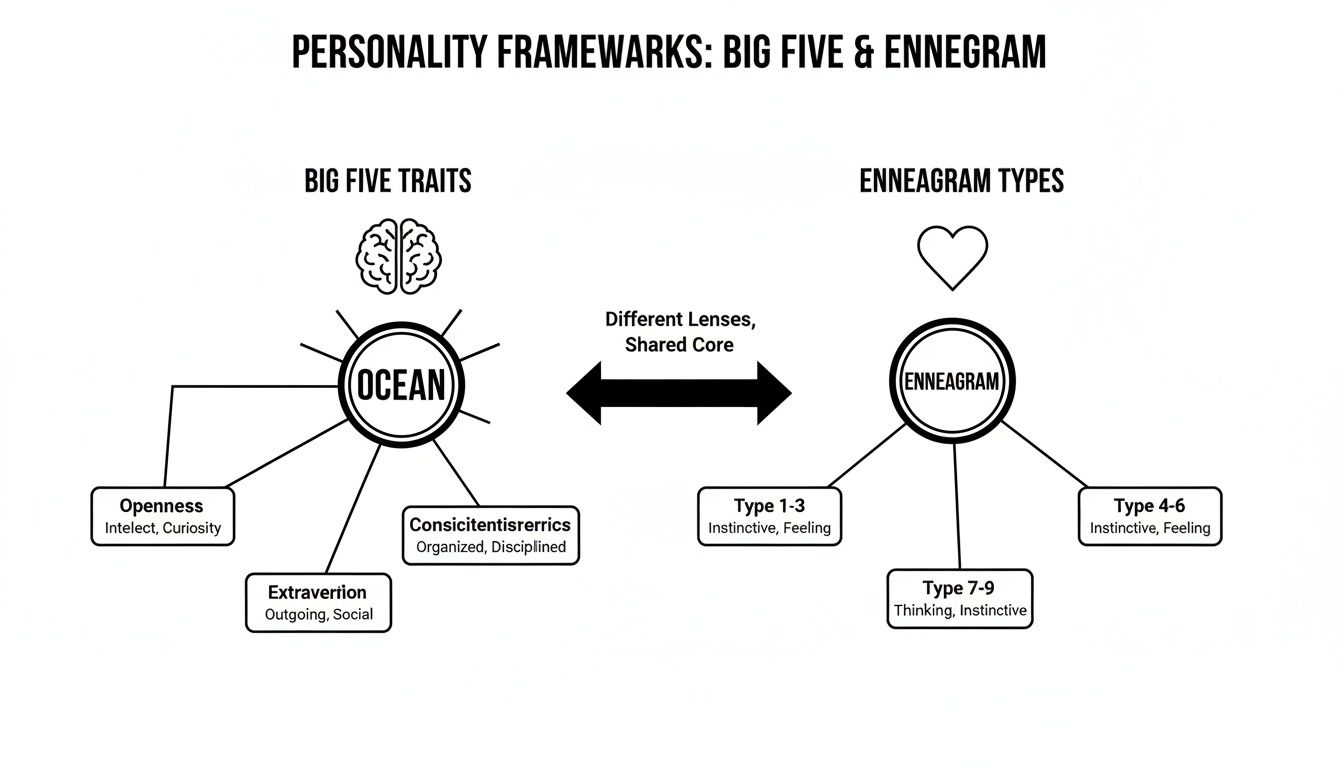
As you can see, the Big Five (the brain) and the Enneagram (the heart) are like two different lenses. When you look through both, you get a much richer, more complete picture of who you are.
Take someone high in Agreeableness , for example. They might struggle to set boundaries because the thought of creating conflict is their personal kryptonite. The goal isn't to become a jerk overnight. It’s about practicing small, boundary-setting phrases. A simple, "Let me think about that, and I'll get back to you," can be revolutionary. It creates space without creating a fight.
Your Big Five results gave you the coordinates to your inner world. Consider this your map and compass. Now, let’s get moving.
A Few Lingering Questions About The Big Five
Still have a few questions swirling around about the big five personality trait model? You're in good company. Let's tackle some of the most common ones that pop up.
Is The Big Five Test Actually Accurate?
Absolutely. In the world of personality psychology, the Big Five is basically the heavyweight champion. It's not some fly-by-night quiz; it's backed by mountains of research over decades.
The model has what researchers call high test-retest reliability. In plain English, that means if you take a test today and then again a few years from now, your scores will likely be remarkably consistent. It’s why academics and professionals alike trust it.
Can My Big Five Traits Change Over Time?
While your core personality is pretty stable, it’s not carved in stone for life. Think of it more like clay that slowly firms up but never completely hardens.
Research shows our personalities can and do shift, often influenced by major life events, new responsibilities, and even just the process of getting older. Many people find they naturally become more Conscientious and Agreeable as they navigate adulthood.
For example, if you know you're high in Neuroticism, you can prepare for nerve-wracking situations like job interviews. Knowing your tendencies allows you to find practical tools for staying calm in an interview and showing up as your best self.
How Is The Big Five Different From Myers-Briggs?
This is a big one! The key difference boils down to science and structure. The Big Five is a spectrum model—you aren't one thing or the other, but fall somewhere on a continuum for each of the five traits. This approach has massive, solid support from the scientific community.
The Myers-Briggs Type Indicator (MBTI), on the other hand, sorts you into one of 16 rigid "types." It’s more like a sorting hat. While popular, it doesn't have the same level of backing from modern psychological research. If you're intrigued by different personality frameworks, you might get a lot out of exploring a high-quality, free Enneagram test .
At Enneagram Universe , we believe true self-discovery comes from understanding your deepest motivations. Ready to uncover the "why" behind your "how"? Take our free, scientifically validated Enneagram test today .