Attachment Theory: Couples Therapy to Strengthen Your Bond
Do you ever feel like you and your partner are trapped in the same fight, just on a continuous loop? Attachment theory couples therapy is an incredibly powerful way to get to the root of why you connect—and disconnect—the way you do. Consider this your first step in turning that recurring frustration into a deep, lasting bond.
How Attachment Theory Can Heal Your Relationship
If this sounds like your life, you are definitely not alone. So many couples get stuck in these patterns that they just can't seem to figure out, where a simple disagreement somehow blows up into a painful, silent standoff.
Maybe one of you desperately seeks reassurance, while the other pulls away, craving space. Sound familiar?
This recurring "dance" you do isn't a sign that your love is failing. More often than not, it's a direct reflection of your attachment styles—an emotional blueprint for relationships that was wired into you early in life. Think of it as your heart's default operating system, quietly running in the background of every interaction.

A Quick Look at the Four Adult Attachment Styles
To really get a handle on this, it helps to see the different styles side-by-side. Each one comes with its own set of expectations and automatic reactions when things get tense.
| Attachment Style | Core Belief About Connection | Typical Behavior in Conflict |
|---|---|---|
| Secure | "I can trust others to be there for me. I am worthy of love." | Communicates needs directly and openly, seeks repair after a fight. |
| Anxious | "I worry my partner won't love me enough. I fear abandonment." | Becomes demanding or clingy, needs constant reassurance. |
| Avoidant | "I must be self-reliant. Intimacy feels suffocating." | Withdraws, shuts down emotionally, or creates distance. |
| Disorganized | "I want to be close, but it feels dangerous. I can't trust anyone." | Swings between anxious and avoidant behaviors; can seem chaotic. |
Understanding these isn't about slapping a label on yourself or your partner. It's about gaining a shared language for the deep-seated fears and needs that drive your behavior, especially when you're feeling disconnected.
Your Past Is Present in Your Relationship
The whole idea behind attachment theory, first developed by the brilliant psychologist John Bowlby, is that the bonds we had with our earliest caregivers created a sort of internal map for how we expect love to work. This map becomes our guide in adult romantic relationships, especially when we feel stressed or threatened.
When you feel safe and connected, your attachment system is calm. But the moment you feel a threat—like your partner seems distant or critical—that system lights up and triggers your go-to survival instincts. And that’s where the trouble usually starts.
For instance, a wife who grew up with parents who were sometimes there for her and sometimes not might become anxious when her husband is late from work. She might text him over and over, not to annoy him, but because her attachment system is screaming, "I'm being abandoned!"
Her husband, on the other hand, might have been raised to be tough and self-reliant. He sees the flood of texts as overwhelming and pulls away, needing space. This retreat, of course, just confirms her deepest fear. Neither of them is "wrong"—they’re just playing out the survival strategies they learned long ago.
What Attachment Theory Couples Therapy Aims to Achieve
The point of attachment theory couples therapy is not to blame your parents or point fingers at your partner. It’s all about bringing these unconscious patterns out into the open so you can finally understand them and tackle them as a team.
The core idea is to transform your relationship into a secure base, where both partners feel safe, seen, and soothed. It's about learning to turn toward each other for comfort instead of turning away in self-protection.
Therapy creates a safe harbor where you can slow down that negative cycle and finally explore the vulnerable feelings hiding underneath the anger or the silence. You start to see that beneath your partner's frustration is a raw fear of not mattering to you, and beneath your own withdrawal is a painful feeling of failure.
• De-escalate Conflict: • You'll learn to spot the first signs of your negative cycle and hit the pause button before it takes over.
• Build Empathy: • You'll finally understand the "why" behind your partner’s reactions, seeing their behavior as a clumsy bid for connection instead of a personal attack.
• Create New Connections: • You’ll practice new, more vulnerable ways of asking for what you need that actually pull your partner closer instead of pushing them away.
Beyond just working on your own dynamic, exploring other avenues like virtual family therapy can offer more tools for strengthening your bond and healing relational wounds. By unpacking these foundational patterns, you can stop fighting against each other and start working together to build the secure, loving partnership you both crave.
Understanding Your Core Attachment Style
To get anywhere in your relationship, you first need a map. Not a roadmap to a destination, but a map of your own emotional landscape. That's exactly what attachment styles give you—a look at the deep-seated "operating system" that runs your reactions, especially when things get tense.
Think of these styles not as rigid boxes you're stuck in, but as clever strategies you learned a long, long time ago to feel safe and connected.
The whole idea comes from a British psychologist named John Bowlby. He figured out that our very first bonds with caregivers create an "internal working model" that we carry into every other relationship for the rest of our lives. It’s the emotional blueprint your heart defaults to, subconsciously asking the one question that matters most: "Can I count on you?"
The Four Key Attachment Styles
In the world of adult relationships, these blueprints generally fall into one of four patterns. Figuring out which one sounds most like you—and your partner—is the first, most crucial step toward compassion and finally breaking those frustrating, repetitive fights. This isn't about blaming anyone; it's about seeing things clearly.
• Secure Attachment: • If this is you, you've hit the relationship jackpot. You generally feel good about yourself and others, and you're comfortable with both closeness and independence. You can say what you need and hear what your partner needs without panicking.
• Anxious Attachment: • People with an anxious style crave closeness more than anything, but they're haunted by a nagging fear of being left. They often find themselves worrying if their partner • really • loves them, which can lead to a constant search for reassurance.
• Avoidant Attachment: • If you're avoidant, your motto is "I've got this." Independence is your holy grail. Too much closeness feels suffocating, and you might find yourself pulling away or shutting down when a partner seems to need you too much.
• Fearful-Avoidant (Disorganized) Attachment: • This is the most complex style, a painful mix of both anxious and avoidant tendencies. You want love desperately, but at the same time, you're terrified of it. You might feel you're unworthy of love and find yourself pushing away the very people you want to hold close.
How These Styles Show Up in Real Life
Let's get this out of the textbook and into your living room. A secure partner is like a sturdy home base in a storm—they trust the connection is solid and can offer comfort without getting swept away themselves. An anxious partner, on the other hand, is more like a storm chaser, constantly scanning the sky for the slightest sign of trouble and needing absolute proof the storm isn't headed their way.
The core of attachment-based conflict is often a tragic misinterpretation of motives. One partner’s bid for connection is heard as a criticism, while the other’s need for space is perceived as rejection.
Let's look at a classic example. Meet Sarah and Tom. Sarah has an anxious attachment style, and Tom leans avoidant. One night, Tom gets home from a brutal day at work and grunts, "I just need some space to think."
For Tom, this is a simple, honest need. He's overwhelmed and knows if he goes to his workshop for a bit, he can cool down and avoid saying something stupid. It’s his go-to strategy for self-regulation.
But for Sarah, those four little words—"I need some space"—trigger a primal fear of abandonment. Her anxious internal working model instantly translates his request into "You're a burden," or worse, "I'm done with you."
Her response? She follows him, pleading, "Are we okay? What did I do wrong?" This pursuit, meant to secure the connection, feels like a cage to Tom. It makes him want to run even farther away. This is the infamous anxious-avoidant dance, and it traps so many couples. Neither person is the villain; they're both just running the survival programs that have been wired into them since childhood.
Learning to see these patterns for what they are—without judgment—is the entire point of attachment theory couples therapy . It's the moment you stop seeing an enemy across the room and start seeing a partner who has a completely different way of seeking safety. Gaining this perspective is a massive step in self-awareness. If you're looking to build this muscle, you can learn more about how to become more self-aware to improve your relationships . This shared understanding is the ground on which you can finally start learning a new dance.
Spotting the Negative Cycles in Your Relationship
If attachment styles are the deep, emotional blueprints we carry around, then negative cycles are the destructive dances you and your partner keep getting tricked into. These predictable patterns, often called "demon dialogues" in attachment theory couples therapy , are the real culprits behind why you keep having the same argument again and again. It's the moment theory becomes painfully, personally real.
We're not just talking about a simple disagreement. This is about getting snared in a self-feeding loop of hurt and misinterpretation. One partner’s reaction triggers the other’s deepest fear, which then confirms the first partner’s original anxiety, and around and around you spin. Simply being able to name this dance is the first real step to stopping the music.
The concept map below lays out how these patterns get wired into us. It all starts with our earliest interactions with caregivers, which build the foundational blueprint for our adult attachment styles.
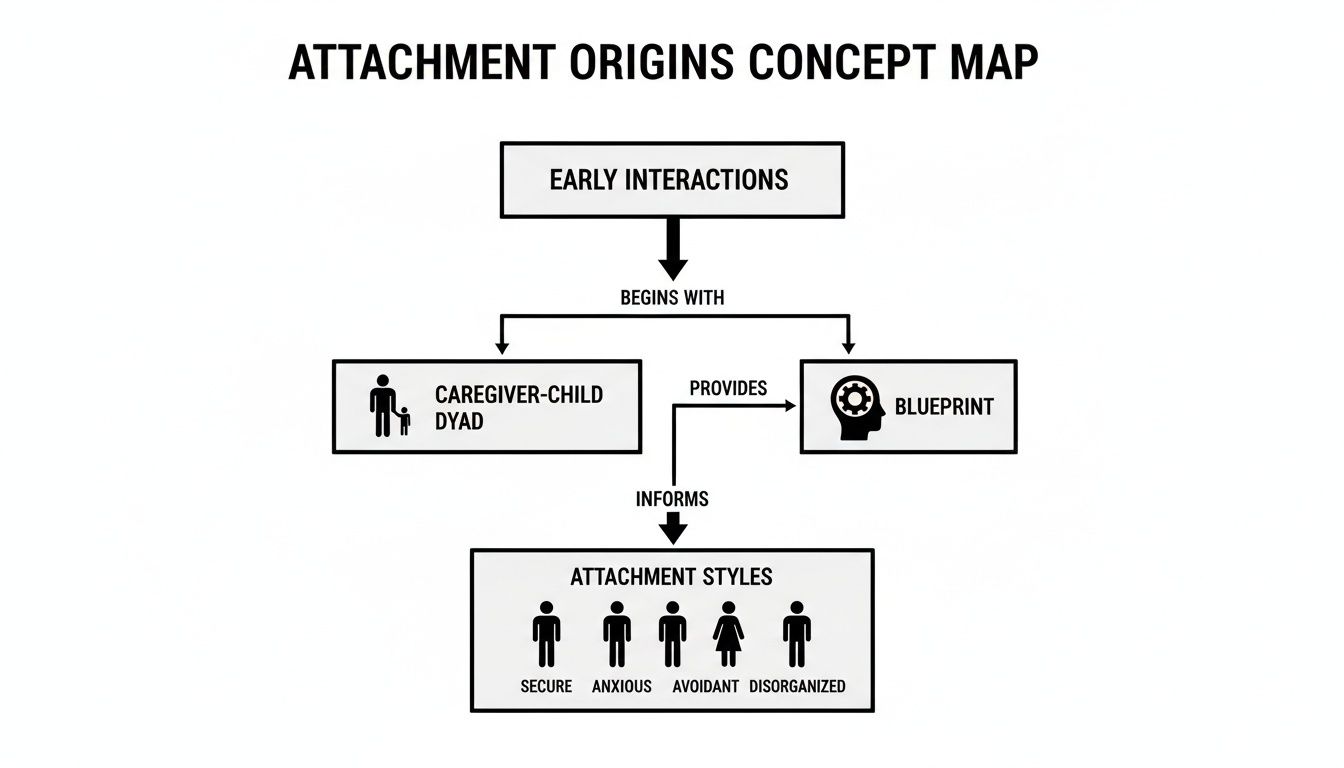
As you can see, the frustrating dances we do in our adult relationships don't just pop up out of nowhere. They're the predictable, almost inevitable, result of the emotional maps we started drawing a long, long time ago.
The Anxious-Avoidant Dance
By far the most common—and most maddening—of these cycles is the pursuit-withdraw pattern. It’s the classic, head-on collision between anxious and avoidant attachment styles. One partner, absolutely terrified of being disconnected, frantically pushes for closeness and reassurance. The other, feeling smothered and judged, pulls away to find safety in emotional or physical distance.
This dynamic is so potent because both partners are desperately trying to feel safe, but their strategies directly attack the other person's sense of safety. It's a perfect storm that guarantees nobody gets what they need.
Let’s watch this play out with a real-world couple, Jenna and Mike. Jenna has a classic anxious attachment style, and Mike leans heavily toward avoidant.
A Practical Example: Jenna and Mike
Jenna shoots Mike a text in the middle of the afternoon: "Hey, thinking of you! Can't wait for dinner tonight. ❤️" Two hours go by. Nothing. A familiar, tight knot of anxiety begins to form in her stomach. Her attachment system, which is like a hyper-sensitive radar for any hint of distance, starts whispering, He’s pulling away. What did I do wrong?
She tries again, this time with a bit more urgency: "Is everything okay?" The silence that follows is deafening. Now, her anxiety isn't whispering; it's screaming. By the time Mike walks through the door later that evening, she's completely primed for a fight.
She meets him right at the door with, "Why do you always ignore me? It’s like I don’t even exist to you." Underneath the anger, this is actually a desperate plea for connection: Please, just show me that I matter to you.
But for Mike, who just survived a soul-crushing day at work, this feels like an ambush. He hears accusation and criticism, and he feels suffocated. His core need is for autonomy and some quiet space to decompress. Jenna’s emotional intensity feels like a wave crashing over him, triggering his own deep fear of being controlled and failing as a partner.
So what does he do? He shuts down. "I can't do this right now, Jenna," he mutters, making a beeline for the garage to tinker with his bike. For Mike, this isn't about punishing her; it's about self-preservation. His actions are screaming: I need space or I’m going to lose it.
Jenna is left standing alone in the kitchen, her worst fear seemingly confirmed: she has been abandoned. Meanwhile, Mike is out in the garage, his deepest belief reinforced: intimacy is a trap. This vicious cycle has won again, leaving them both feeling wounded, alone, and completely misunderstood.
Other Destructive Patterns
While the anxious-avoidant trap is incredibly common, other pairings create their own unique brands of chaos. Seeing them clearly can be just as liberating.
• Anxious-Anxious (Emotional Escalation): • Picture two partners, both haunted by a fear of abandonment. When one feels insecure, they reach for reassurance. But their anxiety makes the other partner anxious, who now also fears the relationship is about to implode. • For example, • one partner might say, "I feel like you've been distant lately," causing the other to panic and reply, "What do you mean? Are you unhappy? Are we going to break up?" This can kick off a dizzying whirlwind of emotional escalation where both partners frantically try to "fix" the problem, often pouring gasoline on the fire with their shared panic.
• Avoidant-Avoidant (The Roommate Marriage): • When two avoidantly attached people get together, you often get a relationship that looks great from the outside—calm, stable, no drama. But beneath the surface, there’s a profound lack of emotional connection. Both partners prioritize their independence and swallow their needs to avoid conflict or vulnerability. • Practically, this might look like • a couple who hasn't discussed a real feeling in months; instead, their conversations revolve around logistics like bills and groceries. This quiet pact can lead to a "roommate marriage," where two people share a home and a life but feel deeply, achingly lonely.
Identifying your specific negative cycle is a complete game-changer. It shifts the entire conversation from "Who's to blame?" to "What is this thing that keeps happening to us ?" Once you can both see the dance itself as the enemy, you can finally join forces and start learning some new steps—together.
How Emotionally Focused Therapy Rewires Your Bond
So, you've spotted the destructive dance that keeps you and your partner stepping on each other's toes. The big question is, "Now what?" This is where the real magic happens, especially with an approach called Emotionally Focused Therapy , or EFT.
Developed by the brilliant Dr. Sue Johnson, EFT isn't about giving you a new script for your arguments. It’s about fundamentally changing the music. It’s designed to rewire your emotional connection from the ground up.
There's a reason EFT is considered the gold standard for couples therapy rooted in attachment theory. It bypasses the surface-level squabbles over whose turn it is to do the dishes and goes straight for the heart of the matter. It targets the raw, vulnerable feelings—the fear, the shame, the loneliness—that are really fueling the fight.
This is how you stop shouting, "You never listen!" and start sharing, "I feel so invisible when you turn away." It's a game-changer.

And this isn't just fluffy, feel-good stuff; the results are staggering. An impressive 70-75% of couples who go through EFT move from distress to recovery. What's more, about 90% report significant improvements in their relationship. Those numbers speak volumes about its power to reshape attachment bonds into something secure and resilient.
The Three Stages of EFT
Think of EFT as a roadmap with three clear stages, guiding you from chaos to connection. It’s a structured journey that helps you and your partner feel safe while exploring some seriously tricky emotional territory.
Creating a Corrective Emotional Experience
The secret sauce of EFT is something called a corrective emotional experience . It's a powerful, in-the-moment exchange where one of you takes a huge risk to be vulnerable, and your partner—maybe for the first time ever—meets you with compassion instead of criticism.
A corrective emotional experience is that heart-stopping moment when you reach for your partner, fully expecting to be pushed away, but instead, you are pulled into a hug. One of these moments can heal more than a hundred conversations about "the problem."
Let’s picture a couple, David (who tends to be avoidant) and Maria (who has an anxious style). In a therapy session, instead of accusing David of being an ice-cold robot, Maria is guided to say, "When you go quiet, I get so scared. There's a little girl inside me who is terrified you're about to leave."
This time, instead of pulling away, David is coached to stay present. He might turn to her and say, "I had no idea you felt that scared. I go quiet because I feel like I can never get it right with you, and I feel like such a failure."
Boom. That’s the breakthrough.
They are no longer fighting about David's silence. They are connecting over their hidden, shared fears. This is how your partner transforms from a source of pain into your safe harbor. These moments stack on top of each other, slowly rewiring your brains to expect comfort instead of conflict. To keep building on this progress, you might also explore some targeted marriage counseling exercises designed to reinforce these new, secure patterns.
Combining Attachment Theory with The Enneagram
If you're the kind of person who loves to peel back the layers of self-discovery, you're in for a treat. Pairing attachment theory with the Enneagram is like adding a turbocharger to your self-awareness engine. It's an incredibly powerful combination, especially for anyone in attachment theory couples therapy .
Have you ever wondered why you have a certain attachment style? The Enneagram often holds the key.
Think of it like this: your Enneagram Type is the 'why' —it explains the deep-seated, core motivation that drives your behavior. Your attachment style is the 'how' —it's the strategy you learned to get those core needs met in relationships.
When you bring these two systems together, you suddenly have a much richer, more detailed map for understanding yourself and your partner. This dual lens helps you move past simply reacting to frustrating patterns and start seeing the core drivers behind them. The result? A massive boost in growth and compassion.
How Enneagram Types and Attachment Styles Connect
It's no accident that certain Enneagram types seem to gravitate toward specific attachment styles. Their core fears and deepest desires naturally push them into predictable relational habits. While these aren't iron-clad rules, the patterns are fascinating and incredibly insightful.
Take an Enneagram Type Two (The Helper) , for instance. Their entire world is built around the need to be needed. To dodge their core fear of being unwanted, they might develop an anxious attachment style . Their strategy becomes over-giving and being hyper-helpful to secure love and make themselves indispensable.
On the flip side, consider a Type Five (The Investigator) . Their greatest fear is being depleted or overwhelmed by others' demands. To protect their precious inner resources, they often lean into an avoidant attachment style , creating distance to keep people from draining their energy.
The Enneagram reveals the engine driving the car, while attachment theory describes how that car behaves in traffic. Understanding both helps you stop blaming the driver and start working on the vehicle together.
This isn't just a neat party trick; it has real-world applications. A Type 2 Helper who recognizes their anxious tendencies can use this insight to refine their approach to love and compatibility. And it's not just for clients—a therapist's own attachment style colors the work, too. Some fascinating data shows that therapists with anxious attachment tend to rate their connection with clients lower. You can explore more of these findings on how attachment styles play out in therapeutic settings .
Common Enneagram and Attachment Style Pairings
While any Enneagram type can technically have any attachment style, some pairings show up more often than others. Seeing these correlations laid out can be a huge "aha!" moment for couples who feel stuck in a rut.
The table below explores some of the most common connections between the Enneagram and attachment. Think of these as common starting points, not rigid boxes. They offer a lens to understand the hidden logic behind your and your partner's relational habits.
| Enneagram Type | Core Fear | Common Attachment Tendency | Relational Focus |
|---|---|---|---|
| Two (Helper) | Being unwanted or unloved. | Anxious | Earns love by over-giving and meeting others' needs. |
| Four (Individualist) | Having no identity or significance. | Anxious or Disorganized | Seeks a rescuer and fears abandonment, leading to push-pull dynamics. |
| Five (Investigator) | Being incapable or overwhelmed. | Avoidant | Protects energy by withdrawing and minimizing needs. |
| Nine (Peacemaker) | Conflict and fragmentation. | Avoidant | Maintains peace by minimizing their own needs and avoiding conflict. |
Understanding these pairings is a game-changer. Imagine a conflict-averse Type Nine Peacemaker partnered with a Type Four Individualist who is terrified of being abandoned. The Nine's instinct is to withdraw to keep the peace, which is the exact trigger for the Four's deepest fear of being left. They get caught in a painful cycle that feels deeply personal, but it's really a systemic clash of their core motivations.
With this dual knowledge, they can finally see the pattern for what it is—not a personal attack, but a predictable dance. This insight is the first step toward changing the music. To dive deeper, you can learn more about how different Enneagram Types behave in relationships and start unpacking these dynamics for yourself.
Your Burning Questions About Attachment Therapy, Answered
Alright, let's get into the nitty-gritty. When couples first hear about attachment-based therapy, a bunch of practical, real-world questions usually bubble to the surface. Let's tackle them head-on, no fluff, just the straight talk you need to feel confident about moving forward.
Can We Actually Change Our Attachment Styles?
Short answer? Heck yes. That’s the entire point. In the therapy world, we even have a beautiful name for it: earned security .
Your attachment style isn't some fixed, unchangeable part of your personality, like your eye color. It's a strategy. A deeply learned, almost automatic set of behaviors you picked up a long, long time ago. Think of it more like the way you instinctively grip the steering wheel in a car—it feels natural, but you absolutely can learn to hold it differently.
Through therapy, you and your partner start creating new, positive emotional experiences together. Each time you have a vulnerable conversation that doesn't end in disaster, you’re slowly proving your old fears wrong. You're literally building new neural pathways, rewiring your brain to expect connection instead of bracing for abandonment or rejection.
Here’s what that looks like in real life: Imagine an anxiously attached person feels that familiar knot of panic when their partner gets quiet. Instead of escalating, they learn to pause, take a breath, and say, "Hey, the storyteller in my brain is making up a scary ending right now. Can you just reassure me that we're okay?" When their partner meets that vulnerability with warmth, a tiny but mighty brick is laid on the foundation of earned security.
How Long Is This Going to Take?
No one wants to be in therapy forever. The good news is that the most popular and well-researched model, Emotionally Focused Therapy (EFT) , is considered a short-term approach. For most couples, the journey takes somewhere between 8 and 20 sessions .
Now, that's a range for a reason. The exact timeline really hinges on a few key factors:
• The depth of the rut: • How long have you been stuck in this negative dance? A few months is different from a few decades.
• The rigidity of the pattern: • How hard-wired is your particular "protest-and-withdraw" cycle?
• The buy-in from both of you: • Is each person truly ready to show up, be a little uncomfortable, and do the work?
The goal isn't to slap a band-aid on your problems. It's to create a deep, lasting shift in your emotional connection. You're learning the skills to become each other's safe harbor for the long haul.
What If My Partner Won't Go to Therapy?
This is probably the most common hurdle, and it’s completely understandable. The secret here is to approach your partner from a place of "we," not "you." Criticizing them for being "avoidant" or having "walls up" is a surefire way to make those walls even taller.
Forget saying, "We need therapy because you always shut me out." That’s a criticism disguised as a solution.
Instead, try leading with your own feelings and framing it as a team effort.
"I was reading about how couples get stuck in these patterns, and it was like a lightbulb went off for me. It helped me understand why I get so panicky when we argue. I feel like I'm not being the best partner I can be, and I'd love for us to learn how to get on the same team again. Would you be open to just trying one session with me, no strings attached?"
See the difference? This isn't an accusation. It’s an invitation. You’re not pointing a finger; you’re extending a hand. Suggesting a single, low-stakes consultation often feels much more manageable and can be the small "yes" that opens the door to real change.
Ready to build a deeper, more compassionate understanding of your own patterns and how they show up in your relationships? At Enneagram Universe , we offer a scientifically validated personality assessment that can reveal your core motivations and fears. Start your journey of self-discovery and build healthier connections today by taking our free Enneagram test .